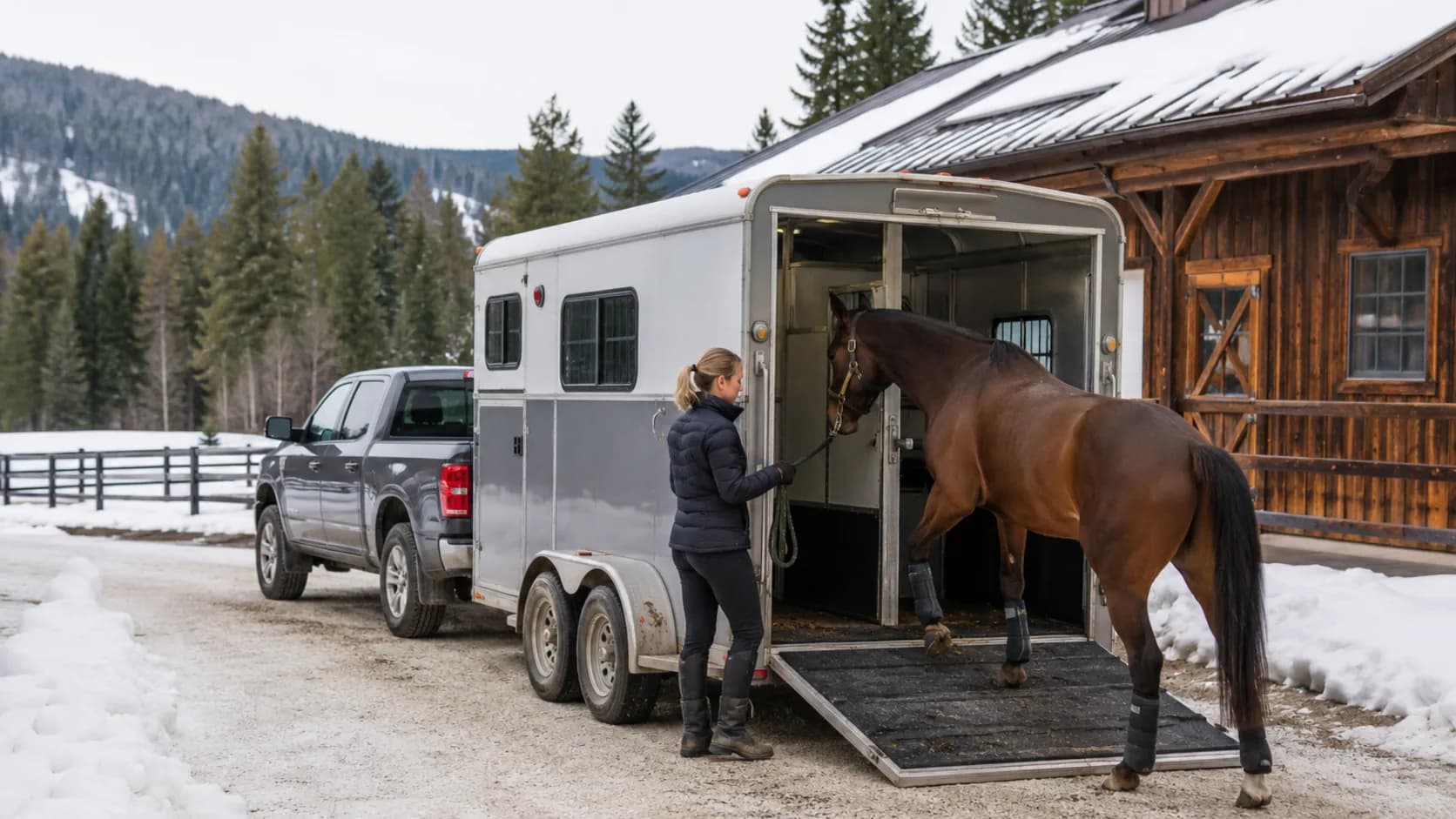
Run a Canadian Horse Trailer Diary Without Guesswork.
A frozen concession road, a slow load and a distant showground can consume every useful hour. Put the trailer away for the time it is truly gone.
 Start with Google
- Barn details ready for the driver
- Travel blocks that include winter roads
- Repeat hauling for regular clients
- Service regions chosen in advance
- Estimates approved before dispatch
Requests with the barn context
Start with the horse, trailer and location
Clients choose the hauling option and send their contact plus one job address while the calendar checks the assigned trailer.
Learn moreA dispatch view for every rig
Winter time belongs on the timeline
Block the whole haul through the planned return, leaving room for rural roads and weather instead of selling a fictional evening opening.
Learn moreDispatch for the kilometres nobody sees.
Loading and winter travel surround the visible appointment. Reserve those hours so the trailer plan reflects the road.
Return time closes the block
A haul remains occupied until the rig should reach home base, not merely until the horse arrives at the showground.
Barn notes stay in reach
The driver can check the client, location and access instructions from the booking before leaving cell coverage.
Equipment fits before dispatch
Different trailers are separate services, making capacity part of the client’s original selection and estimated price.
A trailer on Highway 2 is already sold.
Confirmed time disappears from public availability, preventing the office from promising equipment still hours away.
- Interstate journey · mare in foalPer journey$1,850
- Overnight spell and handling1 night$320
- Vet certificate collectionPre-travel$140
Out and back are two jobs.
A mare going to stud and coming home weeks later is two bookings on one owner, so the return is in the diary rather than a good intention.
Built for your runs
Built for every kind of float work
Pickup at the boarding barn
The client’s postal address, phone and gate directions remain on the job when the driver reaches a snow-covered rural entrance.
The lesson barn every other week
Create one series on the usual weekday at a fortnightly interval, with a final date set for the end of the training term.
A full provincial show day
Hold the trailer until the expected arrival home, because evening traffic and the final class are part of the working day.
A breeding-farm return weeks later
Schedule the delivery and later collection separately under one client, so the return has its own driver, trailer and price.
Gooseneck or bumper-pull
Make each capacity a clear bookable service and stop a multi-horse request from reaching equipment that cannot take it.
An appointment across the city
Secure the named veterinary slot while the public page respects the travel window on both sides of the appointment.
A route outside the core region
Define normal service regions for incoming work, then add a longer intercity haul manually once conditions and timing are known.
A written estimate for the owner
Break out hauling and wait time, send the document for online approval, and carry the accepted scope into the scheduled job.
Keep public hauling inside workable regions.
Control the routine geography shown to clients while preserving the freedom to accept valuable long-distance trips.
Recognizable boundaries
Select supported service regions rather than drawing an arbitrary circle across communities and winter routes.
Do not invite impossible mileage
Online work outside the footprint stays out of a week that lacks the trailer or driver time to cover it.
Intercity work remains possible
Once an Edmonton run checks out, create it manually with the correct equipment and full travel duration.
- Roncesvalles8 regions · 2 crew
- Riverdale7 regions · 2 crew
- Toronto North7 regions · 2 crew
Connect the approved estimate to the haul.
Keep the client’s agreed travel and waiting charges beside every manual payment received for the work.
Itemize before the trailer moves
Present each charge for approval so distance and waiting do not become a debate at the destination.
E-transfers on the client record
Log the transfer against its booking and let the office see immediately whether anything remains outstanding.
Cheques and cash count too
Record offline payment methods on Free, giving the completed haul one reliable financial status.
- Émilie TremblayP-1011 · 25 Jun · Bank transfer$380
- Ryan MacLeodP-1012 · 25 Jun · Cash$240
- Priya SandhuP-1013 · 28 Jun · Card$380
- Jacob WongP-1001 · 27 Jun · Card$190
One app for the whole job
Everything you need to run your float transport business.
Starts free. Grows
only when you do.
Add your whole team and get booking for nothing.
As you grow with us you can go Pro.
Common questions.
Yes. Set the planned departure and return as the booking span, and that equipment cannot be selected inside it.
No. Field-work booking captures one job address. Put another stop, access details and route notes on the booking manually.
Yes. Choose one weekday with a two-week interval and end the series on a date or after a fixed number of hauls.
Yes. They can accept the itemized scope before it is converted into a confirmed job on the trailer schedule.
Yes. Select where public booking is offered and add a suitable job outside those regions yourself when needed.
Move the same booking to the safer date so its client, agreed amount and hauling notes stay intact.