Canadian Tow Truck Dispatch for Real Road Time.
A snowbank recovery and a scheduled dealership move consume very different hours. Keep the flatbed closed until the operator expects to return.
 Start with Google
- Winter jobs include the return road
- One postal address begins the request
- Dealer moves repeat biweekly
- Service regions selected in advance
- E-transfers posted to the recovery
A tow request dispatch can use
Start with the vehicle and postal address
A driver or collision shop chooses the towing service, enters one job address and requests live time for the right flatbed.
Learn moreA winter-ready fleet timeline
Highway time remains occupied
An out-of-town tow stays on the board through delivery and the expected drive home, including the winter buffer.
Learn moreThis is not a dispatch board, and that is the point.
There is no live radio here, no truck tracking and no driver app. What there is holds the half of your work that gets agreed days in advance.
The booked half is the forgotten half
Nobody has ever forgotten the two in the morning callout. The transfer agreed on Tuesday for Friday week is the one that quietly falls through.
Transfers, not emergencies
Dealership moves, workshop runs, machinery relocations and account work: the jobs that are scheduled rather than shouted down a phone line.
The accounts behind them
A yard sending six cars a month is a relationship rather than six emergencies, and it is the part of the business that can actually be planned.
- Mason King · The BeachesEmergency call-out · Wed · 3:30pm$180
- Ava Baker · RoncesvallesCallout +1 · Wed · 1:00pm$560
- Grace Walker · TorontoRepair visit · Wed · 11:30am$120
- Amelia Ryan · The BeachesSecond visit · Tue · 2:00pm$190
A tow includes the winter road home.
Loading and delivery are surrounded by travel. Reserve the complete interval before offering the flatbed again.
Busy until the yard return
The flatbed remains occupied through delivery and expected return rather than freeing itself at pickup.
One postal address starts dispatch
Store the vehicle, driver contact and access note beside the first location for the operator.
Equipment follows the job
Separate towing services keep a heavier or awkward vehicle away from unsuitable equipment.
- Roncesvalles8 regions · 2 crew
- Riverdale7 regions · 2 crew
- Toronto North7 regions · 2 crew
Choose regions the fleet can cover.
Public towing requests should reflect the routine footprint, while dispatch retains control over exceptions.
Compare workable windows by added driving.
The scheduler can rank feasible times by travel added to the day, while dispatch stays in human hands.
No route is rebuilt automatically
Ranking does not reorder confirmed work or send a flatbed without an operator’s decision.
Nearby jobs inform the score
Existing locations help reveal which open window adds less driving to the working day.
The dispatcher chooses
Staff confirm the time, truck and operator, and can disregard the ranking when conditions demand it.
- AWAnna WhitfieldToday · 15:45Best+8 min
- DPDanny PrasadToday · 14:30+22 min
- JYJack YoungTomorrow · 09:15+35 min
Built for your yard
Built for the towing work that gets booked
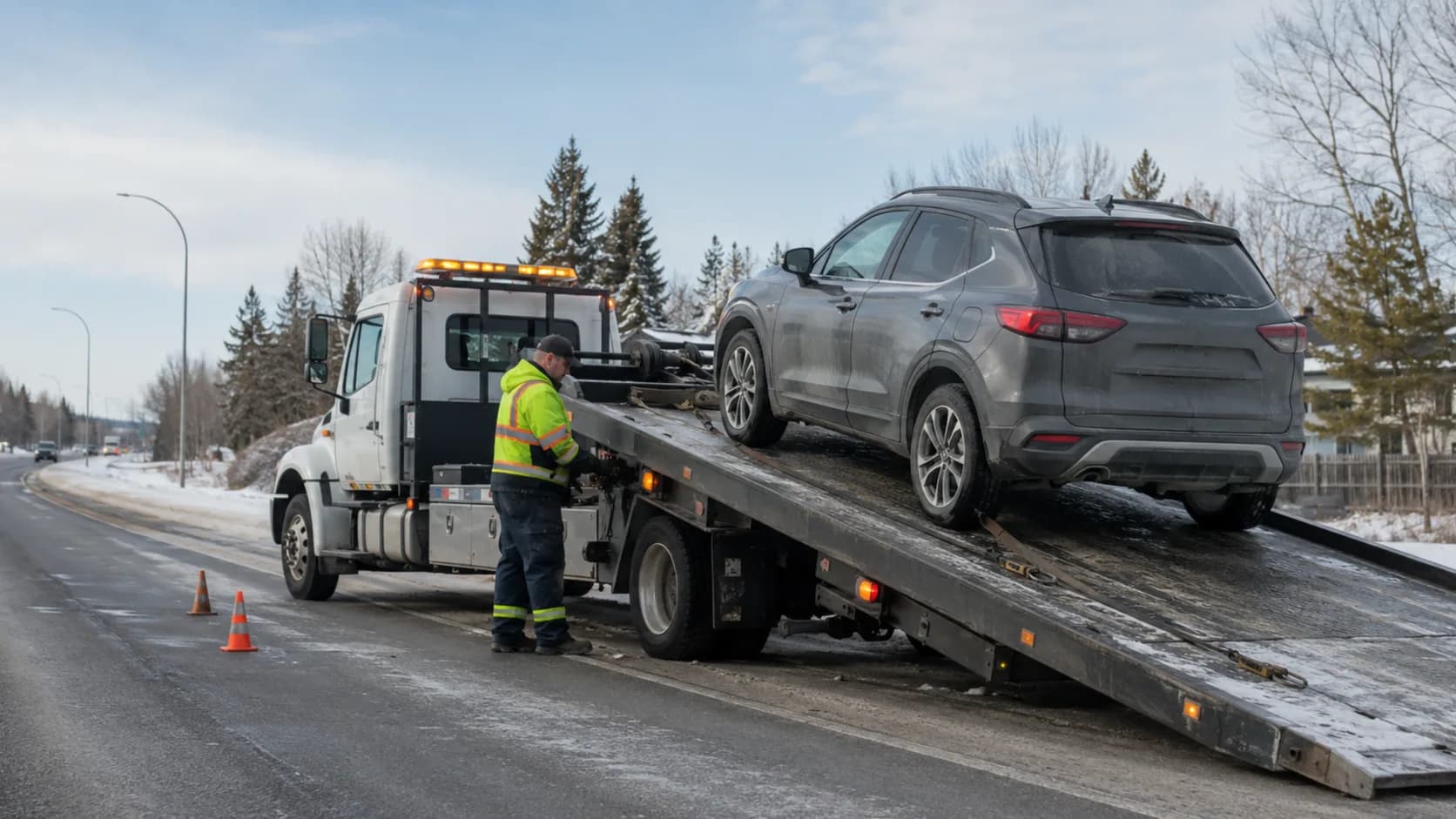
A vehicle stranded in a snowbank
Keep the postal location, driver contact and vehicle note on the recovery while the flatbed is held through return.
The collision-shop transfer
Schedule a planned body-shop movement on its own terms instead of treating every tow as an urgent roadside job.
An auction-yard pickup
Put the buyer, lot information and starting address beside the assigned truck before dispatch.
A dealership move every other Tuesday
Repeat one weekday with a two-week interval and stop the series when the dealer agreement ends.
The condo underground entrance
Staff add clearance and access detail after public booking captures the initial address and customer.
Two flatbeds for two vehicles
Create distinct jobs beneath one collision shop so each truck, operator, span and estimate stays clear.
An estimate for the intercity tow
Itemize towing and wait time for approval, then convert the accepted scope into the dispatch board.
Freezing rain postpones the move
Shift the current recovery to a safer time without losing its customer, vehicle or e-transfer record.
Connect the approved estimate to the tow.
Keep towing and waiting lines beside every e-transfer, cheque or cash receipt entered for the recovery.
Itemize the work first
Show towing, wait time and the longer road leg before the collision shop approves the estimate.
E-transfers stay on the job
Post the received amount and leave the outstanding total visible to the dispatch office.
Offline payments work on Free
Record cheques or cash without turning a separate spreadsheet into the financial record.
- Émilie TremblayP-1011 · 25 Jun · Bank transfer$380
- Ryan MacLeodP-1012 · 25 Jun · Cash$240
- Priya SandhuP-1013 · 28 Jun · Card$380
- Jacob WongP-1001 · 27 Jun · Card$190
One app for the whole job
Everything you need to run your towing business.
Starts free. Grows
only when you do.
Add your whole team and get booking for nothing.
As you grow with us you can go Pro.
Common questions.
Yes. Use the complete expected span, and the truck stays unavailable until the planned return to the yard.
No. Customers enter one starting address. Dispatch adds the destination and later access notes to the job.
Yes. Set one weekday with a two-week interval and end the series by date or after a chosen number of jobs.
Yes. Send the itemized estimate for approval and convert the accepted work into a scheduled tow.
Yes. Select the supported regions and enter an appropriate out-of-area tow manually when needed.
No. It ranks feasible windows by added driving; the office still selects the window, truck and operator.