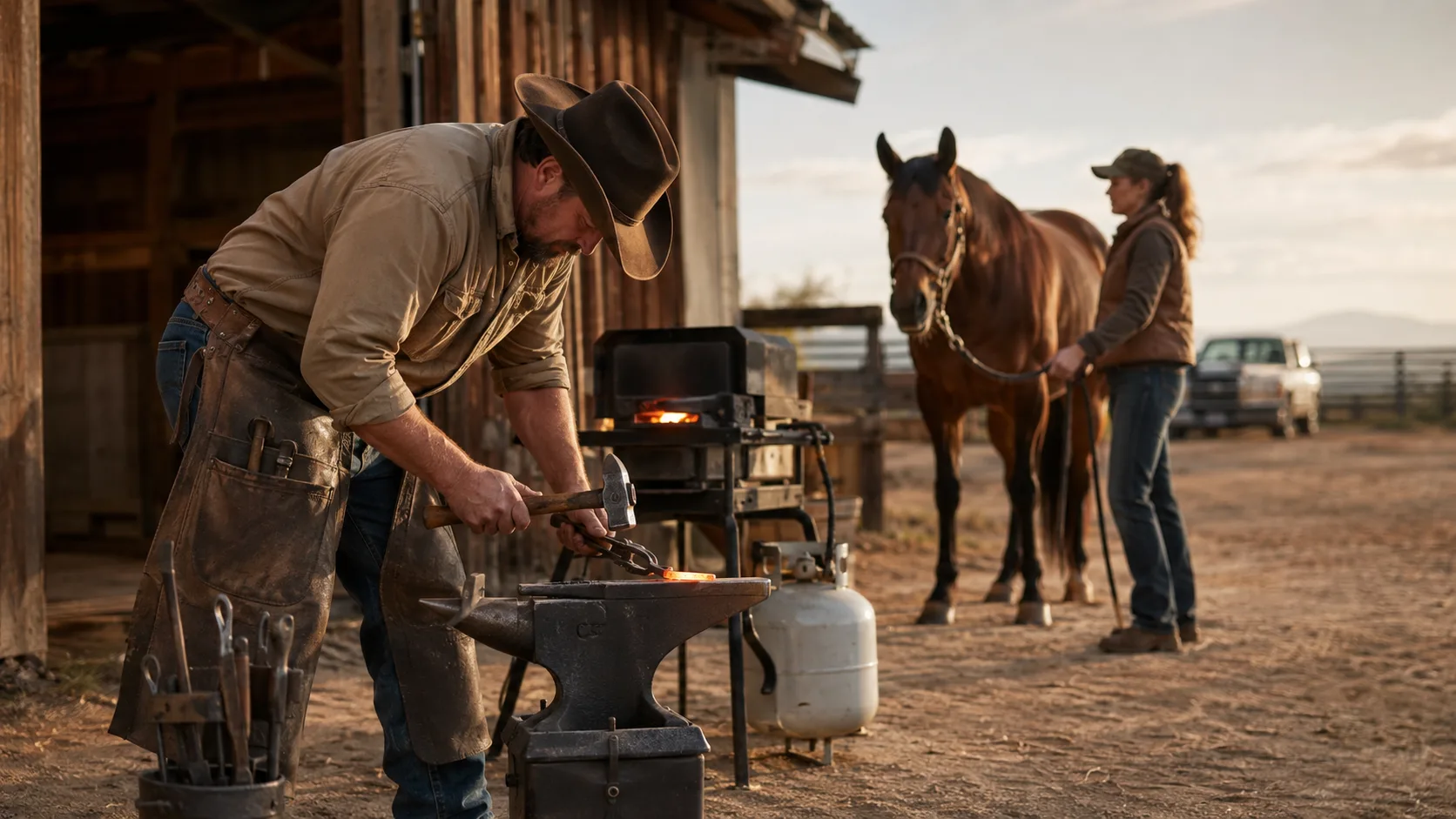
Booking software for farriers in the US.
Your book runs on reset cycles instead of a calendar, so the horse due in six weeks is already on a Tuesday before you close the trailer.
 Start with Google
- Each horse's shoeing cycle and last visit on record
- A reminder the day before to have the horse caught
- The round rebooked in a tap, not a memory test
- Gate codes and paddock access kept on the property
Online booking
The barn books its own next reset
Owners grab a trim or a full set off your page at a time you really work, so a new horse starts with a booking instead of four voicemails.
Learn moreSmart scheduling
Every horse on its own reset cycle
Set the interval once and the next visits are already on your book. Standing arrangements are free and keep generating ahead of you.
Learn moreA month of a round that never really ends.
Every horse you shoe comes back in six to eight weeks, so the useful question is never what is on today. It is who is due, and the month answers it in one look.
The owner is the customer, the horse is the record.
Each horse sits under its owner as its own named record with its own address, so the interval belongs to the animal and not to a line in a diary.
The next one taken off your page.
An owner who wants a trim before you were due back takes a real time you actually work, at the price already on the service.
- Marcus BellBooked just now$215Accepted
- Ashley NguyenOpened 2h ago$480Viewed
- The Oak CaféSent yesterday$120Sent
The remedial quote, and who has opened it.
A set that needs bars or glue-ons goes out as a link. You can see it was opened, so the follow-up is a question rather than a guess.
Trim, full set, or the therapeutic job.
The three prices every owner asks you for, side by side on one document, with the one the horse actually needs marked recommended.
The cycle keeps itself
Five weeks, eight weeks, whatever the horse holds. Standing arrangements are on the free plan and put the next visits on your book ahead of you.
Three prices, one document
A straight reset, a set with pads and clips, and the therapeutic work your vet asked for, as three options with the middle one recommended. Options come with Pro.
Move one visit, keep the cycle
Move the horse whose owner is out of town and the rest of the pattern re-anchors to the new date, so you never rebuild a year of visits by hand.
- Full set, hot shod4 horses · six-week interval$720
- Trim2 horses · unshod$120
- First visit assessmentNew horse on the round$60
One barn, ten owners, ten accounts.
Ten horses at one address almost never means one bill, so every owner stays their own customer with their own horses, visits and money.
Ten bookings, one stop
Each owner gets their own booking at the same address, back to back through the morning, so one stop still leaves you ten clean records.
Cash and checks cost you nothing
Write down what the owner handed you at the barn and the visit is square. Cards are the only part of the money that needs Pro; recording is free.
Or bill the barn, not the owners
When the barn pays for everyone, make it the customer and give the visit a line per horse. What Bookables will not do is split one bill ten ways.
- Marcus BellP-1011 · 25 Jun · Bank transfer$380
- Ashley NguyenP-1012 · 25 Jun · Cash$240
- Tyler BrooksP-1013 · 28 Jun · Card$380
- Jasmine CarterP-1001 · 27 Jun · Card$190
Every horse on the round
The work you actually carry out
Full set, hot shod
Your bread and butter, booked off the interval that horse holds instead of off memory, and back on the book before you load the anvil.
Fronts only
Its own price and its own length, so a fronts horse never swallows the slot you were saving for a full set at the next barn.
Trims and barefoot horses
The trail horse that has never worn a shoe, on a longer interval of its own, so it comes up when it is due and not when someone calls.
Pulling shoes for winter turnout
Pull-offs recorded right on the horse, so when it comes back into work in the spring you know exactly what came off and when.
Boarding barn rounds
Ten horses at one barn, each its own record under its own owner, booked back to back so a single stop clears the whole aisle.
Show season resets
The tight week before a show, taken off your page at hours you actually have open, instead of thirty texts you answer after dinner.
Therapeutic shoeing on a vet referral
Bar shoes, wedges and glue-ons quoted as their own job at their own rate, with your reasoning saved on the horse so the vet can read it back.
First visit on a new horse
Priced apart from a routine reset, because that first look at a set of feet is where the interval and the whole record get set.
Lost shoe calls
The horse that pulled one in the pasture last night. It lands as a request with the story attached, and you take it or turn it down.
- TBTyler BrooksMon–Fri · 8–5On
- JCJasmine CarterTue–Sat · 9–6On
- DADerek AlvarezMon–Fri · 9–5Off
Whoever covers the round when you cannot.
Each person carries their own hours and their own services, so a remedial job is never offered to someone who does not do remedial work.
- 12 AugFull set, hot shodCompleted · $180
- 12 AugPayment received$180
- 1 JulFull set with padsCompleted · $215
- 24 JunRemedial set, on referralAccepted · $340
- 20 MayFronts onlyCompleted · $110
Years of one horse, dated.
Every set of shoes, every trim, every pull-off, kept against the horse rather than in your head. It is what you hand a vet, a new owner or the person covering your round.
A lame horse does not wait for the cycle.
A lost shoe or a horse sore in front comes in as a request on the thread, with the story already written down, instead of as a voicemail.
Accept it and it becomes a booking
One tap turns the request into a real visit at a real time. Turn it down and the owner hears back, instead of wondering whether you got it.
The story stays on the horse
What the owner told you, what you found and what you put on it all live on that horse, so the next reset does not start from a blank page.
They ask you instead of calling around
A page with nothing open this week still takes the request, so the horse that cannot wait until Thursday stays yours rather than the next guy.
He has pulled a hind shoe and is a bit sore on it. Any chance this week?
Weather moves the whole morning.
Nothing gets shod standing in mud. Drag the barn onto a drier day and every booking on it moves together, owners and all, on any plan.
Drag a job, drag the barn
Move one visit or the whole morning onto another day or another person, and commit it all at once instead of making ten calls from the truck.
Nobody hears until you say so
The changes sit as a draft until you commit them, and the owner only gets told if you have switched that message on yourself.
The hours are yours
Availability comes off the hours you really work, so nothing lands before the barn is even open, and a day off stays a day off.
The round only pays if the barns are close.
One horse an hour past the last barn costs you the afternoon. Claim the areas your round covers and an address outside them never becomes a job.
Claim the areas, not a radius
Pick the areas you really get to off real boundaries, and an owner outside them is turned away at the first step rather than after you have quoted.
The far barn can still ask
Past the boundary the owner leaves a request instead of a booking, so opening up a new area is a decision you make rather than one you drift into.
Split the territory between you
When two of you work different areas, each area belongs to one territory and the person who covers it, so neither of you crosses the other.
- Hyde Park8 counties · 2 crew
- Zilker7 counties · 2 crew
- Austin North7 counties · 2 crew
One app for the whole job
Everything you need to run your farriery business.
Starts free. Grows
only when you do.
Add your whole team and get booking for nothing.
As you grow with us you can go Pro.
Common questions.
Yes. The horse is its own named record under its owner, and the standing arrangement that puts it back on your book runs on whatever interval that horse holds, so a five-week jumper and a ten-week trail horse are tracked separately and both come up on time.
Yes, once you turn it on. Every notification ships off, so nothing goes out on your behalf until you say so. Switch on the booking reminder and the owner gets an email ahead of the visit, which is the whole difference between a caught horse and a wasted stop.
No, and it makes no claim about it. Farriery is not licensed here and certification is voluntary, which means the thing an owner can actually look at is your record: every set of shoes on every horse, dated. Bookables keeps that, and you can put your credentials in the booking page copy you write.
Two shapes, and you pick whichever matches who pays. Either every owner is their own customer with a booking at the same address, back to back through the morning, or the barn is the customer and the visit carries a line per horse. One bill never gets split between owners.
Drag the barn onto another day and every booking on it moves together. The changes sit as a draft until you commit them in one go, so a rained-out Tuesday costs you one decision instead of ten phone calls from the truck.
Yes. The free plan gives you a monthly allowance of bookings that covers a full shoeing round, with no card and no time limit, and the standing arrangements your whole round runs on are part of it. The plan cards on this page carry the numbers.

Farrier guides
All articlesHow to take bookings while you're doing the actual work
Set up online bookings around your services, prices, travel and availability so customers can book while you're busy doing the job.
ReadHow much booking notice should you require?
Choose a booking lead time that allows for preparation, staff and travel, with practical examples for mobile services, venues and classes.
ReadHow to reduce appointment no-shows without becoming their mum
Reduce appointment no-shows with clear confirmations, useful reminders and easy rescheduling. Includes a sample reminder and a simple measurement method.
Read