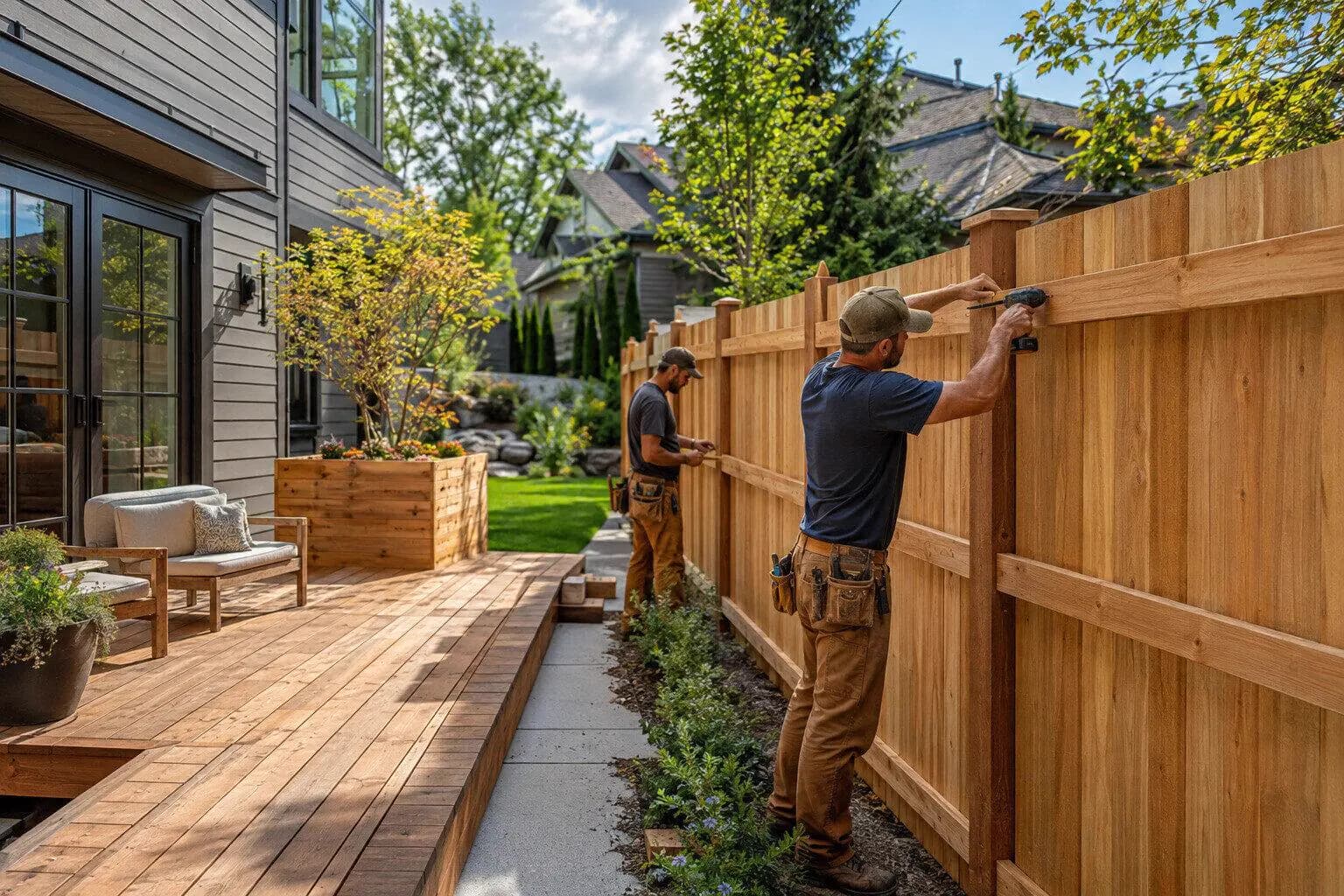
Booking software for US fence and deck contractors.
Estimate visits booked off your live calendar, cedar quoted beside vinyl, and the build days held the moment the lumber order goes in.
 Start with Google
- Measure-ups booked online
- Colorbond and timber quoted in tiers
- Deposits before materials are ordered
- Build starts locked in the diary
Online booking
The estimate visit books itself
What the posts go into sets the price, so your page sells the visit and you give the number once you have walked the property line.
Learn moreSmart scheduling
A deck is three days, not one appointment
Hold the start and hold the days behind it. When the ground is too soaked to set posts, the whole run moves together in one drag.
Learn moreA form can book the visit. It cannot price the fence.
So it does the half it can do. The customer takes a time off your live diary, and the number waits until somebody has stood on the boundary and looked at what is under it.
- Marcus BellBooked just now$215Accepted
- Ashley NguyenOpened 2h ago$480Viewed
- The Oak CaféSent yesterday$120Sent
Which quote was opened, and which went quiet.
A fence quote waits on somebody who is not your customer. See what has been read, what has been signed and what has gone cold, so the one worth a call on Friday is obvious.
The order goes in, the days are already held.
Between a signed quote and the first hole there is a lead time nobody can shorten. The month holds both ends of it: the week the materials land, and the run of days the crew is on site.
Your cleaner Mark is on the way.
A window, not a whole morning.
The visit goes out with the arrival window the day is actually planned around, so nobody waits at a side gate from eight until twelve.
One property line, three ways to fence it.
Pressure-treated pickets, cedar privacy or vinyl, all on one estimate. Both households read the same three prices before anyone signs.
Priced off the run, not off a hunch
Linear feet, post count and the gate go on as their own lines in your own units, so when a number gets questioned you can point right at it.
Two households, one estimate
Both sides read the same options on their own phones. One of them types their name and your estimate becomes a booked job.
It expires on its own
Lumber moves fast. Put a date on the estimate and it lapses by itself instead of coming back at you next spring at an old price.
Extras priced as options · Pro
A walk gate, post caps, extra footing depth where the old concrete comes out, an allowance for rock. Each one is a priced option, so checking the box moves the total instead of rebuilding the estimate.
- Merbau decking · 22 sqmSupply$2,640
- Subframe, bearers & footingsLabour$1,560
- Build, screw down & oil3 days$3,300
It rains, and the whole week shifts.
Holes fill and the mixer stays on the trailer. Drag the build to the next dry stretch and the whole record comes along with it.
Drag it instead of retyping it
Pick the job up on the board and drop it on Thursday. The crew, the customer and the entire thread move across in one motion.
The days behind it move too
A deck booked as a run of days stays a run of days, so Wednesday never quietly reopens for work you cannot possibly get to.
Tell them, or let it tell them
Turn the moved-booking email on and it goes out for you. It ships off, so nothing reaches a customer until you decide it should.
Built for your trade
Built for the runs you actually put in
Cedar privacy fence
Six-foot cedar along the property line, quoted as tiers so the homeowner can see what dog-ear pickets save them over board-on-board.
Vinyl fence installs
Panels, posts and caps as their own lines, so the customer sees exactly what the no-maintenance version is costing them up front.
Composite deck builds
Book day one and hold the days behind it, so the run of days on the board is the run of days your crew genuinely has open.
Chain link and pool code fence
Runs where the gate hardware and the self-closing latch are their own lines, quoted so nothing surprises anyone at final inspection.
Storm and vehicle damage
A flattened run comes in as a request with photos attached and drops between builds instead of going to whoever picks up first.
Gate repair and rehang
A sagging gate is a flat-rate visit your page sells outright, booked online and paid from an emailed request the same afternoon.
Deck rebuilds and ledger repair
The tear-off, the flashing and the new framing quoted as separate lines, so the homeowner sees why the rebuild is not a resurface.
Retaining walls and steps
Timber or block quoted by the course, with the drainage behind it as a line the customer can see rather than one they never hear about.
Deck wash and re-stain
A one-day return to a weathered deck, booked right off your page at a set price with nobody needing to drive out to price it first.
Booked three weeks out and still selling.
Fence season fills the calendar and the calls keep coming. When the board has nothing left, your page captures the job instead of losing it.
It arrives as a request you can answer
The address, the run and what they want shows up as a card you accept or decline when you are off the tools, photos already attached.
The neighbor situation comes with it
They can tell you up front that it is a shared line and the neighbor is on board, which is what decides whether the drive is worth it.
Nothing gets promised for you
A request holds no time on your board until you accept it, so your crew never rolls up to a job nobody actually agreed to.
The back boundary went over in the wind. Neighbor is happy to go halves. Can someone come and look at it?
Get paid for the lumber, then for the work.
You order material long before any money shows up. Record cash and transfers by hand for free, or take cards with Pro.
Cash and transfer are always free
Mark the job paid the day the transfer lands. That costs you nothing on any plan, and there is no plan where it starts to.
Cards come with Pro
Email a card link the day the last post cap goes on. It is a direct charge on your own account, so we never hold your money.
Split it across the build
Part when the job is booked, the rest on the final day. Staged requests come with Pro and go out once the booking exists.
- Marcus BellP-1011 · 25 Jun · Bank transfer$380
- Ashley NguyenP-1012 · 25 Jun · Cash$240
- Tyler BrooksP-1013 · 28 Jun · Card$380
- Jasmine CarterP-1001 · 27 Jun · Card$190
How far the trailer is worth towing.
Posts, panels and an auger have a radius that makes sense, and past it the job stops paying. Set the areas you cover and your page holds them.
You pick the areas, not a radius guess
Claim real boundaries off the map and every address gets matched to whichever one owns it. Past them, your page says so right away.
Out-of-town work gets its own area
Keep the long ranch and acreage runs in their own area with the crew towing the auger, and the subdivision work in another.
The rate is the rate inside it
Nothing is quietly added for a longer haul. Inside the areas you cover, the number on the estimate is the number on the invoice.
- Hyde Park8 counties · 2 crew
- Zilker7 counties · 2 crew
- Austin North7 counties · 2 crew
Starts free. Grows
only when you do.
Add your whole team and get booking for nothing.
As you grow with us you can go Pro.
One app for the whole job
Everything you need to run your fencing business.
Common questions.
Yes. Priced options put all three on one estimate with your pick marked as recommended, and the customer accepts the one they want by typing their name. Options come with Pro.
Book day one as the job and mark the days behind it unavailable, so nothing new can be booked against a week your crew is already committed to.
They book the estimate visit. Linear feet, post count and whether you are hitting caliche, roots or an old concrete footing set the price, and no web form sees that.
Send both households the same estimate so they can read the options and agree before anyone signs. Every view, acceptance and message stays on the record if it later gets argued about.
The permit is yours to pull, but the waiting is a scheduling problem and that it does hold. The job sits on the board with its notes and photos until the inspection clears and the build can start.
Yes. The Free plan includes 200 bookings a month, no credit card required, and there is no per-seat charge, so bringing on a helper costs you nothing.