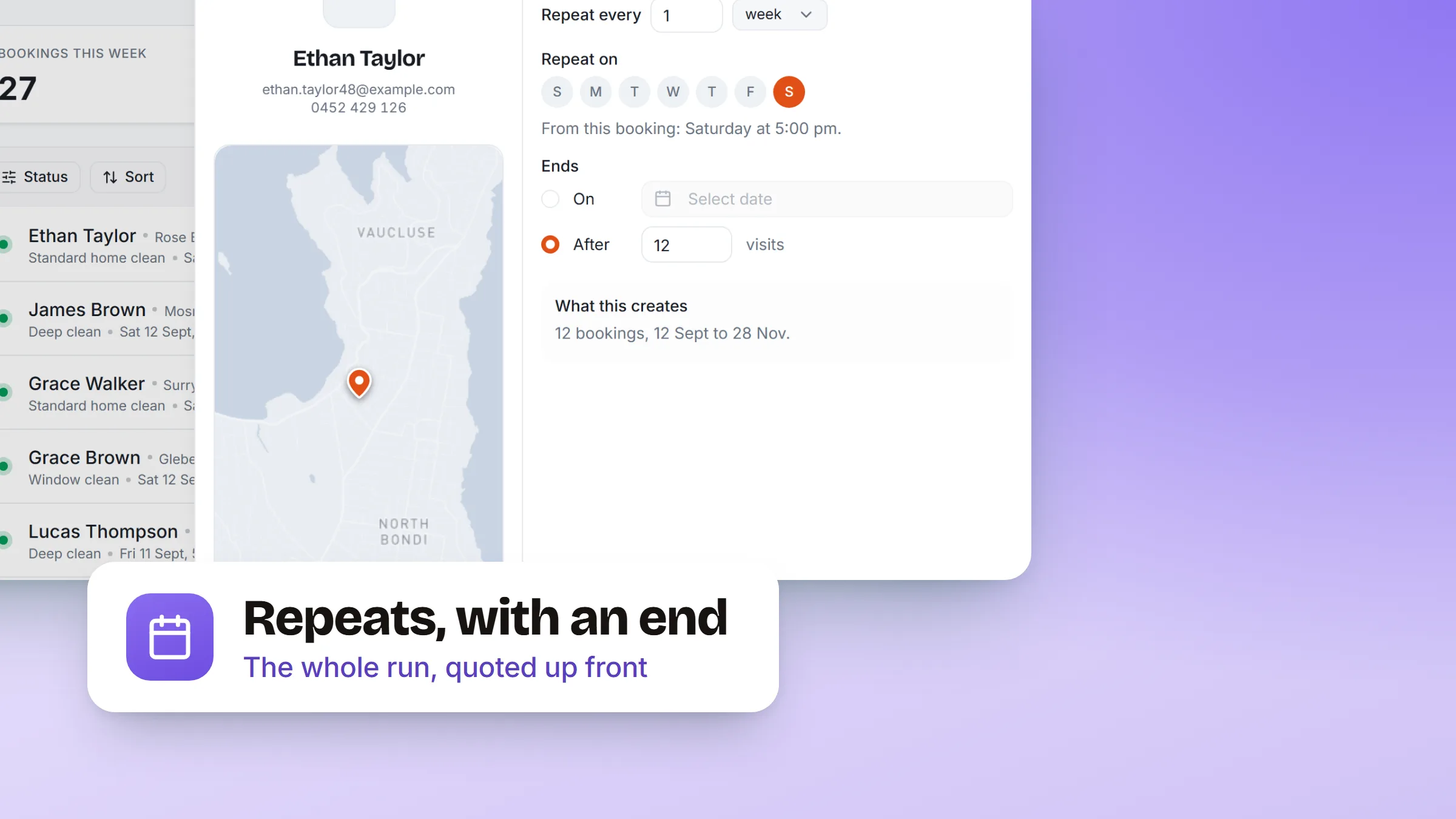
Repeating work has had a big improvement. It used to run as a rolling window: a few bookings ahead, topped up quietly by a job running behind the scenes. That made a simple question, what does this arrangement cost, impossible to answer. A repeat is now a run with a start, a cadence and an end, and every booking in it is real.
- Quote the whole run. A fortnightly clean for six months is priced as a fortnightly clean for six months, not as the next three visits.
- Every visit is a booking. They appear on the schedule, in lists and on the customer's record from the moment the run is made, marked as part of a repeat.
- A form people already know. The repeat panel is laid out like the custom recurrence dialog in Google Calendar, and it opens on the run rather than on one visit.
- End means what you mean by it. Shortening a run says plainly which visits it deletes before it deletes them, and what ending early costs is shown only when you ask.
- It refuses what it cannot honour. A repeat anchored in the past, or one with no end at all, is turned down rather than half made. A run that fails to build is unwound completely instead of leaving a trail.
- Repeats live on the booking, not in a menu. Set up repeats sits on the booking itself, and the cadence is written where the run is shown.
If you run standing work, you can now tell a customer what the arrangement costs without doing the sums yourself.