Booking software for computer and IT repair in Ireland.
Take the machine in as a diagnostic, price it once you know what is actually wrong, and keep the backup note and the handover on the record.
 Start with Google
- Common fixes booked at set prices
- Quotes for network and office jobs
- Home and business visits in one diary
- Full history on every customer
Online booking
Book the diagnostic, not a guess
The page sells the fixes you can price unseen and takes the rest in as a diagnostic, with a real half hour on the bench sitting behind it.
Learn moreSmart scheduling
Bench and callouts, the one day
Workshop jobs and on-site support share one day, so the two hours put aside for a rebuild are not quietly given to a broadband visit.
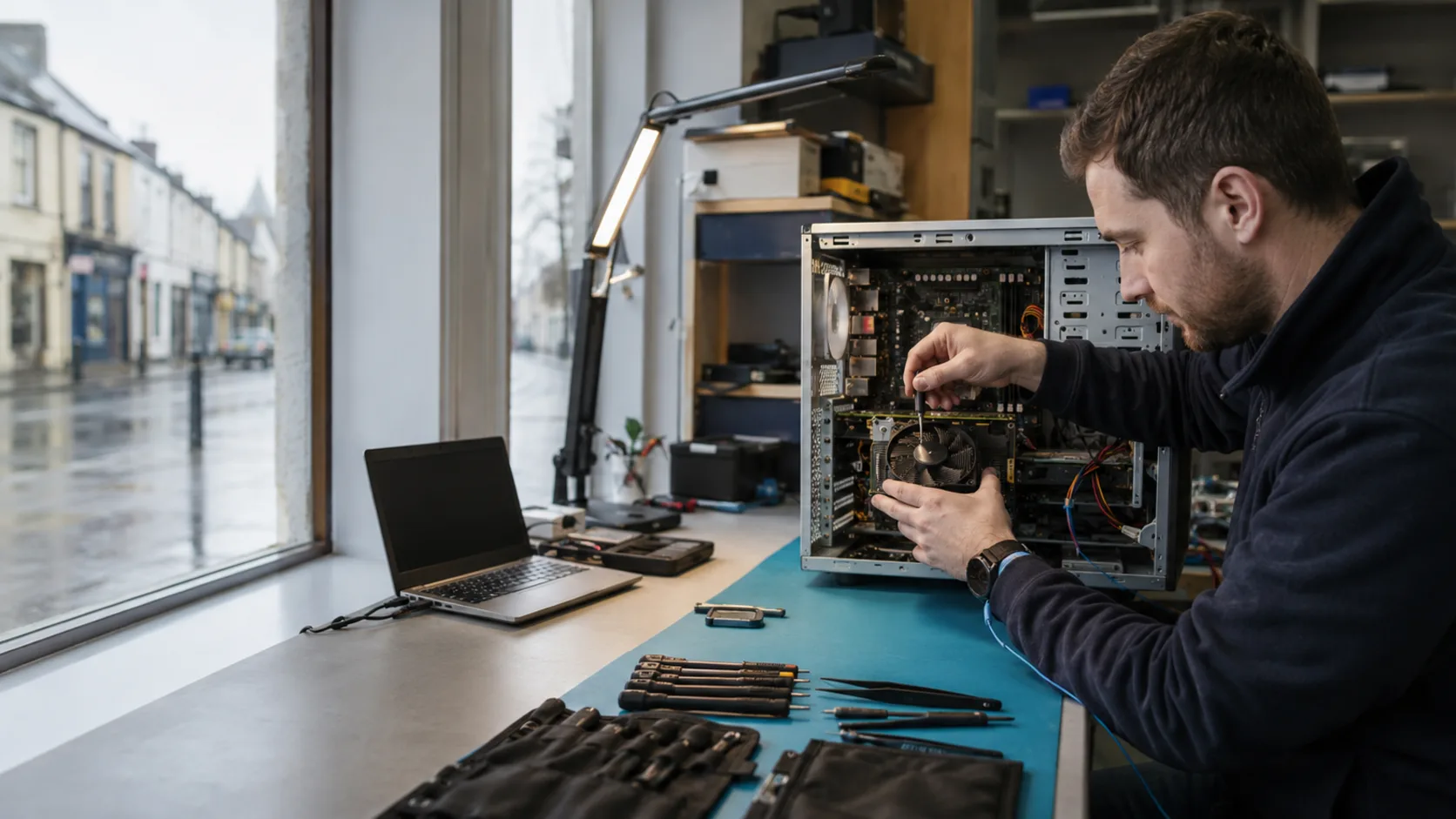
Learn moreThe laptop nobody can price down the phone.
A machine that will not boot has no price until it is opened. The page takes it as a request with the symptoms rather than guessing at one.
It arrives as a question
What it does, when it started and what is on it all come in together, and the whole thing lands as a thread to answer.
The look is chargeable
A diagnostic is a booking in its own right, with its own price and its own half hour, so the bench is not filling up for free.
Nothing promised yet
No turnaround goes out before you know what the fix is, which is the only thing worth saying at that stage.
It died overnight. One beep, then a black screen. Everything for the business is on it.
One dead laptop, three honest answers.
Recover the data and hand it back, fit a new drive and rebuild, or set up a replacement from the backup. Three lines on one quote.
Priced from what you found
The drive, the licence and the hours are separate lines, so they can see what they are paying for rather than one number.
Accepted without printing anything
They type their name to accept, and the accepted quote becomes the booked job with nothing re-typed.
A number set once
The quote number is fixed the moment it is issued, so your copy and their copy are unmistakably the same document.
Three options on one document comes with Pro
Pro sets the three side by side on one document with one marked as recommended, and a diagnostic already paid for can credit back against whichever is chosen. Cash and bank transfer remain free.
- Recover data to a new driveAfter diagnostic€180
- Drive supplied and fitted1 TB€220
- Rebuild, restore and test2 hrs€190
The fixes you can price sell themselves.
A tune-up, a data transfer or a set-up visit each carry a price and a duration, so the easy half of the work books itself in overnight and reaches you with the details already typed.
- Cian Murphy2mCan you come Thursday instead?
- Bookables1hA booking request needs your answer
- Niamh Doyle3hRunning 10 late on the Stoneybatter job
The honest answer is often a part.
Turnaround is the product in this trade, and it depends on something arriving. One thread per customer means the update, the delay and the new date all sit in the conversation that started it.
- NDNiamh DoyleMon–Fri · 8–5On
- SGSeán GallagherTue–Sat · 9–6On
- OKOrla KavanaghMon–Fri · 9–5Off
Someone on the bench, someone in the car.
The two halves of this business need different people at different hours. Each person carries their own working week and their own services, so a network job never lands on the bench.
- Drumcondra8 counties · 2 crew
- Clontarf7 counties · 2 crew
- Dublin North7 counties · 2 crew
How far you will drive for a callout.
Drop-offs come to you, so the line only matters for on-site work. Set it once and a job past it asks first rather than booking itself in.
The office you look after is one record.
Every visit, quote and payment for a business client rolls up under one contact at one site, with what they have spent and what is still owed on the same screen.
Built for the bench and the callout
Every job that comes through the door
Laptop that will not boot
Booked in as a diagnostic with its own price and its own half hour, so you are paid to find out before anyone discusses a fix.
Data recovery from a failing drive
Quoted after the assessment and never before, with the customer told in the thread what came back and what did not.
Slow machine tune-up
A set price and a set hour on your page, so it books itself in and reaches the bench with the symptoms already written down.
Screen or battery replacement
Priced on the page where the part is standard, and pushed to a quote where the model means ordering something in first.
Malware clean-up
A set price, and the machine goes back with a note saying what came off it and what the customer ought to change.
New machine set up and data moved over
Sold as a job with a duration, at the shop or at their desk, with the old machine handover written on the record.
Home broadband and wifi sort-out
An on-site job with an arrival window, ranked into the run you are already doing on that side of town.
Small office network install
Quoted as a scope, with the kit, the cabling and the hours as separate lines the customer accepts online.
The monthly IT visit
A standing arrangement that keeps putting itself back in the diary, weekly or monthly, until you say otherwise.
Mailbox and file migration
Booked as a block of hours outside trading time, with the cutover agreed in the thread before anyone touches a mailbox.
Server down over the weekend
A request that lands as a thread when nothing is bookable, so an out-of-hours outage reaches you rather than the next listing.
Where the machine is up to, without a phone call.
A drop-off moves the same way any job does: accepted when it comes over the counter, in progress once it is opened, done when it works, paid when it leaves. No ticket system, no intake form, no stock to count — a booking with a duration and a record behind it.
Everything they own is on that drive.
Photographs, the tax return, the books for the shop. Trust is most of this job, and the record is where it is written down.
Note the backup before you start
Where it went, when it ran and what it covered goes on the record as an internal note, with photographs of the machine as it came in.
The handover is written down
What you replaced, what you left on it and what they still need to do sits on their record rather than in your head.
Internal stays internal
Notes and attachments on the record are never shown to the customer. Only what you actually send them is.
- 14 AugRebuild · new drive fittedDone · €590
- 9 AugBackup verified before workInternal note · 2 photos
- 7 AugRecovery quoteAccepted · €590
- 2 MarPayment received€140
The callout that fits the run you have.
A broadband visit only pays if it sits near the office you are already going to. Open slots are ranked by the driving each one adds.
Ranked, not rearranged
You still pick the time. The ranking lifts the slots near where you already are; nothing reorders the day for you.
On every plan
Ranking open slots by the travel they add is not the part you pay for. It sits on the calendar you already have.
Only whoever can do it
Only people set up for that job in that county are offered, so the network work does not land on the bench engineer.
- NDNiamh DoyleToday · 15:45Best+8 min
- SGSeán GallagherToday · 14:30+22 min
- OKOrla KavanaghTomorrow · 09:15+35 min
The receipt sees itself out.
Most of this is settled by transfer or by tapping at the counter, and recording cash or a transfer by hand costs nothing at all.
Cash and transfer are free
Mark it paid and the receipt goes out on its own, without a plan being involved.
Cards come with Pro
For the customer who would rather tap than go looking for their banking app at the counter.
Staged, after the booking
Pro can split an office rollout into a leg up front and the balance at handover. It happens on the job, not at a checkout.
- Aoife ByrneP-1011 · 25 Jun · Bank transfer€380
- Cian MurphyP-1012 · 25 Jun · Cash€240
- Niamh DoyleP-1013 · 28 Jun · Card€380
- Seán GallagherP-1001 · 27 Jun · Card€190
One app for the whole job
Everything you need to run your computer and IT repair business.
Starts free. Grows
only when you do.
Add your whole team and get booking for nothing.
As you grow with us you can go Pro.
Common questions.
For the work you can price unseen, yes. A tune-up, a data transfer or a broadband visit each carry a price and a duration and book themselves in. Anything needing the lid off arrives as a request.
Give them the thread rather than a promise. The booking holds the bench time you set aside, and when the part date moves you move the booking and say so in the same conversation.
No, and it is better said plainly. A drop-off is a booking with a duration, a record on the customer and a thread you both write in. There is no ticket system, no intake form and no parts stock to track.
Yes. Book the assessment as a visit with its own price, and where the service is set up for it, a paid visit fee is credited back automatically on the quote that comes out of it.
They do. A practice you look after every month and someone who came in once with a dead laptop are both customer records, with their own bookings, quotes and payments underneath.
It is. The Free plan covers 200 bookings a month with no card required, and recording cash and bank transfer by hand costs nothing on any plan.