Booking software for line striping in the US.
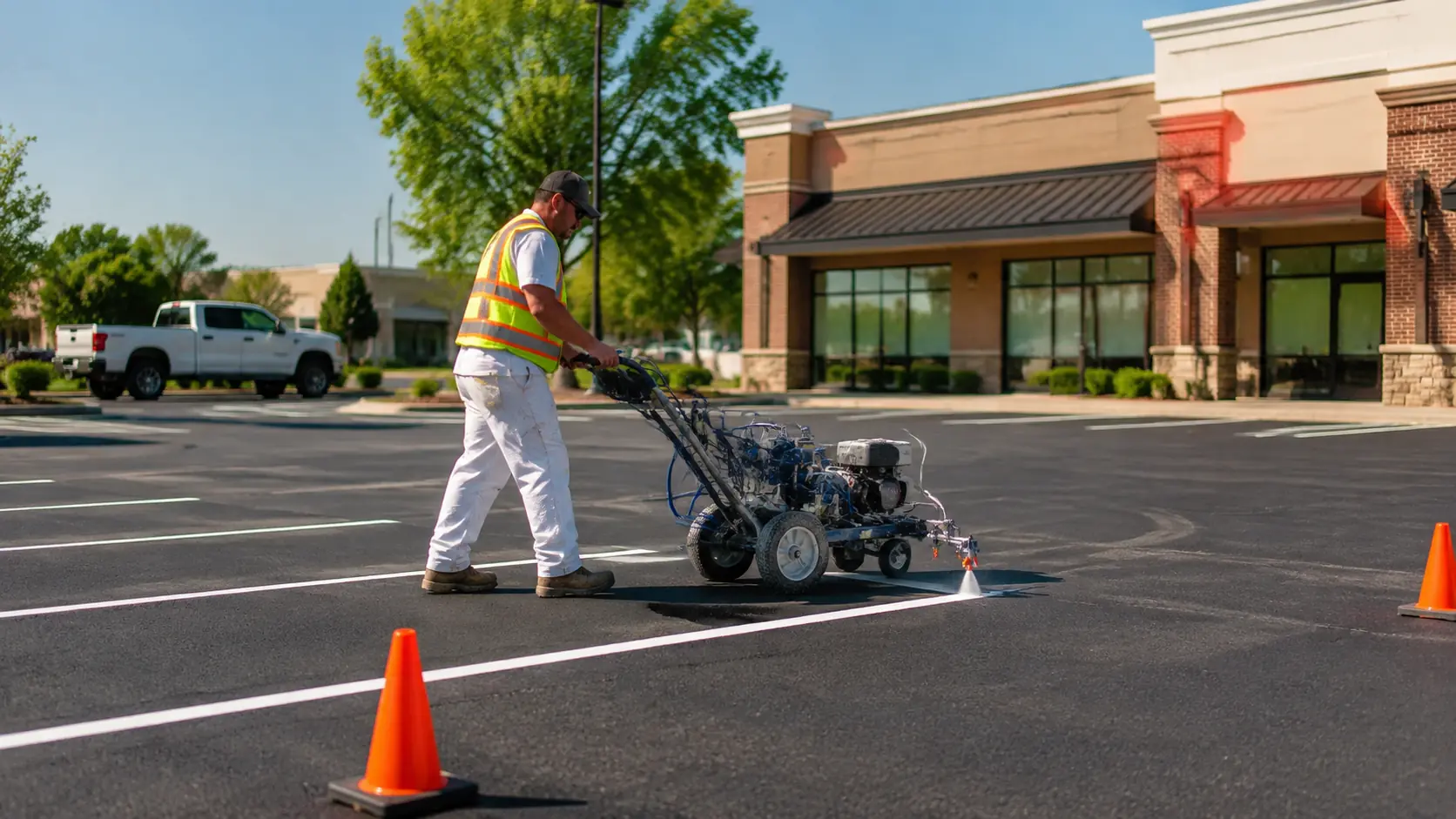
You cannot stripe a stall with a car in it, so the crew works at two in the morning. Publish those hours as your real hours, count the stalls on the quote, and let the seasonal re-stripe repeat itself.
 Start with Google
- Overnight and Sunday availability published as normal hours
- Bays, arrows and hatching counted as separate lines
- The client asked to confirm a clear site at booking
- Site layouts kept for the repaint years later
Online booking
Your overnight hours, right on the page
A property manager reading your page at four in the afternoon books the Sunday two a.m. block, because that is genuinely when you work.
Learn moreSmart scheduling
The re-stripe that books itself
A field marked every week through the season is one standing arrangement, generated ahead of you, and it is free on every plan.
Learn moreOpen when your customer is closed.
Nine to five does nothing for a trade that works behind locked gates. The hours on your page should be the hours the lot is empty.
Overnight blocks, published
Ten at night, two in the morning, Sunday afternoon. Set the hours you actually work and the requests arrive already fitting them.
Booked out until spring
When the season is full your page takes the request instead of looking like a business that closed down.
Priced from the area
The area they enter drives the price, and the extras that take extra paint carry their own price and their own time.
One parking lot, four things to count.
Standard stalls, accessible stalls and their access aisles, directional arrows and the hatching. Four counts, four rates, one document.
Counted, then rated
Every line takes a quantity and a rate, so two hundred stalls and eighteen arrows read as arithmetic instead of one round number.
Drop a section, keep the quote
Your customer cuts the curb painting and the total moves with it. Nobody rebuilds a document to lose one line.
Accepted by name, then booked
They accept online by typing their name, and the accepted quote becomes the booked night carrying its own lines over.
Three columns come with Pro
Pro puts three columns on one document: a re-stripe over the existing layout, a full grind and reset, or everything including curbs and speed bumps. Your customer picks a column and it becomes the booked job.
- Standard spaces240 counted$2,880
- Accessible spaces6 · symbol and surround$420
- Arrows and hatching18 arrows · 2 zones$390
Built for marking work
Built for every site that has to be empty first
Retail and grocery parking lots
An open store striped section by section between close and open, with the property manager calling which rows get coned off.
Office park and medical lots
Visitor stalls, reserved stalls and the drop-off lane, worked around a campus that has somebody on site around the clock.
Warehouse floors and forklift aisles
Rack lines, pedestrian walkways and aisle markings inside a shutdown window that was locked in months back and will not move.
Fire lanes and loading zones
The red curb, the lettering and the no-parking hatching, quoted on their own lines because each takes its own time and paint.
Accessible stalls and access aisles
The stall, the striped aisle beside it and the symbol, counted separately so the customer sees exactly what they are paying for.
School blacktops and playground games
Four square, hopscotch and court keys, painted over the summer because the blacktop is never empty during the school year.
Football, soccer and baseball fields
The preseason layout and then a re-mark every week, booked once as a standing arrangement instead of a call every Thursday.
Pickleball and basketball courts
New courts and overlays, where the surface has to be dry and warm enough for the paint to cure before you start.
Re-stripes after a seal coat
The paving crew finishes and the lot is blank. Your night depends on their week, so moving it needs to cost you nothing.
One record, three people.
Whoever books the site is rarely whoever signs the quote, and neither of them is the one who pays the invoice. The address, the contact and the balance stay in one place.
Every job walks the same ladder.
Requested, accepted, done, paid. Work finished at three in the morning sits on the same board as work quoted last week, so nothing is complete in somebody's head and nowhere else.
North section over the long weekend? We will have it coned off from 10pm and the gate open.
The promise, in writing.
Who is clearing the ground, when the cones go out, who has the keys. Asked in the thread, the answer stays on the job. Not a guarantee, but it changes how often you arrive to a full site.
- TBTyler BrooksMon–Fri · 8–5On
- JCJasmine CarterTue–Sat · 9–6On
- DADerek AlvarezMon–Fri · 9–5Off
The crew who work nights.
Weekly hours and days off sit on the person, so a two in the morning start is only ever offered to the two who genuinely do the overnight run.
- 12 AugRe-mark · north sectionBooked · $1,850
- 4 AugLayout photographed240 spaces · 18 arrows
- 22 JulSeason quoteAccepted · $3,690
- 9 MayPayment received$1,240
The site remembers its own layout.
What was marked, what was photographed and what it came to are all on the site, so the job that comes back is quoted from a record rather than another measure-up.
The same lines, every week, all season.
Half of this trade is a re-mark. Set the pattern once and the visits are generated ahead of you, free, on every plan.
Weekly or monthly, ending when you say
Never, on a date, or after a set number of visits. A whole season becomes one arrangement instead of twenty phone calls.
Rain moves one, the rest follow
Drag the rained-out night to the next dry one and the later visits re-anchor to it instead of drifting out of step.
Moving work is free
Weather runs this trade more than anything else does, so the thing you do most often was never going to be the paid part.
How far the striper is worth towing.
A one-night job four hours out is a two-day job with a motel in it. Draw the ground you cover and everything else has to ask.
Drawn once, then enforced
Work inside your line books itself. Work outside it comes in as a request you can price properly or turn down.
A crew per patch
The people who cover the north run are the only ones offered for a site on the north run.
No charge for the extra distance
Your line decides what can book, not what it costs. A longer tow is a conversation, never a surcharge.
- Hyde Park8 counties · 2 crew
- Zilker7 counties · 2 crew
- Austin North7 counties · 2 crew
Get paid the way your customers pay.
A purchase order, then a transfer three weeks later. Recording that costs you nothing at all. Cards are the part that sits on Pro.
Cash and transfer are free
Mark it paid the day it lands and the receipt goes out on its own. No plan is involved anywhere in that.
Cards come with Pro
For the board member who would much rather tap a card than wait on somebody signing off a transfer.
Stages, after the booking
Pro splits a big lot into a stage at layout and the balance once it cures. It happens on the job, never at a checkout.
- Marcus BellP-1011 · 25 Jun · Bank transfer$380
- Ashley NguyenP-1012 · 25 Jun · Cash$240
- Tyler BrooksP-1013 · 28 Jun · Card$380
- Jasmine CarterP-1001 · 27 Jun · Card$190
One app for the whole job
Everything you need to run your line marking business.
Starts free. Grows
only when you do.
Add your whole team and get booking for nothing.
As you grow with us you can go Pro.
Common questions.
Absolutely. Working hours are yours to set, with single-day and date-range overrides on top, so a page that only offers ten at night to six in the morning is a completely normal setup.
Set it up as a standing arrangement: weekly, ending never or after a set number of visits, with the visits generated ahead of you. It is free on every plan.
You drag it to the next dry night. The site, the notes and the crew all stay attached and only the date moves, and later visits in a standing arrangement re-anchor to it.
Each one is its own line with a quantity, a rate and a unit, so the total is arithmetic your customer can follow and a section can come out without rewriting the document.
It works fine. The quote goes to whoever should receive it and is accepted online by typing a full name, and the payment sits on the same job whether it is a transfer or a card.
Ask in the thread on the job and their answer stays right there on the record. It is not a guarantee, but having it in writing really does cut down on arriving to a full lot.