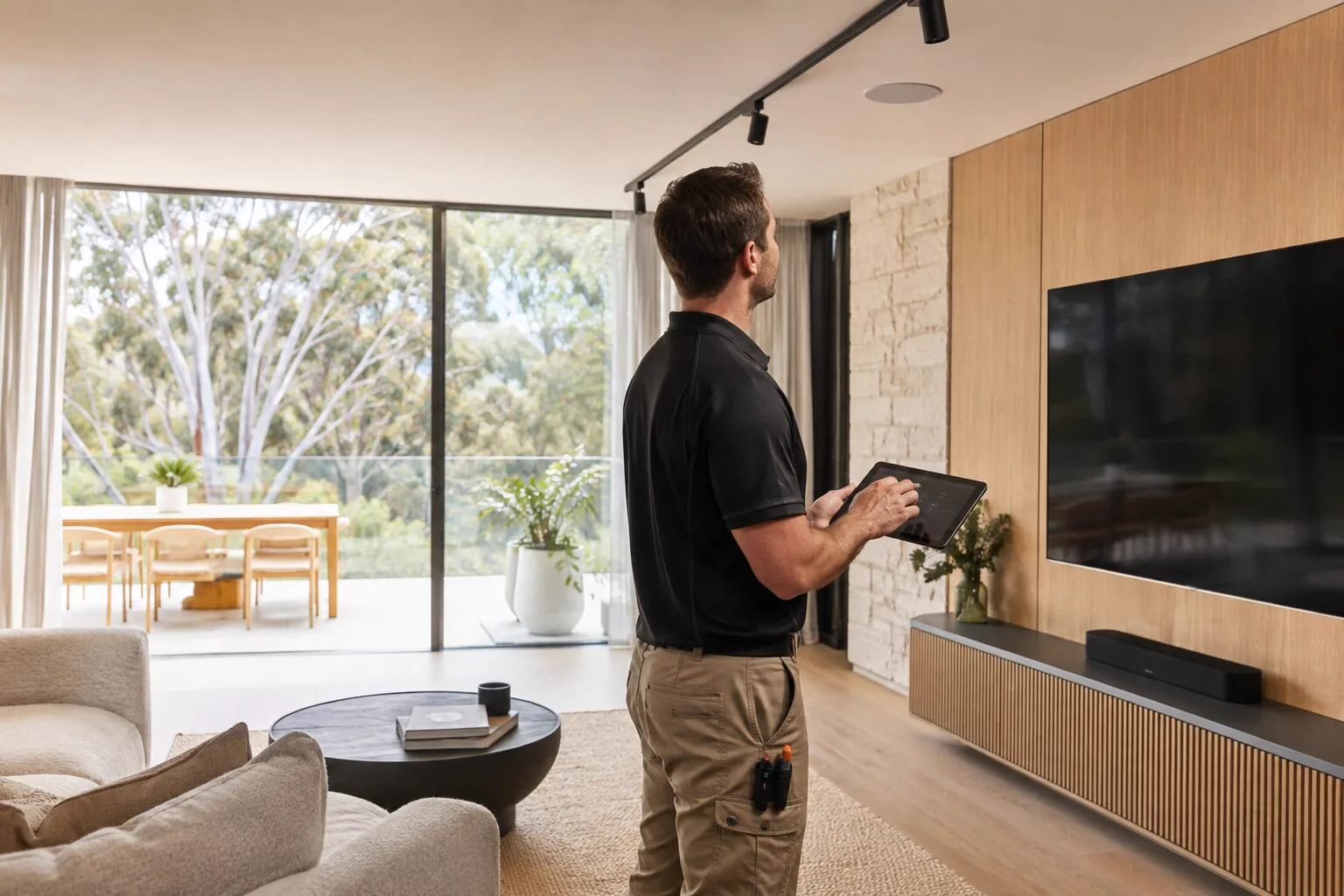
Booking software for home automation and AV installers in Australia.
The rough-in has to land before the wall linings go on and the gear goes in months later. Hold both dates, and move them when the builder does.
 Start with Google
- Projects quoted with online signatures
- Pre-wire and fit-off booked separately
- Builder delays fixed by drag
- Handover paid on the day
Online booking
An enquiry worth driving out to
Ask for the build stage, the rooms and the plans before anyone gets in the ute, so a cinema enquiry at eleven at night is already priceable.
Learn moreSmart scheduling
Two visits, six months apart
Rough-in in March and fit-off in September sit against the same address, so the second one is never the one nobody remembered to book.
Learn moreOne project, four dated jobs.
Cabling while the walls are open, the rack once the linings are on, then the programming and the handover. Each is a real job on a real day against the same address, so none of them is waiting on “sometime after the painters”.
The service call that prices itself.
A visit to a system you installed is a known quantity. The page prices it, offers a slot that is genuinely free and books it while the client still has the fault in front of them.
- 18 SepHandover · demonstrationDone · $1,450
- 2 SepRack build · networkDone · 8 zones
- 11 MarCabling · plan marked upDone · 34 runs
- 2 FebMedia room quoteAccepted · $24,800
The house remembers its own rack.
What went in, which rooms it reaches and when you were last there. The call two years from now starts from something written down rather than from whoever happens to remember the job.
Built for AV work
Built for every stage of a system
Home cinemas
Screen, amp, speakers and seating quoted as one document, with the acoustic treatment sitting as an option rather than a second quote.
Multi-room audio
Zones priced so the client can start with the kitchen, the living room and the main bedroom and see exactly what the rest would add.
Rough-in visits
Booked into the week the frames are open, with the cable schedule and the plan mark-up attached to the job rather than in your head.
Rack builds
The comms cupboard booked as its own day once the linings are on, so it is not squeezed onto the end of somebody else’s afternoon.
Home networks
Access points and cabling for a house with thick walls, quoted off the floor plan and booked as its own visit.
Programming and handover
The last visit is the demonstration. It gets its own date, its own hours and a payment request the moment the client drives it themselves.
Alfresco audio
Outdoor zones added at the table as an option with their own price change, so the total moves in front of the client rather than a week later.
Service calls
The "it has stopped working" call books against the house, with the rack photo and what went in already on the record.
A media room, quoted three ways.
The same room as a screen and a soundbar, as a proper surround install, or with acoustic treatment, tiered seating and a rack of its own.
Priced off the rooms
Zones, keypads and screens sit as options with their own price change, so adding the alfresco zone at the table moves the total in front of them.
A number set once
The quote number is fixed the moment it goes out, so the version they signed and the version in your folder are unmistakably the same document.
Accepted, then booked
They accept online by typing their name, and the accepted document becomes the job with its lines and its address already on it.
Tiered options come with Pro
Pro puts all three on one document with the middle one recommended, so the client compares your thinking instead of three emails. Cash and bank transfer stay free on every plan.
- Media roomScreen · surround$18,400
- Audio zones6 rooms · keypads$5,200
- Network and rack4 access points$3,100
When the plasterers come early.
The cable week is the one week that cannot slide past the linings. When the program moves, drag the visit and the rest of the diary reseats around it.
Drag it, do not rewrite it
The address, the plan mark-up and the cable schedule stay on the job. Only the date moves.
The fit-off moves with it
Both visits hang off the same address, so pushing the first one does not orphan the second one half a year out.
Free on any plan
Moving work around the calendar was never the part you pay for.
Paid the day the remote works.
Handover is the moment the client is happiest and the one moment they are standing next to you. That is when the payment request should go out.
Cash and transfer are free
Mark it paid by hand and the receipt goes out on its own, with no plan involved at all.
Cards come with Pro
For the client who would rather tap on the spot than go looking for their account details that evening.
Staged, after the booking
Pro can split a long build into a leg at rough-in and the balance at handover. It happens on the job, never at a checkout.
- Marco FerraroP-1011 · 25 Jun · Bank transfer$380
- Renee SalterP-1012 · 25 Jun · Cash$240
- Anna WhitfieldP-1013 · 28 Jun · Card$380
- Danny PrasadP-1001 · 27 Jun · Card$190
- Renee Salter2mCan you come Thursday instead?
- Bookables1hA booking request needs your answer
- Anna Whitfield3hRunning 10 late on the Balmain job
Three people, one project.
The builder wants a date, the client wants one more zone, and your programmer wants to know what changed. Each keeps a thread against the job.
- AWAnna WhitfieldMon–Fri · 8–5On
- DPDanny PrasadTue–Sat · 9–6On
- JYJack YoungMon–Fri · 9–5Off
Who pulls cable and who programs.
Two very different days sit inside one project, and the person who is quick on a control system is rarely the person you want in a roof space. Say who does what once, and only the people who can actually do a visit are offered for it.
The enquiry that lands mid-build.
AV gets remembered late, usually once the frames are up and there is not a free week left. A page with nothing on it reads as a business that has closed.
It asks instead of closing
With no slots left the enquiry still arrives, as a request with the plans and the build stage already attached.
Give them the week
Most builds will wait a fortnight for the right installer. They only want to know which week you are coming.
Frames are up on the new build and the client wants audio through the house. Can you get in before the linings? Plans attached.
How far you will drive for a reboot.
A twenty-minute fault call two hours away costs you the day. Set the ground you cover once, and anything past the line has to ask first.
Picked from the real boundaries
Claim the areas you actually work rather than drawing a circle, so your line matches the map everyone else is reading.
Past the line, it asks
A holiday house up the coast arrives as an enquiry rather than booking itself into a Tuesday you needed.
Whoever covers that ground
Only the people who work that patch are offered when a service call comes in from it.
- Surry Hills8 suburbs · 2 crew
- Paddington7 suburbs · 2 crew
- Sydney North7 suburbs · 2 crew
One app for the whole job
Everything you need to run your home automation and AV business.
Starts free. Grows
only when you do.
Add your whole team and get booking for nothing.
As you grow with us you can go Pro.
Common questions.
Each stage is its own dated job against the same address. Rough-in, rack build and handover all hold real days, months apart, and the record follows the house rather than the calendar.
Drag the affected visits to their new dates. The plans, the cable schedule and the notes stay attached, and the crew on those days see the change without a text going out at six.
Yes, on Pro. Good, better and best sit as named options on one document with a recommended one, and the client accepts online by typing their name.
A payment request goes out when you decide. Most installers send one at handover, standing next to a client who has just driven their own system. Cards come with Pro; cash and transfer are free.
No. Being a Registered Cabler is between you and your registrar. Bookables keeps the job record, so photos and notes from the rough-in sit with the address instead of on your phone.
Yes. The Free plan covers 200 bookings a month with no card required, and a two-visit project is two of them.