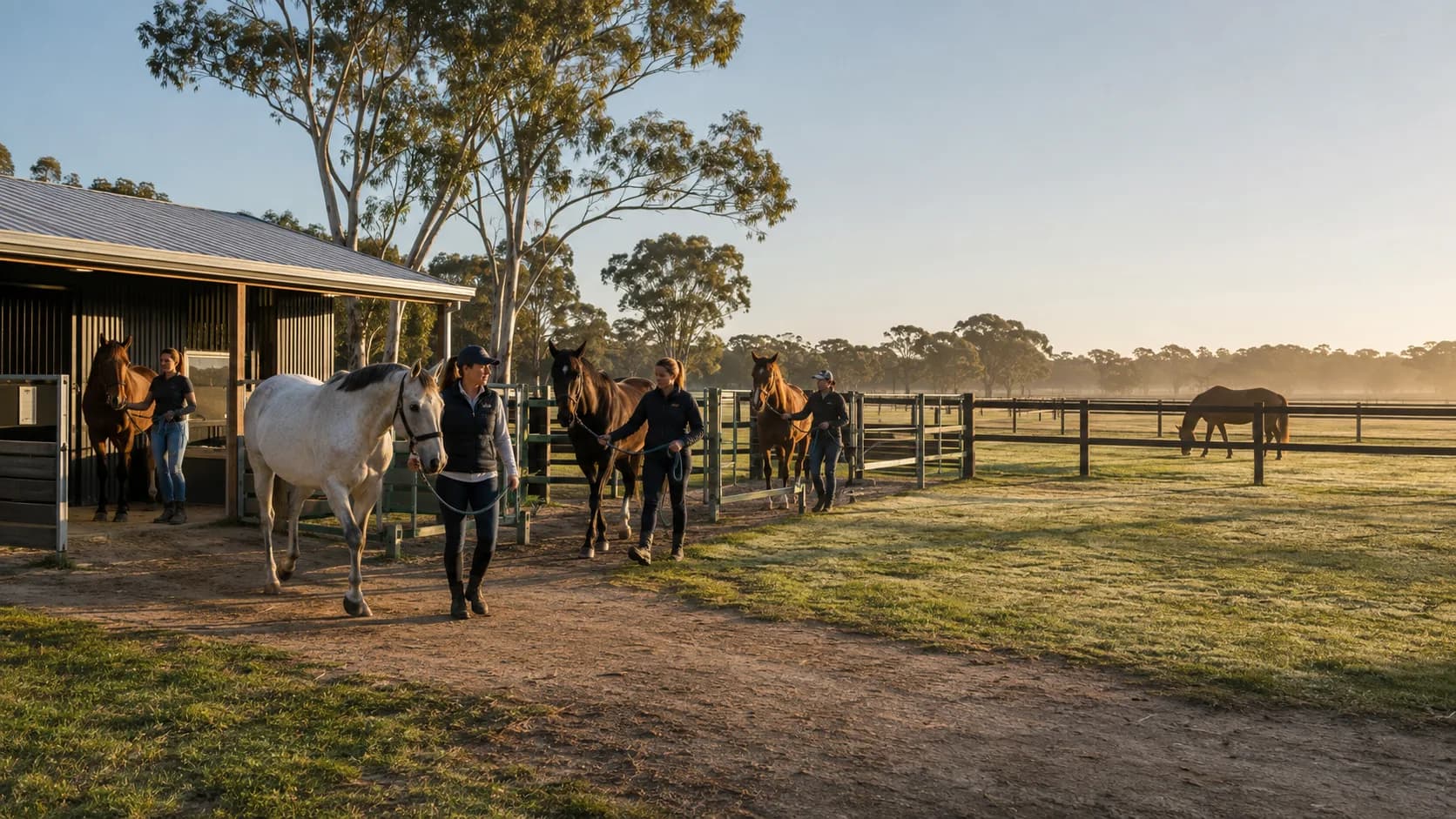
Horse Agistment Booking Software for Australia.
Keep full agistment, part agistment and every paddock-rest closure on one agistment place diary the person opening up can trust.
 Start with Google
- Live paddock or stable availability
- Horse arrival stays protected
- Paddock-rest closure stays visible
- Weekly repeats on Free
- Full card checkout on Pro
Online booking
Sell real agistment place availability
Show only the paddock or stable time you can take. Once a customer confirms the agistment place, that exact resource and window leave the public page.
Learn moreOne live timetable
Keep every horse arrival clear
Put every horse arrival, occupied block and paddock-rest closure on one agistment place calendar, with the actual paddock or stable named on each entry.
Learn morePaddock, part care and full care are three businesses.
One is a fence and some grass. One is feeding and rugging twice a day, every day, in the rain. Charging both as a spot on the property is how a yard undercharges for years.
Each level is its own price
Sell paddock, part and full care as separate things, so the work you actually do is the work that appears on the monthly bill.
Monthly, and it renews itself
An agistment runs until somebody ends it rather than being rebooked, so nobody is re-entering twelve owners on the first of the month.
One paddock, one horse
A taken yard is off the page for its term, so a float arriving on a Saturday is never sent to a paddock that already has something in it.
One clear view of every paddock or stable.
See full agistment, spelling paddocks and paddock-rest closure together, with the actual resource attached to every entry.
- 12 AugOven + windowsBooked · $95
- 2 AugPayment received$140
- 28 JulDeep clean quoteAccepted · $215
- 14 JunRegular cleanCompleted · $70
The horse outlives the booking.
Owner, horse, care level and every payment across four years on one record, so a question about a bill from March is a thirty-second answer.
Built for your property
Built for every kind of agistment
Full agistment
Offer the paddock or stable only for the dates and times it is ready. Confirmation removes that precise agistment place window before it is promised twice.
Part agistment
Hold the complete booking around horse arrival, not just the customer-facing session, while unaffected paddock or stable time stays available.
Spelling paddocks
Repeat this kind of agistment place weekly or monthly on Free, stopping after the final agreed visit instead of leaving an endless block.
Short-term stabling
Keep the customer, paddock or stable and practical notes together so short-term stabling starts from one current record rather than scattered messages.
Competition stopovers
Close only the resources needed for competition stopovers, leaving every unrelated paddock or stable open for another booking.
Multiple-horse families
Begin the longer arrangement with an itemised quote and keep the accepted requirements beside the booking.
Arrival-date changes
Move the date to cover arrival-date changes, without losing the customer, payment position or earlier agreement.
Paddock-rest closures
Block the exact period needed for paddock-rest closure, reopening the paddock or stable only when it is ready to use again.
The agistment fee beside the booking.
Keep payment status with the agistment place, including offline money recorded on Free and complete online card checkout on Pro.
Full card payment online
Pro takes the complete agistment fee by card when the agistment place is booked. Record cash or bank transfer manually on Free.
Offline money stays recorded
Record cash or bank transfer manually on Free, keeping the agistment fee beside the agistment place.
Longer arrangements start with a quote
Send an itemised quote for the longer agistment place and agreed extras, then keep later payments with the accepted details.
- Marco FerraroP-1011 · 25 Jun · Bank transfer$380
- Renee SalterP-1012 · 25 Jun · Cash$240
- Anna WhitfieldP-1013 · 28 Jun · Card$380
- Danny PrasadP-1001 · 27 Jun · Card$190
One app for every booking
Everything you need to run your agistment business.
One paddock, one horse
A taken paddock is off the page for its whole term, so a float arriving Saturday is never sent to a yard that is already occupied.
Care level is the product
Paddock, part and full care are priced separately, so feeding twice a day is a thing you sell rather than a favour you cannot account for.
Email reminders
Email the customer their paddock or stable, horse arrival and practical arrival notes before the booked time begins.
Starts free. Grows
only when you do.
Add your whole team and get booking for nothing.
As you grow with us you can go Pro.
Common questions.
Yes. Your public page shows genuine paddock or stable availability and removes the selected resource or stock when the booking is completed.
Yes. Repeat the same paddock or stable weekly or monthly on Free, ending on a chosen date or after the final planned booking.
Yes. Pro takes the complete agistment fee by card when the agistment place is booked. Record cash or bank transfer manually on Free.
Yes. Close the exact window needed for horse arrival or paddock-rest closure while every unaffected paddock or stable remains available.
Yes. Set each paddock or stable up separately so a confirmed booking removes only that resource and time.
Yes. Itemise the longer agistment place and agreed extras, send the quote and keep the accepted version with the booking.



Horse Agistment & Paddock guides
All articlesFully booked? How to keep the lead without promising the impossible
Handle enquiries when your diary is full with clear requests, alternative times and a practical manual waiting list that avoids double bookings.
ReadHow much booking notice should you require?
Choose a booking lead time that allows for preparation, staff and travel, with practical examples for mobile services, venues and classes.
Read