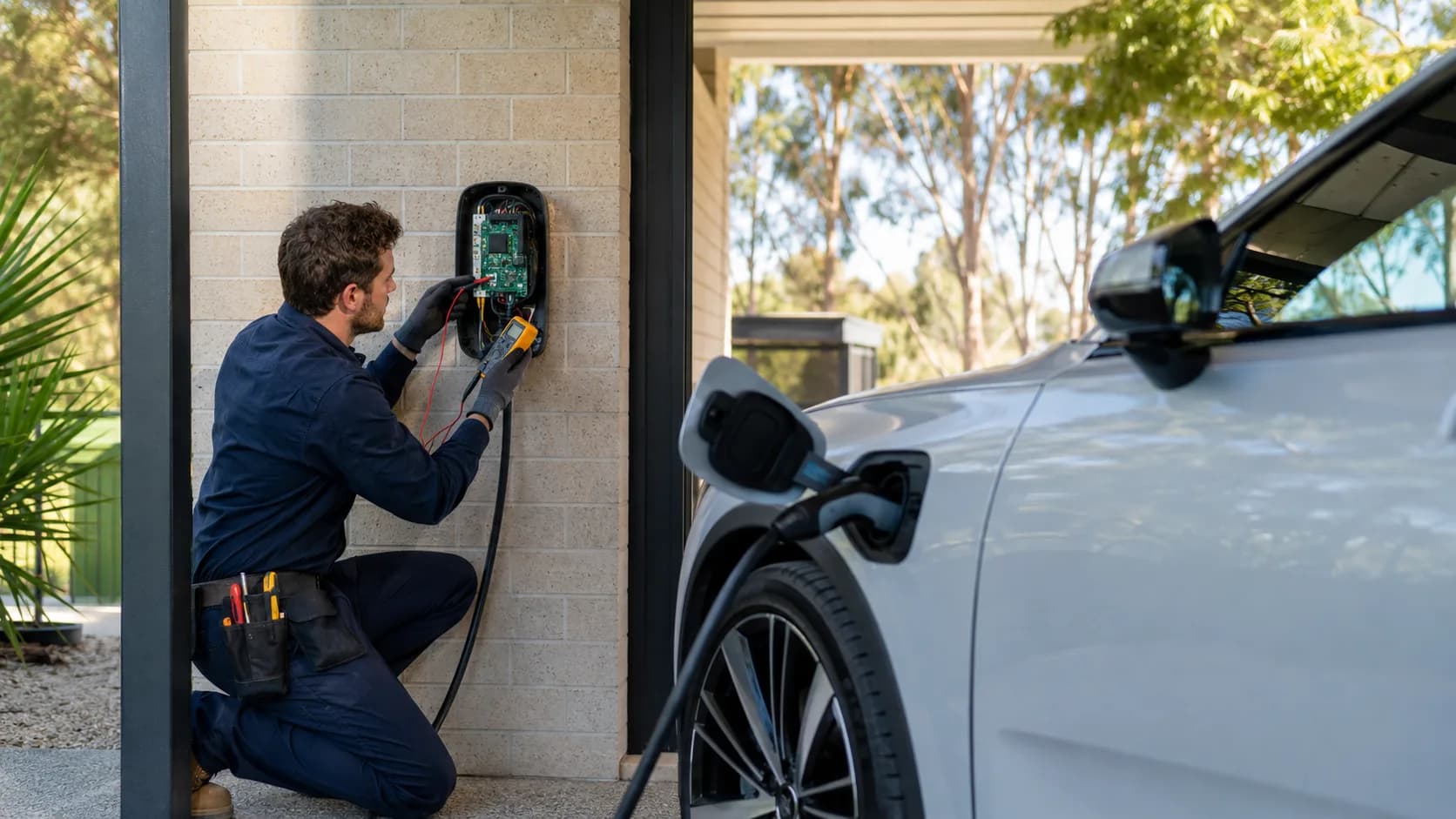
Booking software for EV charger installers in Canada.
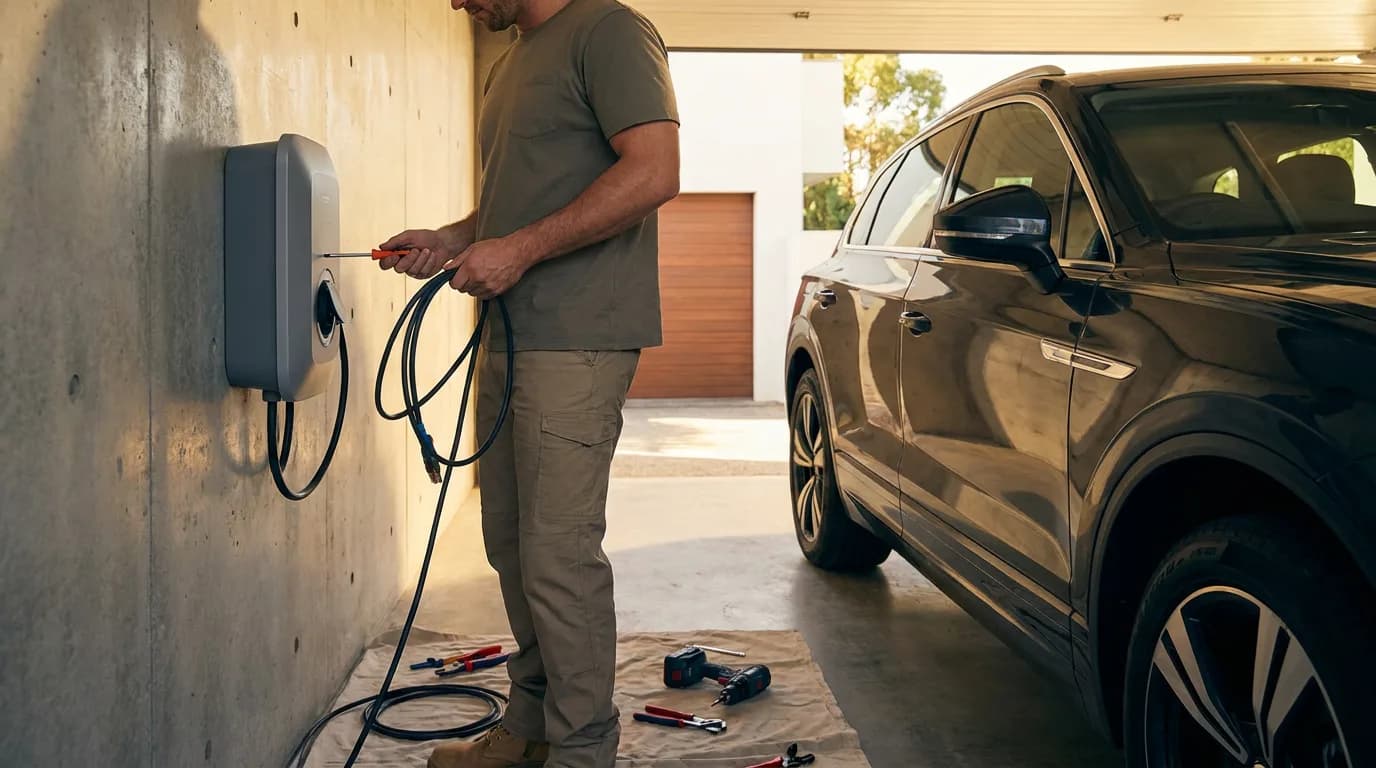
A Level 2 charger in an attached garage is close to a product, so let it book. The service that will not carry it should ask you first.
 Start with Google
- Site surveys booked online
- Single or three-phase quoted with options
- Signed acceptance, not a verbal yes
- The whole install on one record
Online booking
Your standard Level 2 install, sold online
A hardwired charger on a house with a driveway is nearly a fixed price. Set it, ask for a photo of the panel, and let customers book a date.
Learn moreSmart scheduling
Survey, install and inspection on one job
All of it hangs off one record, so when a service upgrade slides you drag the install day instead of rebuilding the whole week.
Learn moreBuilt for charge point work
Every install, and every one that is not standard
Level 2 charger installs
Your everyday job. A set price on your page, a photo of the panel taken at booking, and a real slot filled without one phone call.
NEMA 14-50 receptacles
The receptacle-and-cord customer wants a number today. Give them one online, with the hardwired option priced right beside it.
Service and panel upgrades
When the load calculation says no, the upgrade takes its own line beside the charger, so your customer sees one honest total up front.
EVEMS instead of new service
An energy management system often beats upgrading the service. Quote both on one estimate and let your customer choose between them.
Condo parkade chargers
A charger in a shared parkade is a board decision, not a slot. It comes in as a request and keeps its thread until the condo answers.
Detached garage runs
A trench across the yard changes everything, and freeze-up decides when you dig. The survey settles it and the run is priced as an option.
Utility capacity questions
Some addresses need the utility involved before you promise a date. Those ask you first instead of taking a morning you already sold.
Second chargers for a second EV
The circuit, the breaker and last year’s panel photo sit on the property already, so the second install is priced off real information.
Warranty and cold-weather callbacks
A charger acting up in February comes back to a record with the install date, the breaker and every note you wrote at the time.
No driveway here, but my parking space is right by the meter. Photos attached — is that doable?
When a job should ask before it books.
A parkade stall, a shared driveway, a panel with nothing left in it. None of that is a slot, and none of it should turn into a missed call.
- Ryan MacLeod2mCan you come Thursday instead?
- Bookables1hA booking request needs your answer
- Priya Sandhu3hRunning 10 late on the Parkdale job
One install, two conversations.
The person paying and the person who controls the parking are rarely the same person, and where the parking is shared they are never in the same message. Each keeps a thread, filed against the job, so the answer that unblocks the install is not sitting unread on somebody's phone.
- Roncesvalles8 regions · 2 crew
- Riverdale7 regions · 2 crew
- Toronto North7 regions · 2 crew
How far a spool of wire is worth driving.
Claim the regions you cover once. Inside that line your standard install books itself; outside it the job asks you first rather than landing on Tuesday.
One garage, three prices they can read.
The charger on the panel you have, the charger on a new dedicated circuit, or the service upgraded first so a second EV has somewhere to go.
Priced from the panel, not the phone
That photo of the panel and the parking spot is what your number is built on, so the price you send is the price you can hold.
Extras are options, not extra paperwork
A longer cord, a trenched run, an energy management system: each one carries its own price change on the same estimate.
A number set once
The quote number is fixed the moment you issue it, so your copy and their copy are unmistakably the same document.
Options side by side come with Pro
Putting all three side by side on one estimate, with your recommendation marked, is the Pro part. Writing the quote, sending it and getting it signed are free on every plan.
- Wallbox charger · 7kW tetheredSupply$1,250
- Dedicated circuit & cable runMaterials$640
- Install, test & commission4 hrs$500
Two dates on one job, weeks apart.
You survey this week and the install waits on the utility or the thaw. Both dates live on one job, so your month shows the gap you left.
Your month holds both
Survey, panel work and install read across weeks instead of one day, which is where this trade’s calendar actually lives.
Move the second date
When the service upgrade slides, the install moves and the address, the charger and your notes ride along with it.
Free on any plan
Moving work around your month was never the part you pay for.
Get paid before you load the truck.
Plenty of installs still settle by transfer, and recording one costs you nothing. Cards are the piece that sits on Pro.
Cash and transfer are free
Mark it paid, the receipt goes out by itself, and no plan comes into it anywhere.
Cards come with Pro
For the customer who would rather tap in the driveway than go dig up their account details.
Staged, after the booking
Pro splits a service upgrade and a charger into two legs with their own due dates. It happens on the booked job, never at a checkout.
- Émilie TremblayP-1011 · 25 Jun · Bank transfer$380
- Ryan MacLeodP-1012 · 25 Jun · Cash$240
- Priya SandhuP-1013 · 28 Jun · Card$380
- Jacob WongP-1001 · 27 Jun · Card$190
- 12 AugCharger commissionedDedicated circuit · tested
- 9 AugPayment received$1,480
- 28 JulInstall quoteAccepted · $2,390
- 21 JulSite surveyBoard photographed · run measured
The install outlives the installer.
What was fitted, what protects it and what the board looked like before you touched it stay on the property, so the fault call two winters later starts from something written down rather than from memory.
- PSPriya SandhuToday · 15:45Best+8 min
- JWJacob WongToday · 14:30+22 min
- CBChloé BergeronTomorrow · 09:15+35 min
Small jobs that make a morning pay.
A cord swap or a breaker call only pays if it sits near the install you are already on. Open slots get scored on the driving each one adds.
One app for the whole job
Everything you need to run your charge point work business.
Starts free. Grows
only when you do.
Add your whole team and get booking for nothing.
As you grow with us you can go Pro.
Common questions.
For your standard job, yes. Ask for a photo of the panel and the parking spot at booking, hold your price, and do the survey from your phone. A parkade, a trenched run or a tight service comes in as a request instead.
Those stay with you. The work is done under a permit and inspected by your authority, wired to Section 86 of the Canadian Electrical Code. Bookables holds the job it belongs to: the address, the breaker, the charger and the date.
It prices them as what they are: two different answers to the same problem, sitting side by side on one estimate. Your customer picks one, signs by typing their name, and the accepted option becomes the booked install.
Absolutely, and it is the honest way to do it. The charger, the circuit and the service work are separate lines on one estimate, and your customer accepts by typing their full name.
Cash and bank transfer are recorded by hand on any plan and the receipt goes out on its own. Cards come with Pro, and Pro can split a bigger install into a leg at the start and the balance at commissioning, once the job is booked.
It will. The charger, the breaker, the panel photo and your notes stay on the property, so a callback never starts with twenty questions.