Booking software for home automation and AV integrators in Canada.
Rough-in has to beat the drywall, and trim-out lands months later. Hold both dates, and move them together when the GC pushes the schedule.
 Start with Google
- Projects quoted with online signatures
- Pre-wire and fit-off booked separately
- Builder delays fixed by drag
- Handover paid on the day
Online booking
Leads that arrive ready to price
Your page asks for the build stage, the rooms and the drawings, so a theater inquiry that lands at midnight is worth quoting first thing.
Learn moreSmart scheduling
Two trips, six months apart
Rough-in before the freeze and trim-out in the spring live on one address, so the second trip is never the one nobody remembered to book.
Learn moreOne project, four dated jobs.
Cabling while the walls are open, the rack once the linings are on, then the programming and the handover. Each is a real job on a real day against the same address, so none of them is waiting on “sometime after the painters”.
The service call that prices itself.
A visit to a system you installed is a known quantity. The page prices it, offers a slot that is genuinely free and books it while the client still has the fault in front of them.
- 18 SepHandover · demonstrationDone · $1,450
- 2 SepRack build · networkDone · 8 zones
- 11 MarCabling · plan marked upDone · 34 runs
- 2 FebMedia room quoteAccepted · $24,800
The house remembers its own rack.
What went in, which rooms it reaches and when you were last there. The call two years from now starts from something written down rather than from whoever happens to remember the job.
Built for AV work
Built for every stage of a system
Home theaters
Screen, processor, speakers and seating on one document, with acoustic treatment as an option instead of a second quote two weeks later.
Whole-home audio
Zones priced so the client can start with the kitchen, the great room and the primary bedroom, and see exactly what the rest would add.
Rough-in trips
Booked into the week the studs are open, with the cable schedule and the marked-up drawing riding on the job instead of in your head.
Rack builds
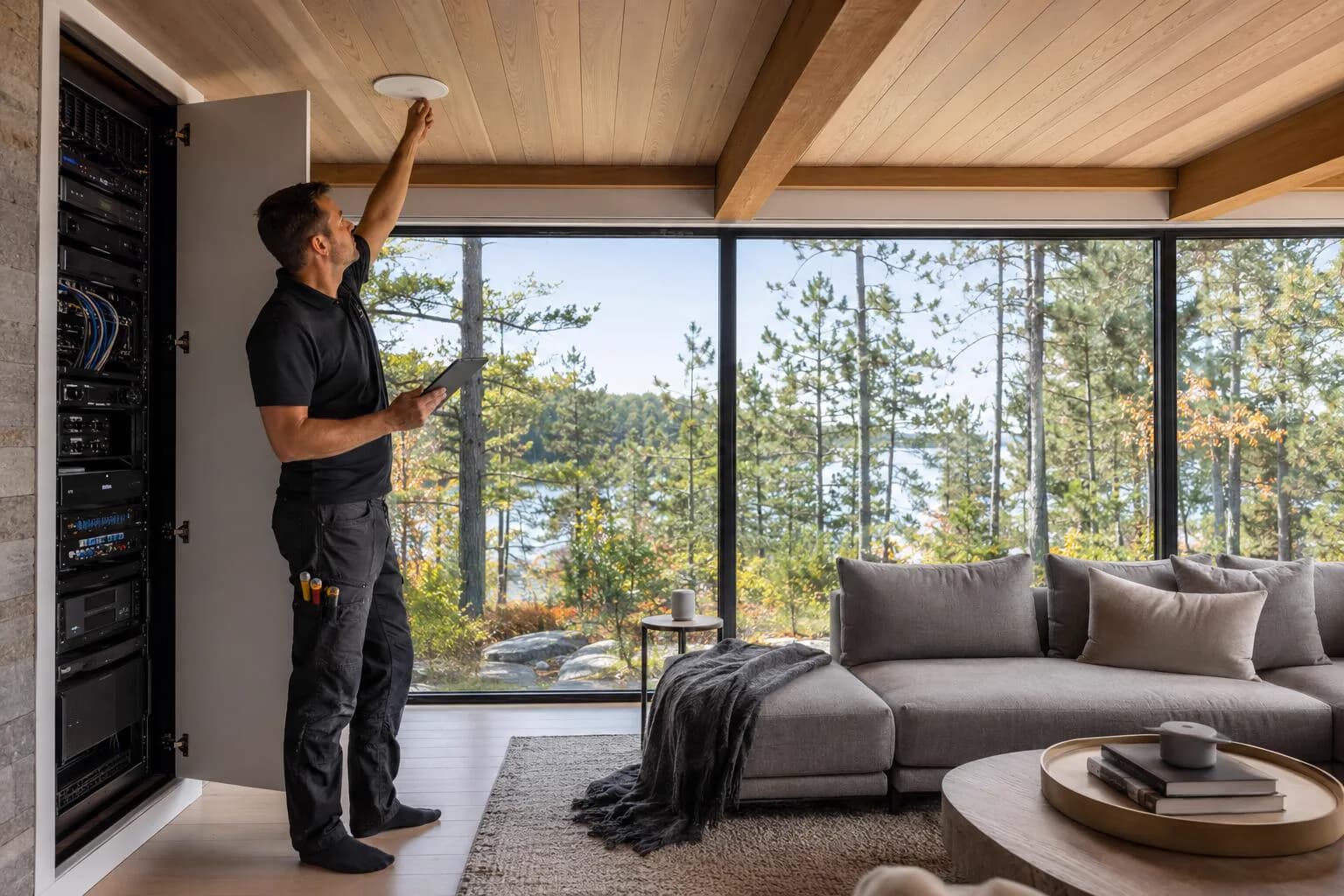
The equipment room gets a day of its own once the drywall is up, instead of being squeezed onto the end of somebody else’s afternoon.
Home networks
Access points and structured cabling for a house that swallows Wi-Fi, quoted off the floor plan and booked as a visit of its own.
Programming and handoff
The last trip is the demo. It gets its own date, its own hours, and a payment request the moment the client runs the system themselves.
Deck and patio audio
Outdoor zones added right at the table as an option with its own price change, so the total moves in front of the client, not next week.
Deficiency calls
The handset that stopped talking to the amp books against the house, with the rack photo and everything you installed already recorded.
One media room, quoted three ways.
The same room as a screen and a soundbar, as a real surround install, or with acoustic treatment, tiered seating and a rack of its own.
Priced off the rooms
Zones, keypads and screens sit as options with their own price change, so adding the deck zone right at the table moves the total in front of them.
A number set once
The quote number is locked the moment it goes out, so the version they signed and the version in your folder are unmistakably the same document.
Accepted, then booked
They accept online by typing their name, and the accepted document turns into the job with its lines and its address already on it.
Tiered options come with Pro
Pro puts all three on one document with your recommendation marked, so the client is comparing your thinking instead of three emails. Cash and bank transfer stay free on every plan.
- Media roomScreen · surround$18,400
- Audio zones6 rooms · keypads$5,200
- Network and rack4 access points$3,100
When drywall shows up early.
Cable week is the one week that cannot slide past the drywall crew. When the schedule moves, drag the trip and the rest of your week reseats around it.
Drag it, do not rebuild it
The address, the marked-up drawing and the cable schedule stay on the job. All that moves is the date.
Trim-out comes along
Both trips hang off the same address, so pushing the first one never orphans the second one six months out.
Free on every plan
Moving work around your calendar was never the part you pay for.
Paid the day the remote works.
Handoff is the happiest your client will ever be, and the one moment they are standing right next to you. That is when the request should go.
Cash and transfer are free
Mark it paid by hand and the receipt goes out on its own. No plan is involved and we never hold your money.
Cards come with Pro
For the client who would rather tap on the spot than go dig up their account details later that night.
Staged, after the booking
Pro splits a long build into a leg at rough-in and the balance at handoff. It happens on the job itself, never at a checkout.
- Émilie TremblayP-1011 · 25 Jun · Bank transfer$380
- Ryan MacLeodP-1012 · 25 Jun · Cash$240
- Priya SandhuP-1013 · 28 Jun · Card$380
- Jacob WongP-1001 · 27 Jun · Card$190
- Ryan MacLeod2mCan you come Thursday instead?
- Bookables1hA booking request needs your answer
- Priya Sandhu3hRunning 10 late on the Parkdale job
Three people, one project.
The builder wants a date, the client wants one more zone, and your programmer wants to know what changed. Each keeps a thread against the job.
- PSPriya SandhuMon–Fri · 8–5On
- JWJacob WongTue–Sat · 9–6On
- CBChloé BergeronMon–Fri · 9–5Off
Who pulls cable and who programs.
Two very different days sit inside one project, and the person who is quick on a control system is rarely the person you want in a roof space. Say who does what once, and only the people who can actually do a visit are offered for it.
The lead that lands mid-build.
AV gets remembered late, usually once the studs are up and there is not a free week left. A page with nothing open on it reads like a shop that closed.
It asks instead of closing
With no slots left the lead still reaches you, as a request with the drawings and the build stage already attached to it.
Give them the week
Most builds will happily wait two weeks for the right integrator. They just want to hear which week you are coming.
Frames are up on the new build and the client wants audio through the house. Can you get in before the linings? Plans attached.
How far you will drive for a reboot.
A twenty-minute fault call two hours out costs you the whole day. Set the ground you cover once, and anything past the line has to ask first.
Picked from real boundaries
Claim the areas you actually work instead of drawing a circle, so your line matches the map everybody else is already reading.
Past the line, it asks
A cottage three regions over reaches you as an inquiry instead of booking itself into a Tuesday you needed.
Whoever covers that ground
Only the people who work that area get offered when a service call comes in from it.
- Roncesvalles8 regions · 2 crew
- Riverdale7 regions · 2 crew
- Toronto North7 regions · 2 crew
One app for the whole job
Everything you need to run your home automation and AV business.
Starts free. Grows
only when you do.
Add your whole team and get booking for nothing.
As you grow with us you can go Pro.
Common questions.
Every stage is its own dated job on the same address. Rough-in, rack build and handoff all hold real days, months apart, and the record follows the house instead of the calendar.
Drag the affected trips to their new dates. The drawings, the cable schedule and the notes come with them, and the crew on those days see the change without a text at six.
Yes, on Pro. Good, better and best sit as named options on one document with your recommendation marked, and the client accepts online by typing their name.
You send the payment request when it suits you. Most integrators send it at handoff, standing next to a client who just ran their own system. Cards come with Pro; cash and transfer are free.
No. Your CEDIA credentials and your AVIXA CTS are yours to hold, and low-voltage licensing is a provincial matter. Bookables keeps the job record, so rough-in photos file against the address.
Yes. The Free plan covers 200 bookings a month with no credit card, and a two-trip project uses two of them.