Booking software for EV charger installers in Ireland.
The charger on a driveway can simply be booked. The apartment space and the tired fuse board have to ask first, which is a rather different job.
 Start with Google
- Site surveys booked online
- Single or three-phase quoted with options
- Signed acceptance, not a verbal yes
- The whole install on one record
Online booking
The ordinary charger, simply booked
A home charger on a house with a driveway is close to a product. Price it, ask for a photo of the fuse board, and let the customer take a date.
Learn moreSmart scheduling
The survey and the fit on one job
Both days hang off the same record, so when the board work waits on an answer the fit moves with a drag rather than a rewrite.
Learn moreBuilt for charge point work
Every install, and every one that is not standard
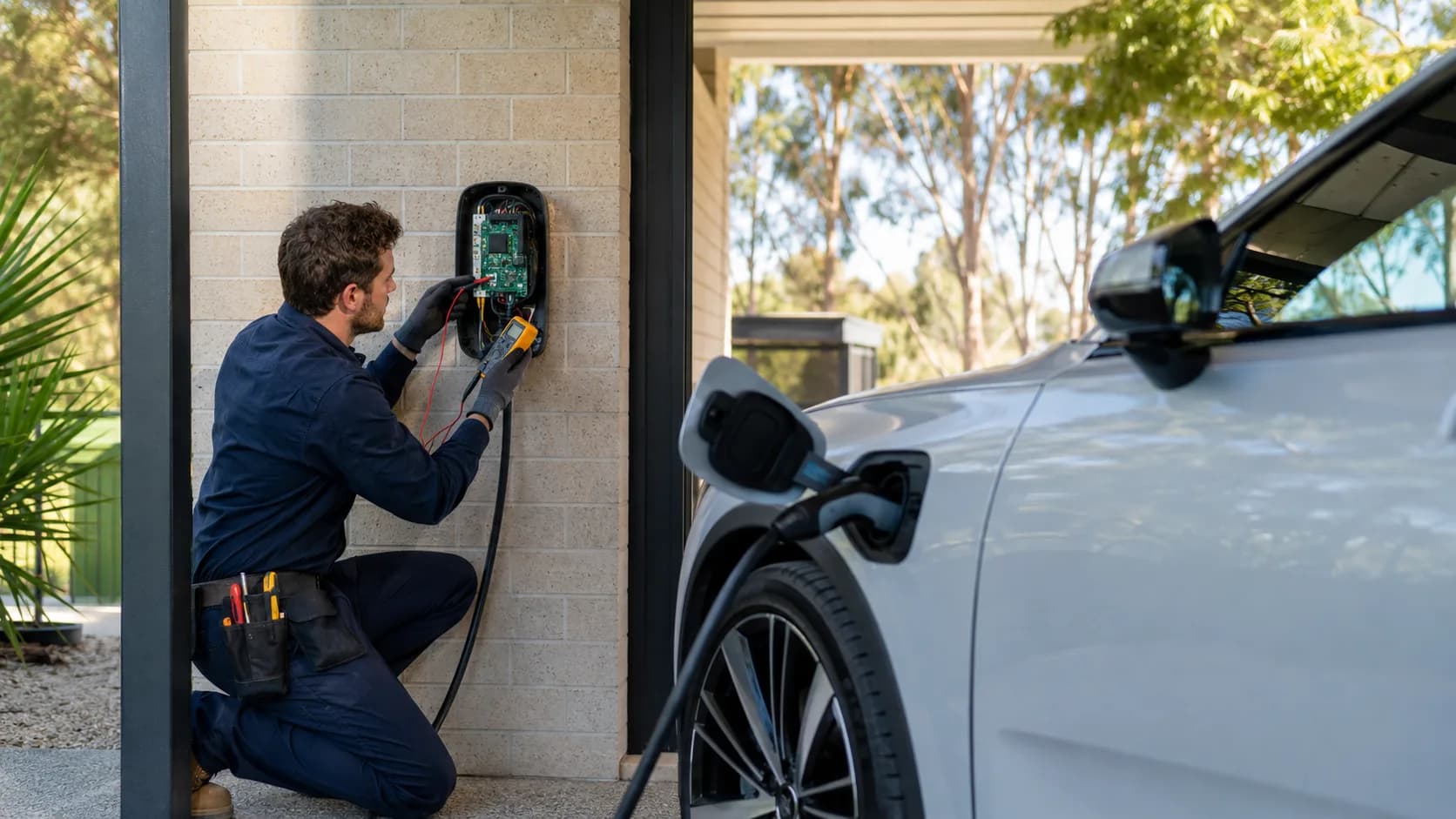
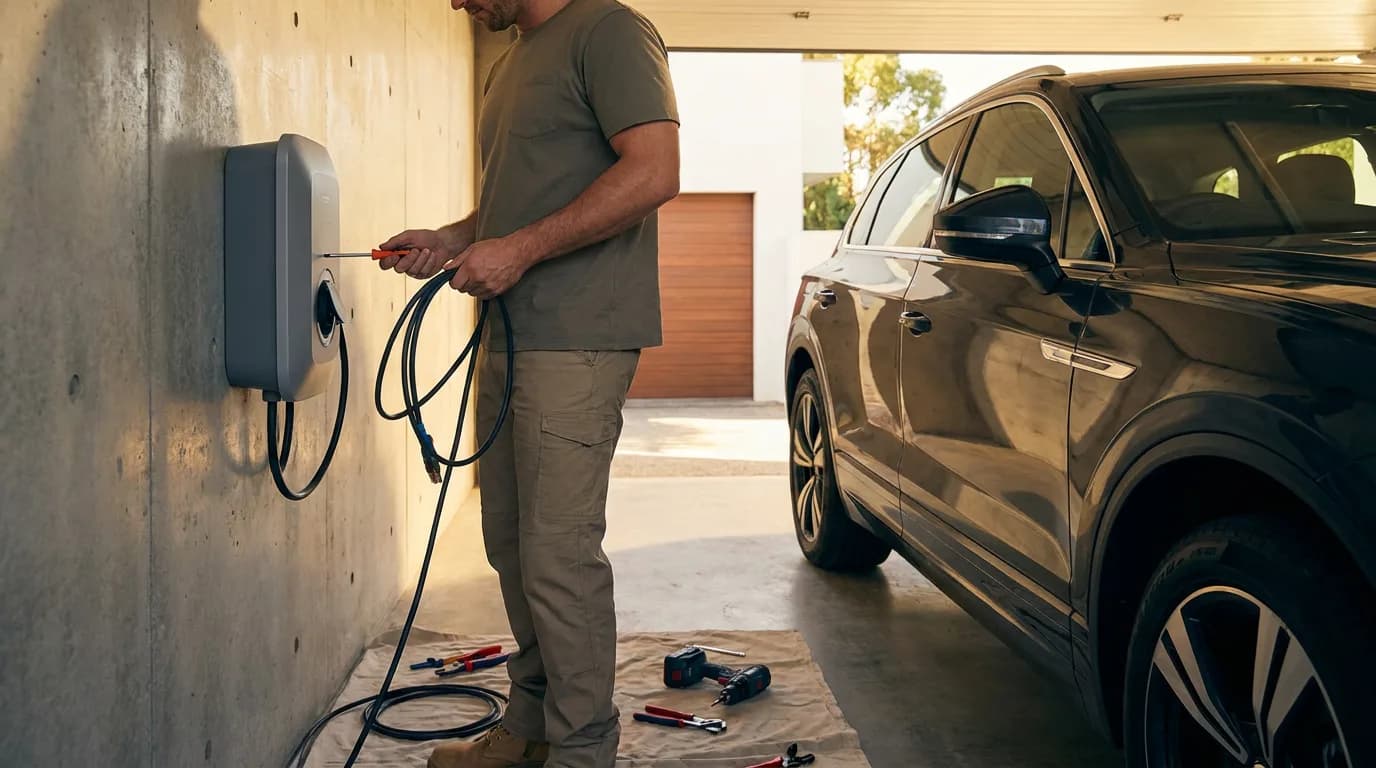
Home charger installs
The everyday job. A set price on the page, a photo of the fuse board at booking, and a genuine slot taken without the phone ringing.
Three-phase installs
Three-phase will not sit behind a fixed price. It arrives as a request with the board photo attached, so the quote starts from what is there.
Fuse board upgrades
Where there is no room for the circuit, the board upgrade is its own line beside the charger rather than an awkward call on the day.
Supply questions on the MPRN
Some connections have to be asked about before a date is promised. Those jobs ask you first instead of taking a morning you have sold.
Apartment and duplex parking
A charger in a shared car park is a management company question, not a slot. It lands as a request and keeps its thread until an answer arrives.
Long runs to a detached garage
Twenty-five metres down the side of the house changes the price. The survey settles it and the run sits as an option on the same quote.
Load-managed installs
Where the supply is tight, a load-limiting device is quoted beside the alternative and the customer chooses between the two.
A second charger for the second car
The circuit, the device fitted and last time’s photographs are on the property, so the second install is priced off what is recorded.
Faults and warranty call-outs
A unit tripping two winters on comes back to a record holding the install date, the protective device and your own notes.
No driveway here, but my parking space is right by the meter. Photos attached — is that doable?
When the job cannot simply book.
An apartment space, a shared driveway, a board with nothing spare in it. None of that is a slot, and none of it wants to become a lost call.
- Cian Murphy2mCan you come Thursday instead?
- Bookables1hA booking request needs your answer
- Niamh Doyle3hRunning 10 late on the Stoneybatter job
One install, two conversations.
The person paying and the person who controls the parking are rarely the same person, and where the parking is shared they are never in the same message. Each keeps a thread, filed against the job, so the answer that unblocks the install is not sitting unread on somebody's phone.
- Drumcondra8 counties · 2 crew
- Clontarf7 counties · 2 crew
- Dublin North7 counties · 2 crew
How far a drum of cable is worth going.
Claim the counties you cover once. Inside the line the ordinary install books itself; outside it the job asks first rather than appearing on Tuesday.
One driveway, three prices worth reading.
The charger on the board as it stands, the charger on a new dedicated circuit, or the board upgraded first so a second car has somewhere to go.
Priced from the board, not the phone
The photograph of the fuse board and the parking is what the number is built on, so the price you send is the price you keep.
Extras are options, not more documents
A tethered lead, another twenty metres of run, a load-limiting device: each carries its own price change on the same estimate.
A number set once
The quote number is fixed the moment it is issued, so your copy and theirs are unmistakably the same document.
Options side by side come with Pro
Setting the three beside one another on a single estimate, with your recommendation marked, is the Pro part. Writing the quote, sending it and having it signed cost nothing on any plan.
- Wallbox charger · 7kW tetheredSupply€1,250
- Dedicated circuit & cable runMaterials€640
- Install, test & commission4 hrs€500
Two dates, weeks apart, on one job.
The survey is this week; the fit waits on the supply answer. Both dates belong to the same job, so the month shows the gap you left on purpose.
The month holds both
Survey, board work and fit read across weeks rather than a single day, which is where this trade’s diary genuinely lives.
Move the second date
When the board work overruns, the fit moves and the address, the charger and the notes go with it.
Free on any plan
Moving work about the month was never the part you pay for.
The invoice sees itself out.
Most installs are still settled by transfer, and recording one costs nothing whatever. Cards are the part that sits on Pro.
Cash and transfer are free
Mark it paid and the receipt leaves on its own, with no plan involved in the matter.
Cards come with Pro
For the customer who would rather tap on the driveway than go looking for their account details.
Staged, after the booking
Pro can split a board upgrade and a charger into two legs with their own due dates. It happens on the booked job, not at a checkout.
- Aoife ByrneP-1011 · 25 Jun · Bank transfer€380
- Cian MurphyP-1012 · 25 Jun · Cash€240
- Niamh DoyleP-1013 · 28 Jun · Card€380
- Seán GallagherP-1001 · 27 Jun · Card€190
- 12 AugCharger commissionedDedicated circuit · tested
- 9 AugPayment received€1,480
- 28 JulInstall quoteAccepted · €2,390
- 21 JulSite surveyBoard photographed · run measured
The install outlives the installer.
What was fitted, what protects it and what the board looked like before you touched it stay on the property, so the fault call two winters later starts from something written down rather than from memory.
- NDNiamh DoyleToday · 15:45Best+8 min
- SGSeán GallagherToday · 14:30+22 min
- OKOrla KavanaghTomorrow · 09:15+35 min
The small work that makes a morning.
A lead swap or a nuisance trip only pays if it sits near the install you are already on. Open slots are scored on the driving each one adds.
One app for the whole job
Everything you need to run your charge point work business.
Starts free. Grows
only when you do.
Add your whole team and get booking for nothing.
As you grow with us you can go Pro.
Common questions.
For the ordinary job, yes. Ask for a photograph of the fuse board and the parking at booking, hold the price, and the survey is done from your phone. Three-phase, an apartment, or a house with nowhere off the street to park comes through as a request instead.
That stays with you. The work is notifiable, wired and certified against I.S. 10101 by a Safe Electric registered electrician, and the certificate goes to the customer. Bookables holds the job it belongs to: the address, the circuit, the charger and the date.
Take it as a request rather than a booking. The thread stays open while ESB Networks comes back to you, and the fit only goes in the diary once you know the supply will carry it.
It can, and it saves the conversation later. The charger, the circuit and the board work are separate lines on one estimate, the alternatives sit side by side, and the customer accepts by typing their full name.
Cash and bank transfer are recorded by hand on any plan and the receipt sees itself out. Cards come with Pro, and Pro can split a larger job into a leg at the start and the balance at commissioning, once the booking exists.
It will. The charger, the circuit, the photographs and your notes stay on the property, so a fault call does not begin with twenty questions.