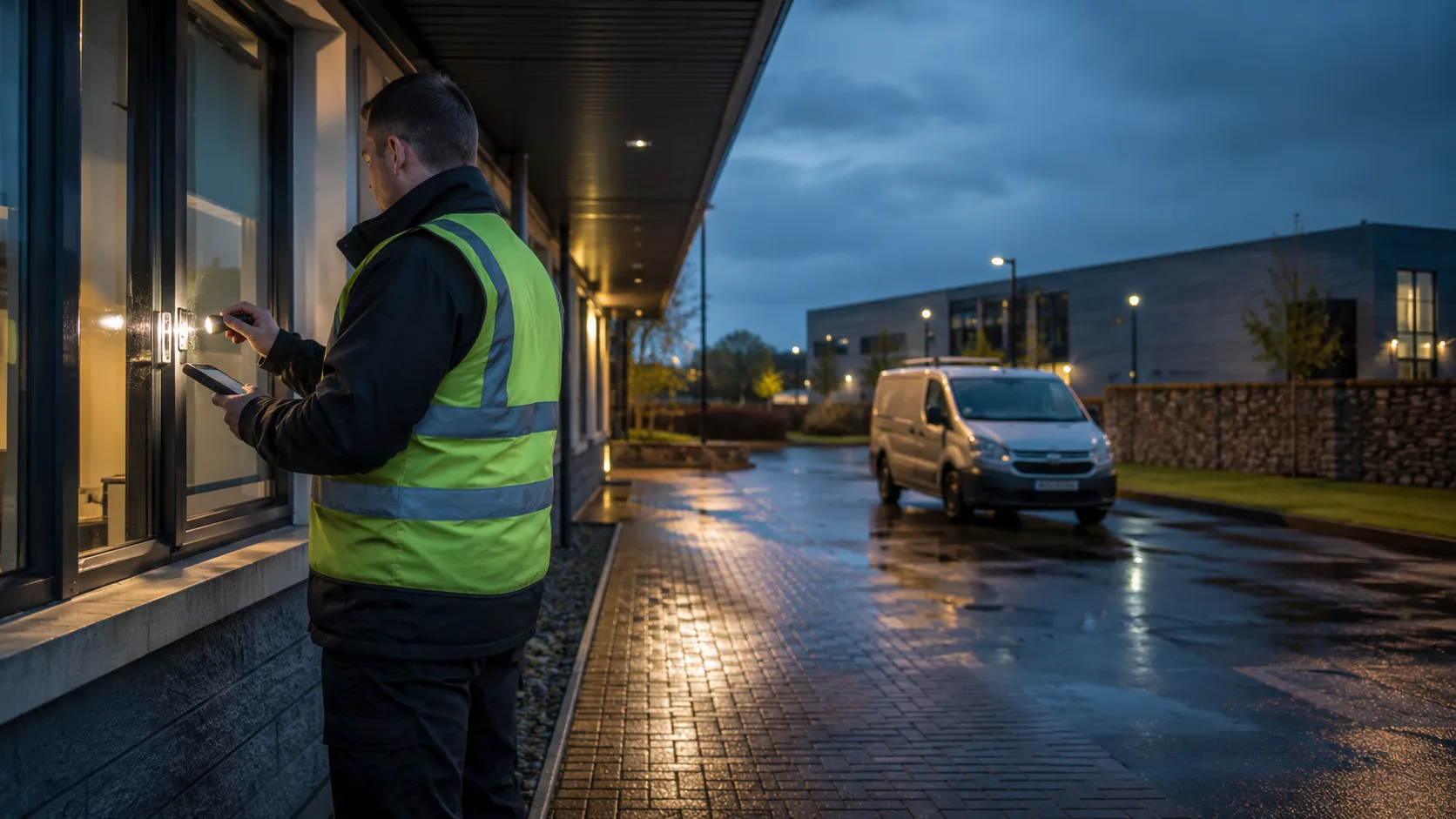
Mobile patrol and keyholding software for Ireland.
The work runs from lock-up to daybreak, and it is sold as a contract rather than a job. Set the run once and every night of the term is already on the roster.
 Start with Google
- Each guard's licence and expiry kept on their record
- Patrol shifts and alarm callouts priced as separate services
- A night's sites sequenced so none get missed
- Contract clients billed on account, casual callouts paid on the day
Online booking
Cover arranged at eleven at night
A site manager wanting a compound watched from tomorrow will not wait for the morning. Your page takes it, priced, and the arrangement sees itself in.
Learn moreSmart scheduling
A roster that starts when yours does
Set the hours your guards genuinely work and the board draws the night as it runs, rather than a working day that finished before you started.
Learn moreA contract, rather than a run of jobs.
A client signs for two patrols a night for twelve months. That is a pattern, not a booking, and it ought to go on the roster once.
Every night of the term
Set the pattern once and end it on a date at the end of the contract. Visits are generated ahead, so the run is on the roster before anybody asks where it is.
One arrangement per patrol
Two patrols a night is two standing arrangements against the same site, each its own booking with its own time and its own guard.
Standing work is free
Repeating bookings are on every plan. Move one night and you choose whether the remainder of the term follows it or stays put.
Lock-up to daybreak.
A tool built around nine to five is little use here: the first job starts at ten at night. Hours sit with the guard, so the board draws the real shift.
The hours belong to the guard
Each one has their own weekly hours and their own nights off, and nobody is offered a shift falling outside them.
The night can be redrawn
Drag a patrol onto another guard or another hour when somebody calls in sick, and the run moves before the shift begins.
Nothing lands on top of anything
Two jobs cannot sit on one guard at one time. The database declines the overlap, so a clash surfaces when it is made rather than at two in the morning.
- NDNiamh DoyleMon–Fri · 8–5On
- SGSeán GallagherTue–Sat · 9–6On
- OKOrla KavanaghMon–Fri · 9–5Off
Only the guards who are cleared.
Bookables is not a licence register and will not pretend to be one. What it holds is which services each guard is assigned, and only a guard carrying that service is ever offered the work.
The callout has its own price.
A trip out at half past one is not the contract rate with a different name on it. Run it as its own service so it is booked, priced and billed as the separate thing it is.
- One patrol a nightPer night€95
- Two patrols a nightRecommended€170
- Lock-up and unlockAdded€45
Three ways to cover one site.
On Pro one document carries three versions of the same site: one patrol a night, two, and two with a lock and unlock on the end. The client picks the one they want and accepts it by typing their name.
- 14 AugPatrol · 1:40amCompleted
- 13 AugPatrol · 11:20pmCompleted
- 9 AugAlarm responsePaid · €180
- 1 AugContract renewalAccepted · €215 a night
Everything that ever happened at that address.
The gate code, where the panel sits and who to ring at two in the morning belong on the site, not in somebody's phone. Every patrol, every callout and every payment lands on the same record, so the guard covering it for the first time knows what the last one knew.
Built for your trade
Built for the work you do after dark
Mobile patrol contracts
A run of sites visited two or three times a night, each patrol its own standing arrangement so the whole term is on the roster from day one.
Keyholding and alarm response
Attending a signal at three in the morning, booked as its own service at its own rate rather than lost inside a contract that never priced it.
Lock and unlock services
Securing premises at close and opening them at first light, two short bookings on one record, so there is a note of who locked up and when.
Construction site night cover
A fixed-term run for the length of the build, ending the week the hoarding comes down, with its own hours and its own guards.
Business park mobile patrols
Car park and service yard checks between close and open, repeating on the nights the managing agent asked for and no others.
Vacant premises inspections
A weekly visit to an empty unit, priced per inspection, with the access notes and the agent to ring kept on the site record.
Static guarding for a fixed term
One guard on one site for a set number of nights, booked as a block with the hours it actually runs rather than a run of callouts.
Retail park out-of-hours patrols
Loading bay and service road checks after close, on the nights the centre pays for, each visit logged against that unit.
Event and function cover
A weekend of guards on a site with its own hours, quoted as a document the organiser accepts before anybody goes on the roster.
One client, several sites.
A managing agent with six addresses is one record with six sites under it, each with its own history and its own standing arrangement, and one balance across the lot.
- Aoife ByrneBooked just now€215Accepted
- Cian MurphyOpened 2h ago€480Viewed
- The Oak CaféSent yesterday€120Sent
The proposals still sitting with somebody.
Cover for a new site is won on paper before anybody drives it. Each one shows whether it has been opened and whether it has been accepted, so a renewal that has gone quiet is visible rather than assumed.
On account, or on the night.
A contract client is invoiced monthly and a one-off attendance is settled the same week. Both are the same sort of record here, billed differently.
Cash and transfer cost nothing
Record a transfer against the job by hand in a few taps. It is free on every plan and it always has been.
Cards come with Pro
Send a payment request as a link the client settles, and card money is paid out to your own account rather than held here.
An invoice off the record
Every booking carries its own paid and outstanding figure, and an invoice comes off it as a PDF the moment the client asks.
- Aoife ByrneP-1011 · 25 Jun · Bank transfer€380
- Cian MurphyP-1012 · 25 Jun · Cash€240
- Niamh DoyleP-1013 · 28 Jun · Card€380
- Seán GallagherP-1001 · 27 Jun · Card€190
How far one vehicle gets in a shift.
A patrol run is bounded by what can be driven between lock-up and daybreak. The areas you claim decide which sites your page will take on.
Checked before it books
A new address is matched against your areas first, so nothing lands confirmed for a unit nobody was going to reach in time.
Areas belong to people
Guards are assigned to areas, so the far end of the run goes to whoever is already working that side rather than whoever answered.
Past them it is a request
A site outside your areas is not turned away flat. It waits on a yes from you instead of taking a slot on its own.
- Drumcondra8 counties · 2 crew
- Clontarf7 counties · 2 crew
- Dublin North7 counties · 2 crew
The call that comes in at three.
Nobody rings a patrol company at a convenient hour. What arrives while the crew is out should not be a voicemail with half an address on it.
It arrives with the site on it
The request carries the address, what activated and when they rang, so a guard is moving before anybody has been rung back.
Accept it and it is a booking
One tap turns the request into a real booking on the night, assigned to whoever is out that way, and the thread stays with it.
Decline it and it closes
A site you do not cover gets an answer rather than silence, and either way the thread stays on that client record.
The rear roller door alarm has gone again and nobody here can get across tonight. Can somebody attend and secure it?
Starts free. Grows
only when you do.
Add your whole team and get booking for nothing.
As you grow with us you can go Pro.
One app for the whole job
Everything you need to run your security patrol business.
Common questions.
Bookables does not hold licence numbers and does not watch expiry dates, so it is not a substitute for the register. What it holds is which services each guard is assigned, and only somebody carrying that service is offered the work. Remove the service and they are off tonight immediately.
Yes, and it is rather the point. Each patrol on the run is a standing arrangement with its own pattern, weekly or every few weeks, ending on a date at the end of the term. Visits are generated ahead, and standing arrangements cost nothing on any plan.
It becomes its own booking against the site, priced as an alarm attendance rather than absorbed into the contract rate. Arriving through your page out of hours it lands as a request in the inbox with the address attached, and accepting it puts a real booking on the night.
No, and it is worth being plain about it. There is no checkpoint scanning, no live tracking and no incident reporting here. What Bookables keeps is a booking for every patrol, a record per site with your access notes, the thread with the client and the invoice.
Yes. Cash and bank transfer are recorded by hand against the job and cost nothing on any plan, and a payment request is simply a link the client settles. Card payments come with Pro, and card money is paid out to your own Stripe account rather than held here.
On the site itself. Each one is a record with its own address, and notes and photographs sit on it, so the code for the side gate and the number to ring at two in the morning are in the same place as every attendance ever made.





Security Patrol & Alarm Response guides
All articlesHow to take bookings while you're doing the actual work
Set up online bookings around your services, prices, travel and availability so customers can book while you're busy doing the job.
ReadHow much booking notice should you require?
Choose a booking lead time that allows for preparation, staff and travel, with practical examples for mobile services, venues and classes.
ReadHow to reduce appointment no-shows without becoming their mum
Reduce appointment no-shows with clear confirmations, useful reminders and easy rescheduling. Includes a sample reminder and a simple measurement method.
Read