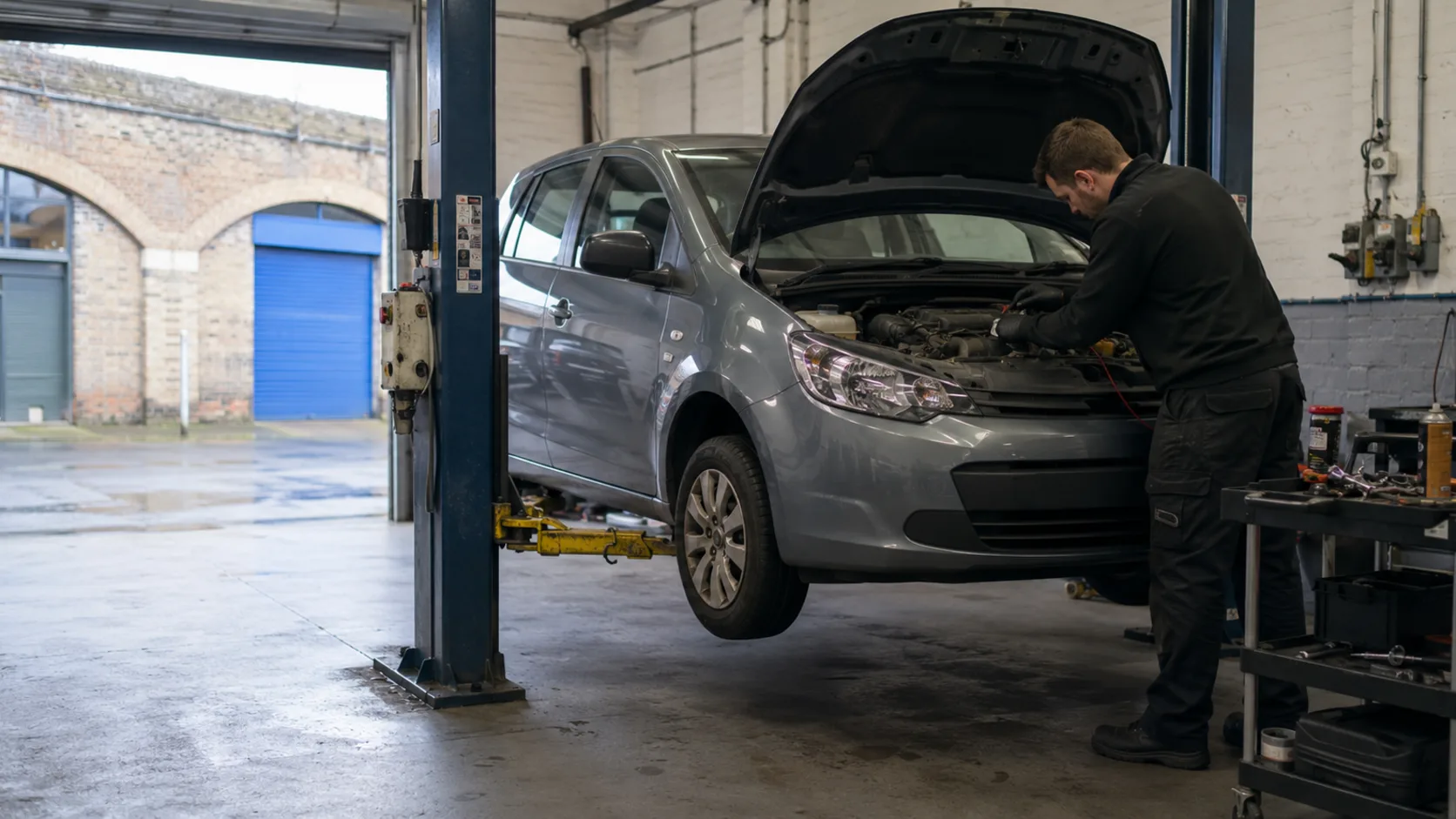
Booking software for garages and MOT centres in the UK.
Put your service and MOT prices on a page owners can book from at half ten at night, hold the ramp in the diary, and send the corroded brake pipe you have found for agreement before you touch it.
 Start with Google
- Customers book their car in from your page
- Logbook and service prices shown up front
- Extra work approved from the customer's phone
- Every vehicle on file with its full history
- Service-due reminders that rebook the car
Online booking
Service and MOT, priced on the page
Each job carries its own price and its own ramp time, so a car books itself in overnight rather than leaving you a message to return.
Learn moreSmart scheduling
A ramp you have genuinely got
The diary knows what is still in the air, so nothing lands on a ramp that is quietly holding yesterday’s cambelt job.
Learn moreA household is one customer, not three.
Every car hangs off its owner as its own record, with its own details and its own run of work, so two cars at one address stay one relationship.
- APAisha PatelMon–Fri · 8–5On
- LDLiam DochertyTue–Sat · 9–6On
- SMSophie MarshMon–Fri · 9–5Off
Not every bay can take every job.
Each mechanic carries their own hours and their own services, so the diagnostic work is only ever offered on a day the person who does it is in.
There is a knock over bumps at the front. Anything this week?
Full for the week, and they still ask.
With no ramp left the page says so, and the customer leaves a request rather than quietly trying the garage on the next street.
Where each car has got to.
Booked in, on the ramp, waiting on agreement, ready to collect. Whoever is on reception can answer without walking through.
The tidy fix, the proper one, or both.
Worn pads on lipped discs is three jobs at three prices. Put them on one quote and let the customer decide, rather than two more phone calls.
The known jobs price themselves
An MOT, an interim service or a battery each carry their own price and their own ramp time on your page, on any plan.
Three ways round it, on one quote
Pads only, pads with discs, or both axles done properly with fresh fluid, with the one you would recommend marked as such. Options come with Pro.
Agreed by typing their name
They accept online, name and time recorded, and the agreed lines land on the booking, so the car on the ramp is now the car you quoted.
- Front pads and discsParts and labour£460
- Split constant velocity boot2 hrs£320
- Cabin and engine filtersParts£95
The yes arrives while the car is still in the bay.
You can see the quote land, see it opened and see it accepted, so nobody is standing beside a half-stripped car wondering whether the message got through.
Sent, opened, answered
Every quote shows where it stands and when it was last opened, which is the difference between chasing an owner and knowing they have not looked yet.
The accepted work joins the job
Accepting turns the quote into real lines on the booking, so the value of the job in the bay moves the moment the owner says yes.
A no is an answer too
Declined is recorded against the car with the date, so next year you can see you offered it and they said not this time.
- Gemma WhitfieldBooked just now£215Accepted
- Danny OkoroOpened 2h ago£480Viewed
- The Oak CaféSent yesterday£120Sent
The conversation belongs to the car.
Approvals, the question about the noise and the message about who is collecting all sit against the job, instead of across three people’s phones.
One thread per job
The history of what was agreed lives on the record, so whoever picks the car up next time can read it back rather than take somebody’s word.
Notes and photos stay internal
A photo of the corroded part goes on the record feed for your own people. The owner never sees it unless you send it to them.
Reminders you switch on yourself
Nothing is emailed to an owner until you turn that moment on. Every notification ships off, which is deliberate.
- Danny Okoro2mCan you come Thursday instead?
- Bookables1hA booking request needs your answer
- Aisha Patel3hRunning 10 late on the Sale job
Built for the workshop
Every job that comes through the door
MOT tests and the retest
A short booking at a set price, taken online, with the failure items going straight back out as a priced quote.
Interim and full servicing
Price each level once and the customer picks the one their car is due, with the ramp time already accounted for.
Brake discs, pads and fluid
The job that grows once the wheels are off. Quote the three ways round it and let the customer choose before you start.
Cambelt and water pump
Interval work you can see coming. Set the standing arrangement as you fit it and the next one is already in the diary.
Clutch and dual-mass flywheel
A full-day job that owns a ramp. Book it at its own length so nothing short gets stacked on top of it.
Diagnostics on a warning light
Booked as a diagnostic first at its own price, then quoted properly once you know what the fault code is actually telling you.
DPF and exhaust work
Rarely priced over the phone. It comes in as a request, gets looked at, and goes back out itemised for agreement.
Suspension, steering and tracking
Quoted off what you find under the car, agreed from the customer’s phone, and added to the job already on the ramp.
Tyres fitted and balanced
A quick in-and-out that should not cost half an hour on the phone. It books itself into the gap it happens to fit.
Van and small fleet servicing
One customer, several vehicles, each on its own record and its own interval, all rebooking without a spreadsheet.
- Mason King · ChorltonScheduled service · Wed · 3:30pm£180
- Ava Baker · AncoatsBrakes and fluid · Wed · 1:00pm£560
- Grace Walker · ManchesterDiagnostic · Wed · 11:30am£120
- Amelia Ryan · ChorltonWheel alignment · Tue · 2:00pm£190
Every car you are holding, on one screen.
Not what you did last month — what is sitting on your floor right now, whose it is, what it is in for and what it is worth when it leaves.
Settled before the keys go back.
Cash at the desk costs nothing to record. Take the card when they collect, or send the request the moment the car is off the ramp.
Cash and bank transfer are free
Record what was handed over against the job on the Free plan, with the paid-on date. Cards are the only part of the money that wants Pro.
Or take the card at collection
Charged against the booking on your own connected account, so the money is yours and reaches your bank rather than sitting with us.
A link for whoever is not there
Send a payment request when somebody else is collecting, and it tends to be settled before they reach the desk.
- Gemma WhitfieldP-1011 · 25 Jun · Bank transfer£380
- Danny OkoroP-1012 · 25 Jun · Cash£240
- Aisha PatelP-1013 · 28 Jun · Card£380
- Liam DochertyP-1001 · 27 Jun · Card£190
The service interval is a standing arrangement.
A car that left in March is a booking in September, not a note in a diary. Set the interval once and the next visits are generated ahead of you.
Weekly or monthly, ending when you say
Never, on a date, or after a set number of visits. A fleet on six-monthly servicing keeps rebooking itself without anyone rekeying it.
Every vehicle on its own record
One owner can hold several cars, each with its own details and its own history, so the reminder is about the right one.
Recurring work is free
Standing arrangements are on every plan, including the free one. Nothing about bringing a car back sits behind Pro.
- 12 AugScheduled serviceBooked · £390
- 12 AugExtra work approvedAccepted · £875
- 12 AugPayment received£1,265
- 3 FebTiming belt and water pumpCompleted · £1,180
- 14 AugScheduled serviceCompleted · £360
One app for the whole job
Everything you need to run your car service and repair business.
Starts free. Grows
only when you do.
Add your whole team and get booking for nothing.
As you grow with us you can go Pro.
Common questions.
They can. Put each one on your page with its real price and its real length, and the customer takes a time you actually have. It arrives in the workshop diary without a phone call at either end.
Send it from the job as a quote, itemised and priced. The customer opens it on their phone, accepts by typing their name, and the lines land on the booking, so the agreement is in writing before anything is undone.
Each car sits on the customer’s record as its own subject with every booking, quote and payment against it, so last year’s work and what it came to is one glance rather than a rummage through the file.
Yes, and it costs nothing extra. Set the arrangement once and the following visits are generated ahead, which is how a handful of vans on six-monthly servicing keeps rebooking itself.
No, and it would be dishonest to suggest otherwise. Bookables covers the booking, the quote, the agreement and the money. What is on the shelf stays with your factor’s system.
The page stops offering times you cannot serve, and the customer leaves a request rather than trying the garage on the next street. It arrives as a thread you accept or decline once something frees up.