Booking software for mobile fuel delivery in the US.
Your customers are yards, jobsites and generator rooms, the rack price moved this morning, and the loading dock window closes at seven. That is the whole job.
 Start with Google
- A "from" figure and a callback, not a published rate
- Tank capacity, fuel type and fill point on the site
- Coverage drawn over the country you actually run
- The farm office billed while the manager books
Online booking
A standing fuel-up beats a price list
Your page collects the site, the product and the window and hands you a real request. The number stays yours to quote on the day you load.
Learn moreSmart scheduling
Every fuel-up gets its own window
Each stop carries a duration and an address, so an overnight yard fill and a quick generator top-off never compete for the same slot.
Learn moreThe honest number comes with a date.
What you can really commit to is a figure with gallons behind it and a day it stops being good. Anything firmer is the market’s call.
It expires by itself
Set a valid-until date and the quote lapses on its own, so nobody comes back in five weeks holding you to a number from March.
Volume is its own line
Quantity and rate sit on the document as one priced line, so the account sees exactly what makes up the total you sent.
A yes becomes the delivery
Accepting turns the quote into a booking with the site, the product and the duration already on it, and the priced lines follow.
- Bulk fuel deliveryVolume × rate$1,640
- Second tank, same visitVolume × rate$410
- Out of hours dropSite window$120
How far the truck really goes.
The drive is the cost in this business. Where you will run should be a setting you made once, not a call you make at five in the morning.
Checked before it books
The address is matched against your areas before anything is accepted, so a small drop two hours out never confirms itself.
Outside it, it waits for you
The far site is not turned away. It waits as a request while you weigh the gallons against the miles, which is the right order.
Areas belong to drivers
North side and south side are separate territories with separate names on them, so the truck already out there gets offered it.
- Hyde Park8 counties · 2 crew
- Zilker7 counties · 2 crew
- Austin North7 counties · 2 crew
One invoice per delivery.
Fleet and facilities accounts pay against paper. Every stop leaves its own document with the gallons, the product and the date on it.
Cash and transfer are always free
Record what the office sent against that delivery by hand. That costs nothing on any plan and it never has.
Cards come with Pro
Send a payment request the account contact settles from their phone, and the receipt goes back without you writing it.
We never hold your money
Card payments are paid out to your own Stripe account. Nothing sits inside Bookables waiting on a payout cycle.
- Marcus BellP-1011 · 25 Jun · Bank transfer$380
- Ashley NguyenP-1012 · 25 Jun · Cash$240
- Tyler BrooksP-1013 · 28 Jun · Card$380
- Jasmine CarterP-1001 · 27 Jun · Card$190
We are down to about a quarter on the site tank and the crew starts at seven. Any chance of a drop tomorrow morning?
The call that comes in at five.
A generator is down to a quarter tank or a crew is standing around waiting. That call should reach you with the site already on it.
A record per site, not per customer.
One company can have four tanks in three places. Each address is its own record, holding the capacity, the fill point and where the truck has to stand.
- 2 JulTank top-upBooked · $1,180
- 18 JunPayment received$960
- 18 JunBulk fuel deliveryCompleted · $960
- 4 JunStanding drop quoteAccepted · $1,640
Every drop stays on the address.
What went in, when, and what the driver noted about the tank. The compliance question gets answered off a record instead of a folder in the cab.
Dock windows move, and they move late.
Between shift change and the exclusion zone you get maybe an hour, and it slides. Move the stop instead of calling everyone back.
Past your coverage. Decline politely, or make an exception.
The one past the end of the run.
A single drop a long way out is not automatically a no, but it should never book itself. It waits while you weigh the load against the road.
Built for your trade
Built for the tanks you actually fill
Overnight fleet fueling
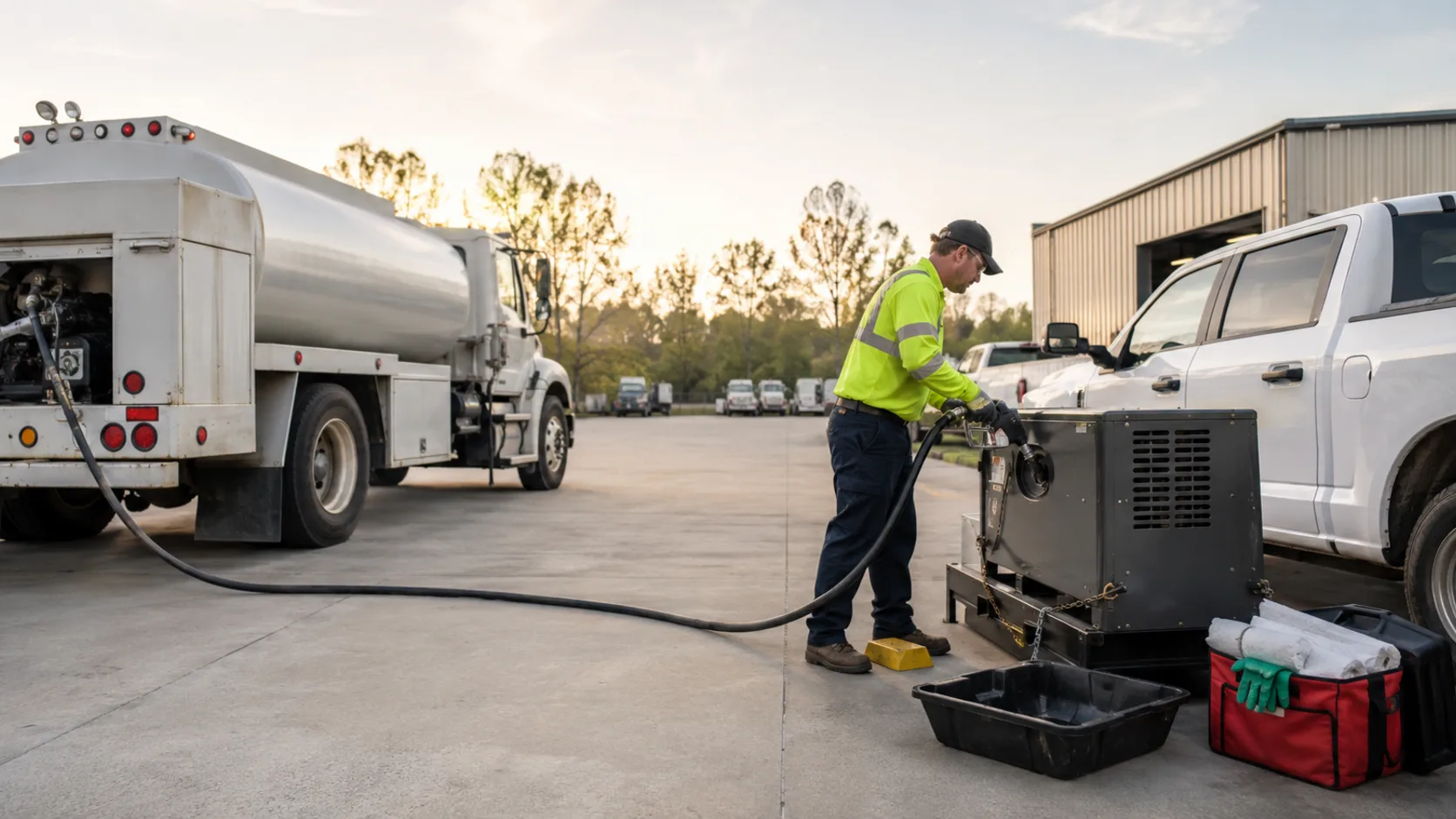
A yard of trucks fueled while nobody is driving them, on a standing weekly visit, so every driver starts the shift full instead of in line.
Jobsite equipment
Excavators and loaders fueled where they sit, inside whatever window the superintendent gives you between safety meeting and first pour.
Generator fuel for critical sites
Data centers and hospitals topping off standby tanks, where badging in and getting an escort takes longer than the fuel transfer does.
DEF deliveries
Diesel exhaust fluid dropped on the same visit as the diesel, priced as its own line so the account can see what drove the total.
Home heating oil
Winter deliveries to houses off the gas main, set up as a standing drop so nobody discovers an empty tank at ten at night.
Storm and outage response
Generator runs booked back to back through an outage, each with its own address and duration, and each leaving its own invoice.
Marina and dock fueling
A truck to the hardstand for a boat that cannot come to a pump, scheduled against a tide window and billed to the marina office.
Roadside fuel rescue
The out-of-fuel call that lands as a request with the location already attached, so you can say yes or no in one tap.
The tank that empties on a schedule.
Most of this work is not an emergency, it is arithmetic somebody keeps doing in their head. Set a standing arrangement on the site instead: weekly or monthly, a fixed day or a flexible one, ending on a date, after a set number of drops, or never. The visits are generated ahead, so the run already exists before the week starts and nobody has to ring to keep it going.
Starts free. Grows
only when you do.
Add your whole team and get booking for nothing.
As you grow with us you can go Pro.
One app for the whole job
Everything you need to run your mobile fuel delivery business.
Common questions.
No, and we would rather say that up front than let you find out. Nothing here reads a wholesale market. It carries the number you typed as gallons times a rate, on a quote that expires on a date you choose.
As a standing arrangement on that site. Weekly or monthly, a fixed day or a flexible one, ending on a date, after a set number of visits, or never. Visits are generated ahead of time so the route is already built for you.
On the site, not the customer. Every yard, jobsite or facility is its own record with its own address, notes and delivery history, so a new driver rolls up knowing where to park and which fill point actually works.
You can. Coverage is claimed from official county boundaries, and an address outside it comes in as a request you accept or decline instead of a booking that already took a slot. It applies once you have claimed areas.
Absolutely. The delivery records who requested it, and the payment request emails whichever account contact you name. Cash and bank transfer you record by hand are free on any plan, and card payments come with Pro.
That is what territories do. Areas belong to people, so the north side and the south side sit with different drivers, and open times get ranked by the driving each one adds before you commit.