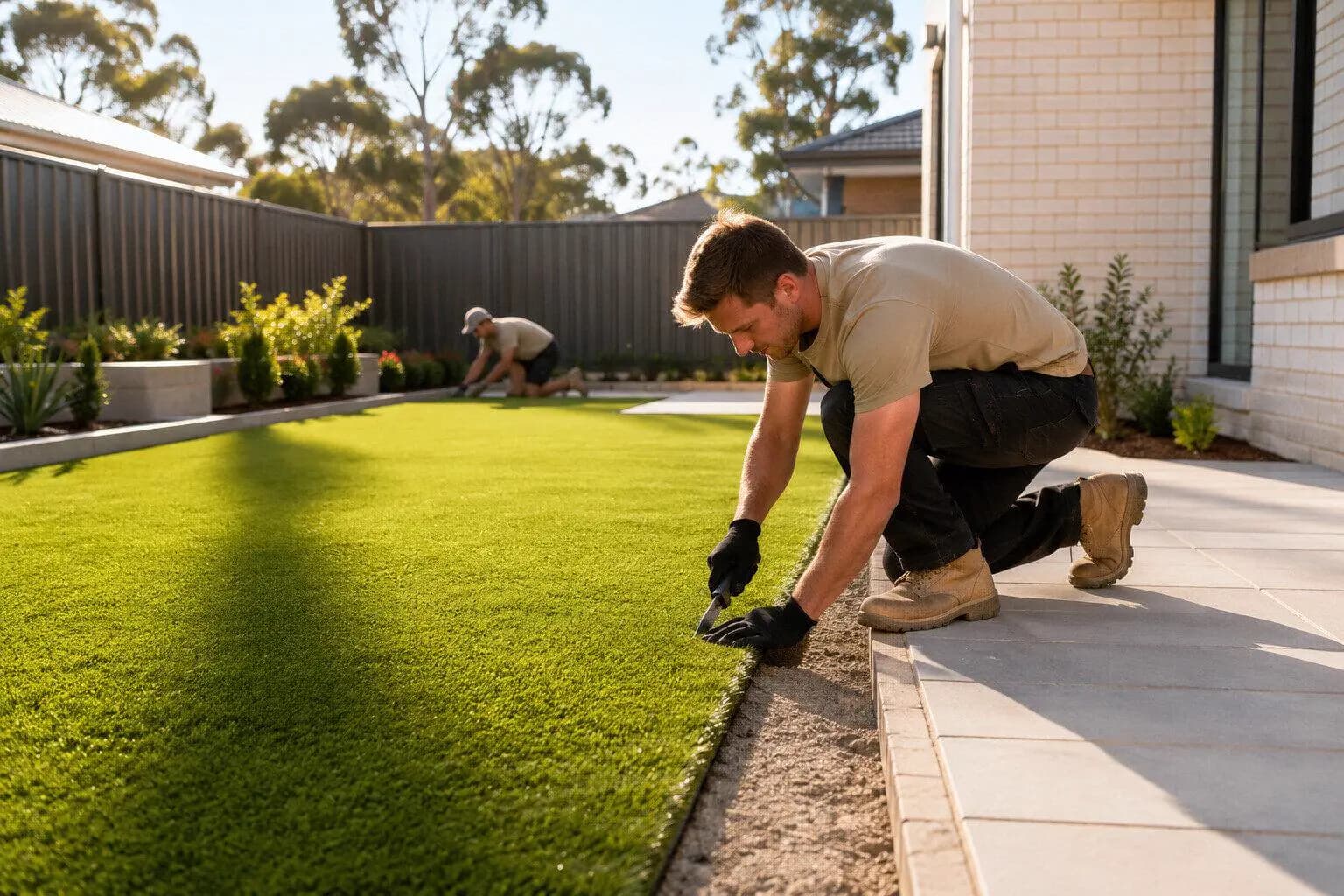
Booking software for synthetic turf installers in Australia.
A sample chosen, an area measured, and a spec sheet that still reads straight in ten summers.
 Start with Google
- Measure-ups booked online
- Turf ranges quoted as tiers
- Deposits cover the turf order
- Install dates that hold
Online booking
Measure-ups booked off the sample bag
Your page asks the area, the aspect and whether a dog lives there, so the visit starts as a spec conversation rather than a look around.
Learn moreSmart scheduling
The dig-out and the lay day, one job
Excavation, base and the lay sit on the same booking, so the crew compacting road base on Tuesday is not promised to a courtyard on Wednesday.
Learn moreOne lawn, three piles.
Same area, same base. A short hard-wearing pile for the dog, a softer mid pile for the kids, or a two-tone with thatch that passes for buffalo.
The square metres are the price
Area is a real pricing driver, so the number off the tape builds the supply and lay lines before you are back at the ute.
Spec, not adjectives
Pile height, stitch rate, infill and the pad each sit as a named option with its own price change, so premium means something on paper.
A number set once
The quote reference is fixed the moment it is issued, so the sheet they dig out in year six is unmistakably the sheet you sent.
Several options on one estimate is Pro
Pile height, infill and a shockpad each carry their own price change on the one document, so trading up is a tick rather than a second quote. Several named options on one estimate comes with Pro.
- Premium pile turf · 60m²Supply$2,400
- Ground prep & crushed-rock baseLabour$1,650
- Lay, join & sand infill1 day$1,350
When you are booked out to March.
Turf sells in the first hot week and the diary is gone by the second. A page with nothing free on it reads as a business that has shut.
The enquiry still lands
With no slots left the page takes a request instead of closing, and it arrives with the area and the photos already attached to it.
Give them a month, not a maybe
People will wait for the installer they picked. They would just like to know whether it is a fortnight or the other side of summer.
Back lawn is bare under the trampoline and mud the rest of the year. Roughly 70 by my count. Photos attached.
- Marco FerraroBooked just now$215Accepted
- Renee SalterOpened 2h ago$480Viewed
- The Oak CaféSent yesterday$120Sent
You can see them open it.
The quote goes out as a link and stamps the moment it is opened, which is the difference between chasing on a hunch and ringing the day after they read it. It carries an expiry, and they accept by typing their full name.
- 3 SepInstall complete · photos filedMid pile · sand infill
- 21 AugSpecification acceptedSigned · $5,400
- 14 AugMeasure-upRear lawn · shaded corner noted
- 3 SepBalance received$3,240
The property keeps the spec for a decade.
You are selling the next ten years, so the paperwork has to last that long. The measure, the accepted specification, the install dates and the photographs all file against the address rather than against whoever happened to sell it.
The measure-up books itself.
A visit worth driving to is one that already knows the area, the aspect and whether a dog lives there.
- Renee Salter2mCan you come Thursday instead?
- Bookables1hA booking request needs your answer
- Anna Whitfield3hRunning 10 late on the Balmain job
Everything asked between the sample and the last roll.
A turf sale is a fortnight of small questions: can you do the bit behind the shed, will it get hot in the sun, does the dog need a different infill. Each one keeps a thread against the job it belongs to, so the answer you gave on the phone is still there when the crew turns up.
Built for laying grass
Every lawn that is never going to grow
The back lawn the dog owns
Dirt since the second winter. Measured, priced off the square metres and signed inside the week rather than drifting into next season.
Pool surrounds
The strip that gets chlorine, bare feet and full sun quoted with a UV-stable pile and a free-draining base written into the lines.
Putting greens
A bespoke shape off the measure, with the fringe, the cups and the roll direction sitting as options the customer picks before you order.
Nature strips and verges
Small area, awkward access, council out the front. Quoted from the measure with the spoil run priced in rather than absorbed.
Courtyards and balconies
Single-day fits where the whole job is carrying rolls up a stairwell, so the access questions get asked on the booking form.
The shaded side return
The corner where nothing has grown since the neighbour built. The one job where the ten-year argument sells itself at the measure-up.
Childcare play areas
A pad under the turf and a fall height to hold. Both are options on the quote, so the centre sees what it is paying for.
Rooftop terraces
Weight, drainage and a crane or a lift. The visit is booked with the constraints already written down instead of discovered on the day.
Pet runs and kennels
A drainage backing and an infill that does not hold odour, quoted as the spec they are actually buying rather than as a grade name.
Display homes
A builder ordering the same spec across a dozen addresses, with every lot booked, priced and recorded against its own property.
Two crews, two days, one seam that has to be invisible.
Excavation and base go down one day and the rolls are cut, joined and pinned the next, by people who need to be the same people. One timeline shows both sets of hands across the week, so the day somebody quietly moves the layers onto another address is a thing you see rather than a thing you find out about at eight the following morning.
How far the pallets are worth carting.
Rolls are heavy and the base comes by the tonne. Mark the ground you cover once and the boundary decides what books itself.
Picked, not typed
You claim real areas straight off the map rather than keeping a list, and each one belongs to exactly one patch of yours.
The spoil run counts
A dig-out means a tonne of dirt going somewhere. The line you draw is about the round trip, not just the drive out.
Nothing extra for distance
The boundary only decides what books itself and what has to ask you first. It never quietly adds anything to the price.
- Surry Hills8 suburbs · 2 crew
- Paddington7 suburbs · 2 crew
- Sydney North7 suburbs · 2 crew
The week the rain moves.
You cannot compact a base in a downpour and you cannot lay onto a wet one. When the dig-out slides, the lay day has to slide with it.
Drag the pair, not the job
The address, the spec and the roll already on order stay attached. Only the dates move.
The crew sees it themselves
Whoever was on those days reads the change off their own list, without a message going out at half six.
Free on any plan
Moving work around the calendar was never the part you pay for.
Paid before you pack the trailer.
Most turf jobs still settle by transfer, and recording one costs nothing at all. Cards are the only part of money that sits on Pro.
Cash and transfer are free
Mark it paid and the receipt goes out on its own, with no plan involved anywhere in it.
Cards come with Pro
For the customer who would rather tap than go hunting for your BSB and account number.
Stages, after the booking
Pro splits a job into a leg when the rolls are ordered and the balance at handover. It happens on the booking, never at a checkout.
- Marco FerraroP-1011 · 25 Jun · Bank transfer$380
- Renee SalterP-1012 · 25 Jun · Cash$240
- Anna WhitfieldP-1013 · 28 Jun · Card$380
- Danny PrasadP-1001 · 27 Jun · Card$190
One app for the whole job
Everything you need to run your artificial grass business.
Starts free. Grows
only when you do.
Add your whole team and get booking for nothing.
As you grow with us you can go Pro.
Common questions.
Yes. Each spec is a named option with its own price change and its own duration, and you can flag the one you recommend. Several named options on one estimate is the Pro part; a single spec quote is free.
Yes. Area is a real pricing driver, so the number off the tape sets the supply and lay lines, and the pile, the infill and a shockpad sit on top of it as options rather than as separate quotes.
Yes. Your page shows genuinely free slots worked out from your hours minus what is already booked, and a mobile visit comes back with an arrival window rather than a morning. Confirmation emails are a switch you turn on.
It stays on the property. The measure, the accepted quote with the pile and infill on it, the install dates and the photos all file against that address, so a call in year six starts from the document rather than from memory.
Yes, and moving them is a drag rather than a rewrite. When the rain pushes the excavation, the pair goes with it and the spec, the address and the roll on order stay attached to the job.
Everything on this page runs on the Free plan except the three things named as Pro: several options on one estimate, staged payments, and taking cards. Cash and bank transfer recorded by hand cost nothing.