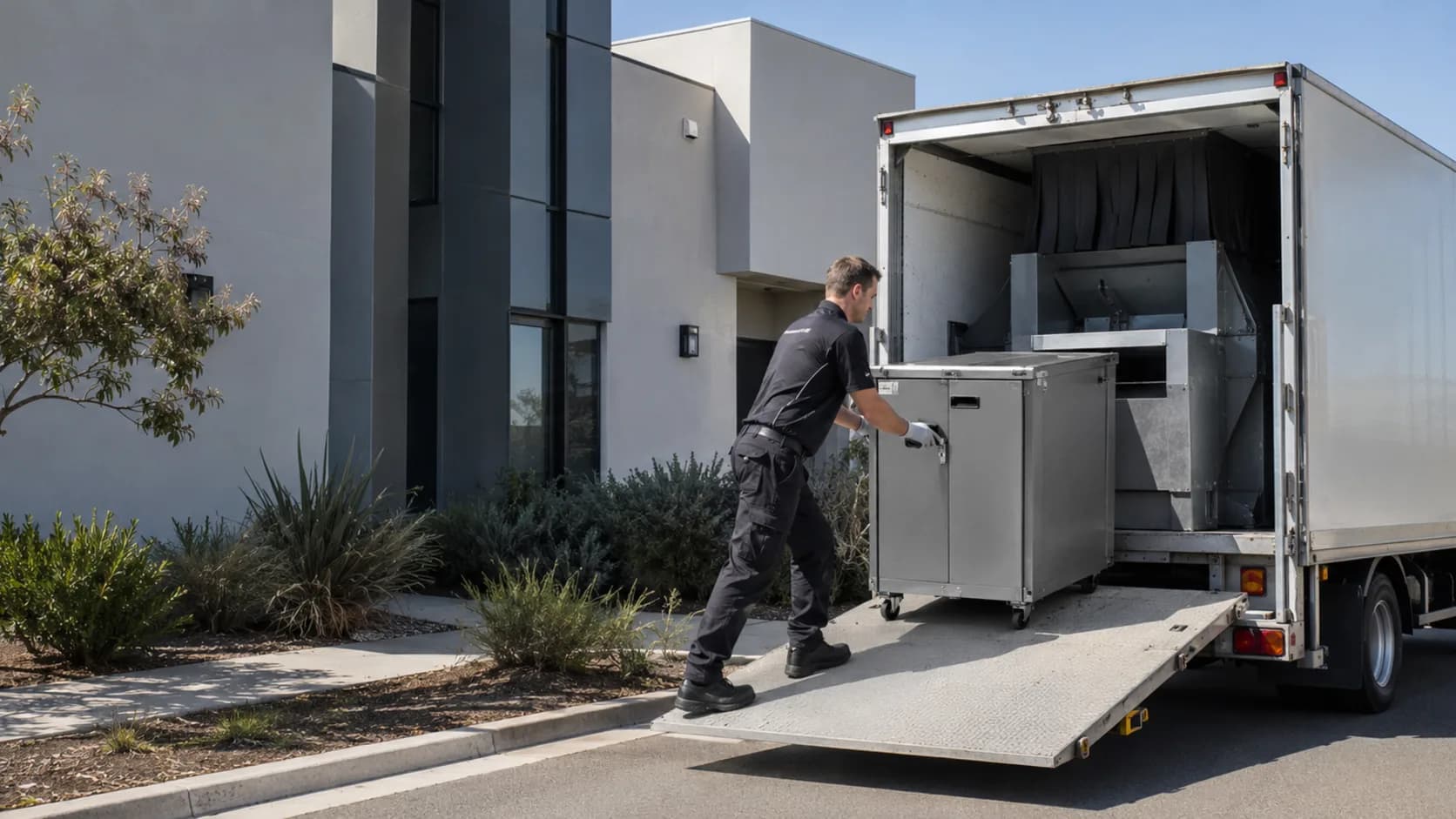
Booking software for mobile document shredding in Australia.
Bins are the unit, the loading dock has rules nobody told you about, and the certificate is the thing the client is actually paying for.
 Start with Google
- Priced per bin, with the count chosen at booking
- Dock hours, codes and escorts kept on the site
- Booked by reception, billed to accounts
- One-off purges priced apart from console swaps
Online booking
Sell the swap, let them pick the bins
A console round is work you can price unseen. Put the bin count on the form as an option and the total is settled before the truck leaves the yard.
Learn moreSmart scheduling
The dock shuts at three, so book around it
Dock hours, the goods lift cut-off and the escort contact sit on the site record, so the run is planned around the tower instead of discovered at it.
Learn moreThe collection that already carries a price.
Consoles beside the printers, tipped into the truck on site. Put the bin count on the form as a choice and the total is agreed before anyone drives.
The site record the whole run depends on.
Access hours, the entry code and who to ask for at the security desk live on the customer beside the address, so whoever attends next opens the job knowing them.
Two console rounds and a purge, on one board.
A twenty-minute job and a half-day clear-out are the same Monday. One board holds both, so a purge is never promised into an afternoon that was already spoken for.
The purge quoted at three depths.
Nobody knows what is in a records room until it is opened. Quote the boxes they flagged, the whole room, or the room and the offsite unit.
Bins, hours and access on their own lines
The office manager sees what the volume cost and what the after-hours access cost, so a query is about one line rather than the whole number.
Signed on their phone, booked on your board
They accept and sign online and the collection day lands in the diary, with the dock notes already attached to it.
Sent before you leave the loading dock
The quote goes from the phone while you are still standing in the basement, which is usually before the second quote has been rung for.
Access and witnessing priced as options · Pro
After-hours access, a security escort, hard drives pulled out of the store, destruction witnessed at the truck. Each carries its own price and moves the total when the client ticks it.
- Archive box purge20 bins$900
- After-hours escortBuilding requirement$60
- Certificate of destructionPer job$0
The goods lift is out on level nine.
Building management rings at eight. Move the collection to the next day the dock is free and the client knows before they book a meeting room.
Drag it to the next open dock
Pick the job up and drop it on a day that works. The board rebuilds around it and the collection keeps its notes and its history.
The reminder follows the job
Move the run and the reminder moves with it, so nobody is standing at a locked basement door on the old date.
Free on every plan
Moving your own work around your own day has never been the paid part and never will be.
Built for your trade
Built for the collections you actually run
Office console swaps
Locked consoles under the printers, emptied into the truck on site. A bin count, a published price and twenty minutes on the floor.
Records room purges before a move
Twenty years of archive boxes going at once because the lease is up. Quoted after a look, with the bins and the access hours on separate lines.
End of financial year clear-outs
The July rush when every office empties the store room at once. Repeat clients book the same week each year off their own card.
Medical practice destruction runs
Practices working to a retention rule who care more about the paperwork than the price. Every run stays filed against the practice.
Law firm file destruction
Closed matters coming out of the archive on a schedule. Booked as a standing job so the boxes never pile up in the corridor again.
Strata and building manager clear-outs
A basement store nobody has opened since the last committee. Quoted with the lift booking and the after-hours access priced in.
Hard drive and media destruction
Old laptops and backup tapes going with the paper. Added to the quote as its own line so the client can see what was covered.
Deceased estate and home office bins
One bin at a house after an estate is wound up. Small, one-off, booked online and paid by card before you pull the roller door down.
Uniform and branded stock destruction
Rebranded shirts and old signage that cannot go in a skip. Priced as an option on the run rather than quoted from scratch.
We are clearing the store room before the move, maybe fifteen boxes plus the two consoles on our floor. The office is in Surry Hills.
The truck is full until the tenth.
Purge weeks eat the diary. When there is nothing bookable this side of the month, the page says so and takes the job as an enquiry.
- Mason King · NewtownEmergency call-out · Wed · 3:30pm$180
- Ava Baker · Surry HillsCallout +1 · Wed · 1:00pm$560
- Grace Walker · SydneyRepair visit · Wed · 11:30am$120
- Amelia Ryan · NewtownSecond visit · Tue · 2:00pm$190
Published prices and quoted purges in one list.
A four-bin round taken off your page and a clear-out you priced after a look sit in the same list, with what it is, when it is and what it is worth on the row.
The record behind the certificate.
Nobody buys shredding, they buy evidence that a box of files is gone. Every collection stays on the client with its date and what went with you.
Filed against the client, not the job sheet
Rounds, purges and bin counts build up on one card, so an audit question in eighteen months is answered from a record rather than a memory.
The site history travels with the address
What was collected there last quarter is on the same card as the access hours, which is what a new driver reads before turning up.
It is why they stop shopping the price
A client who can answer their own auditor from your history has a reason not to move for a cheaper quote next year.
- 12 AugConsole round · 4 binsCompleted · $180
- 2 AugPayment received$960
- 24 JulRecords room purgeAccepted · $960
- 9 JunConsole round · 4 binsCompleted · $180
Reception books it, accounts pays it.
The person who arranged the collection almost never holds the card. Bill the accounts contact without making anyone chase a purchase order.
Cash and transfer cost nothing
Mark the collection paid when the transfer lands. Free on every plan and it will stay that way.
Cards come with Pro
Send a card link to the accounts inbox while the truck is still on the dock, and the receipt goes out on its own.
Split a purge across two requests
Ask for part at booking and the balance once the room is empty. Staged requests come with Pro and go out after the job is booked.
- Marco FerraroP-1011 · 25 Jun · Bank transfer$380
- Renee SalterP-1012 · 25 Jun · Cash$240
- Anna WhitfieldP-1013 · 28 Jun · Card$380
- Danny PrasadP-1001 · 27 Jun · Card$190
The towers you can get a truck into.
A basement with a two point one metre clearance is not your job. Draw what you cover and the form stops taking work you would have to hand back.
Your patch, your call
Mark out the suburbs the truck runs. An address past them is told at the form instead of a fortnight later on the phone.
Different areas for different work
A console round can cover the whole city while a one-bin residential job is limited to the suburbs on the way home.
Same rate right across it
Inside your area the price is the price. Bookables never quietly adds anything because the drive was longer.
- Surry Hills8 suburbs · 2 crew
- Paddington7 suburbs · 2 crew
- Sydney North7 suburbs · 2 crew
Starts free. Grows
only when you do.
Add your whole team and get booking for nothing.
As you grow with us you can go Pro.
One app for the whole job
Everything you need to run your document shredding business.
Common questions.
Yes. Put the bin count on the service as an option group: a four-bin console round, an eight-bin round, a full truck. Each choice carries its own price and moves the total the moment it is picked, so nobody argues on the floor about what "a few boxes" meant.
Take it as an enquiry and quote it after a look. Bins, on-site hours and building access go out as separate lines with a total under them, and when the office manager signs on their phone the collection day lands on your board without anyone typing it out again.
On the site, against the customer, once. Every later job at that address opens with them, which is the difference between a run only you can do and a run a driver can be sent on.
Take the booking from whoever rang, then send the payment request to the accounts contact on the customer. Cash and bank transfer you record by hand are free on any plan; card links come with Pro and the receipt goes out on its own.
Every collection stays filed against the client with the date, what was collected and what it cost. Bookables does not issue your certificate, but when their auditor asks under APP 11 the answer comes off a record rather than out of a memory.
Draw the areas the truck covers and set them per service. Residential one-offs can be limited to the suburbs you actually run, and an address outside them is told at the form rather than a week later.



Mobile Document Shredding guides
All articlesOnline booking vs phone booking: which one actually gets the job booked?
Compare online and phone bookings for service businesses, with a practical way to handle standard jobs, tricky enquiries and customers who prefer a call.
ReadHow to take bookings while you're doing the actual work
Set up online bookings around your services, prices, travel and availability so customers can book while you're busy doing the job.
ReadYour booking form is not a police interview: what should you actually ask?
Choose booking form questions that help you price, schedule and prepare for the work, without making customers complete an unnecessary questionnaire.
Read