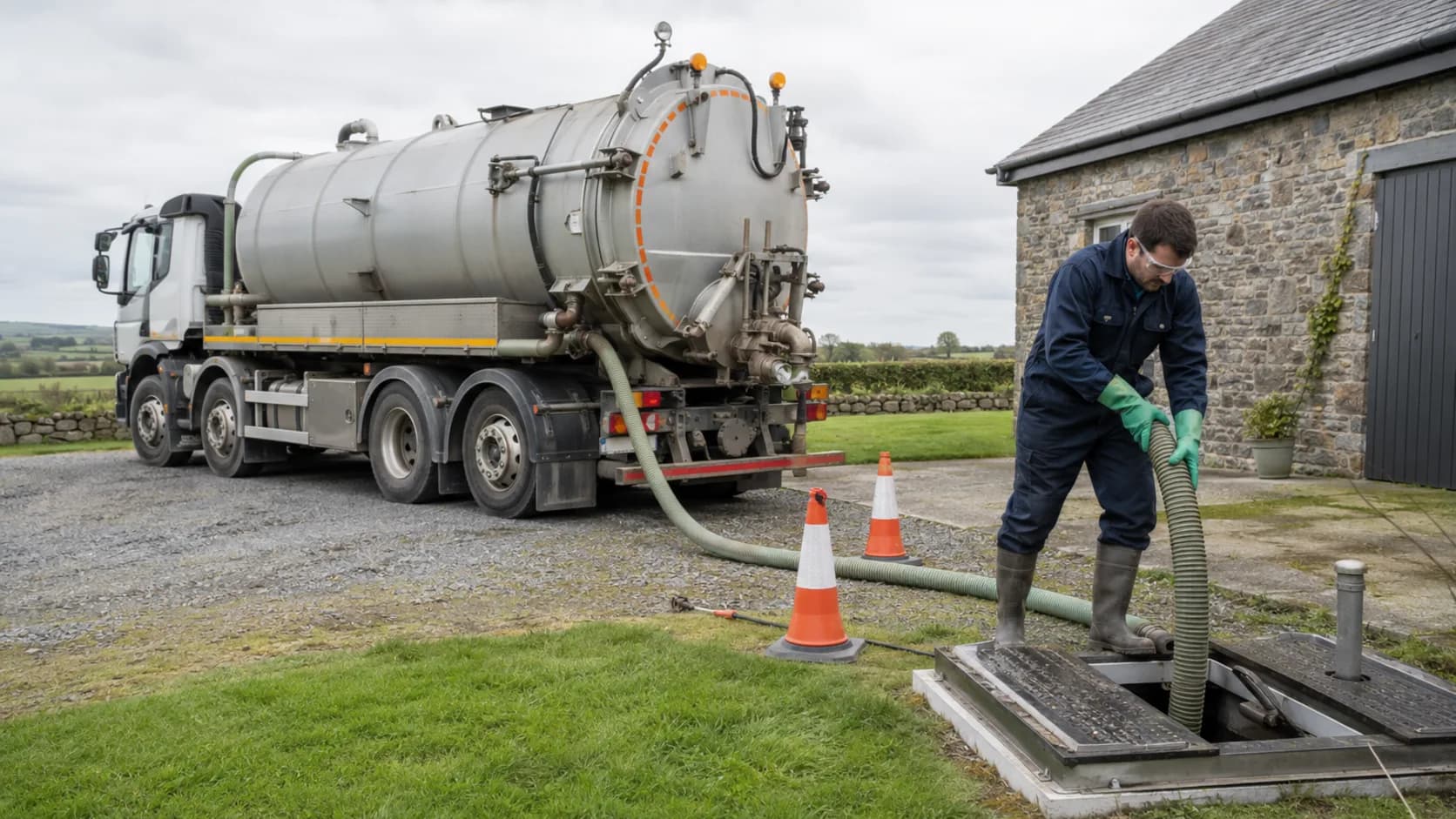
Booking software for septic and grease trap work in Ireland.
Two things end your day and a calendar knows about neither: the tanker fills, and the plant that takes the load shuts its gate. Build the round on those instead of on the order the calls came in.
 Start with Google
- The disposal run counted inside the job length
- After-hours slots for traps, daytime slots for households
- The day sequenced so the depot run lands before closing
- Tank size, lid location and last service kept on the site
Online booking
A gap you can genuinely fill
Houses go into the daytime, kitchens into the late hours, and the run to the plant is counted inside every job, so the tanker is never promised twice.
Learn moreSmart scheduling
A round that gets the load away
The work reads in driving order with honest lengths on it, so the last tank is a decision you make in the morning rather than a scramble at four.
Learn moreThe barrel decides when you finish.
Three large tanks and there is nowhere to put anything else. A fourth booking is not extra work, it is a phone call you make at two in the afternoon.
Count the run to the plant
If the duration is only the time at the cover, the calendar believes the barrel empties itself. Put the whole task in and the road is reserved along with the rest.
Move one, move the round
Push a desludge to tomorrow and the work behind it travels with it, with the driver seeing the change before you have finished the call.
Rearranging costs nothing
Shuffling the day is not a paid feature. What sits on Pro is the harder question of what deserves to go into the hole you have just opened.
Night traps, daytime tanks.
A kitchen cannot be pumped out during service and a household does not want you there at midnight. They are two different products, not one product with a note on it.
Two services, two sets of hours
Trap work carries its own availability, so a restaurant only ever sees the late slots and a homeowner only ever sees the morning ones.
The cycle books itself
Recurring visits are free on every plan. Set the interval once and the trap keeps landing on the calendar with its access time on it.
Each job as long as it really is
A level check is twenty minutes and a full tank is most of a morning. Duration is per service, so neither has to pretend to be the other.
- Mason King · RanelaghEmergency call-out · Wed · 3:30pm€180
- Ava Baker · DrumcondraCallout +1 · Wed · 1:00pm€560
- Grace Walker · DublinRepair visit · Wed · 11:30am€120
- Amelia Ryan · RanelaghSecond visit · Tue · 2:00pm€190
The tank is right up and there is a smell in the yard. It was last done about four years ago, I think. Anything today or tomorrow?
The tanker is spoken for until Thursday.
Being full is not a scheduling opinion you can argue with. What is worth fixing is that the asking keeps working while the answering waits its turn.
The one that booked itself overnight.
A household pump-out picked a slot at eleven at night, took the address and the tank details with it, and was on the run before you opened the laptop.
- 4 MarSeptic pump-outTank clear · baffle sound
- 4 MarReport sentAttached to the site
- 11 FebLevel checkNot due yet
- 2 SepLid raised to gradeNo digging next time
What you knew about that tank in 2023.
Where the lid is, whether it has to be dug out, what the baffle looked like last time and every visit since. Read before the truck leaves the yard, not after.
Every tank you empty
Built for households, kitchens and the ones that will not wait
Household tank desludging
The regular clean-out on a house off the public sewer. Daytime work, and always further down the boreen than the map suggested.
Restaurant grease trap servicing
Work that only happens after the kitchen closes. A separate service with its own hours, its own rate and usually its own account.
Treatment system servicing
The scheduled service on a small treatment unit. Quicker than a full desludge, priced as its own job, and due on a cycle owners forget.
Emergency overflows
A tank surfacing in the garden on a Sunday. It goes to the front of the round and everyone shifted behind it needs to hear about it.
Pre-sale tank reports
A desludge and an inspection before a sale closes, with something written the solicitor can hand on. Sent from the job, not typed up later.
Farmyard and holding tanks
Bigger tanks where the yard, the gate and the turning space decide the price far more than the volume in the tank ever does.
Percolation area investigations
The tank that keeps needing the tanker because the ground has given up. Quoted as a survey first, then whatever the survey finds.
Cafe and takeaway traps
Small traps on a tight cycle, where the whole value is arriving on the night you said you would, month after month.
School and community systems
Larger systems on a term cycle, invoiced to a committee that wants a numbered document with a date it can put in a folder.
Sludge level checks
The short visit that settles whether the tanker is needed at all. Booked, recorded and priced as the small job it really is.
- Drumcondra8 counties · 2 crew
- Clontarf7 counties · 2 crew
- Dublin North7 counties · 2 crew
The ground you will bring a tanker onto.
Ninety minutes for one household tank is the afternoon, not a job. That boundary is better decided once, calmly, than argued each time the phone goes.
Past your coverage. Decline politely, or make an exception.
The one that sits outside it.
Flagged before it is accepted, so the long haul is a decision you make in the morning rather than something you discover at the second gate.
Whether the hole is worth filling.
A trap cancels and eleven at night is suddenly free. That is either a bonus or an hour of empty road, and the difference is entirely geography.
Ranked by the road they add, with Pro
Each open slot is scored against the round already built, so what rises to the top of the booking page is what adds the least driving to it.
Promised work stays promised
Ranking chooses what to offer next and nothing more. It has no say over the order you have already given people times for.
- 1Septic pump-outRathmines09:00~9 min
- 2Septic pump-outRanelagh11:00~6 min
- 3Grease trap pump-outDrumcondra22:00
The tank is the symptom, not the fault.
Twice a year is the ground telling you about the percolation area. Put the desludge, the baffle and the survey on one document and let them decide.
Three answers on one quote, with Pro
Options on a quote come with Pro. They tick the outlet filter or the percolation survey and the total redraws itself in front of them, which is why the second quote never has to be written.
Every line does its own sum
Quantity against rate, line by line, so the desludge, the second chamber and the extra hose come to the same figure in a farmyard as they would at a desk.
Getting to the tank is work
Lifting a cover out of a lawn and running hose the length of a garden takes an hour of somebody. Named on its own line it reads as labour; folded into the total it reads as a markup.
A number that stays put
The document number is assigned once and then it is settled. A year later the quote and the invoice still point at each other, which is the only reason to number anything.
- Grease trap pump-outMonthly · after hours€420
- Disposal runIncluded in job length€0
- Compliance docketPer visit€40
Closed out at the tank, not by post.
Two customers with two rhythms: the household that wants it finished today, and the restaurant that runs on account. Both should end where the work ended.
Cash and transfer cost nothing
What came in is recorded against the job on any plan. The free tier has no business standing between you and payment for a tank that is already empty.
Cards are the Pro part
A link sent while the reel is still turning clears before you are out the gate, which beats carrying a terminal or leaving an invoice to age in the door pocket.
Bigger work, paid in parts
A percolation repair can ask for money in stages, on Pro. Those requests belong to the job once it exists, never to the moment a date gets picked.
- Aoife ByrneP-1011 · 25 Jun · Bank transfer€380
- Cian MurphyP-1012 · 25 Jun · Cash€240
- Niamh DoyleP-1013 · 28 Jun · Card€380
- Seán GallagherP-1001 · 27 Jun · Card€190
One app for the whole job
Everything you need to run your septic and grease trap work business.
Starts free. Grows
only when you do.
Add your whole team and get booking for nothing.
As you grow with us you can go Pro.
Common questions.
Give the service the length the job actually takes, disposal run included. The calendar reserves the whole block and refuses anything overlapping it, so the slot is never shown.
They can. Trap work and household tanks run as two services with their own availability, so a restaurant sees the late slots and a householder sees the morning ones.
Recurring bookings are free on every plan. Set the interval once and the visit keeps coming back on the calendar with its access time and its notes attached.
On the property. Tank type, where the cover is, whether the lane takes a full tanker, the last three visits and your notes on the percolation area, all in one record.
No. The permits and the inspection rules are yours to hold, and any software claiming otherwise is selling you something. What it keeps is a dated record per site with your files on it.
Cash and bank transfer are recorded by hand on every plan, free included. Card payments come with Pro, so a household desludge is settled before you leave the yard.





Septic & Grease Trap Pump-Out guides
All articlesOnline booking vs phone booking: which one actually gets the job booked?
Compare online and phone bookings for service businesses, with a practical way to handle standard jobs, tricky enquiries and customers who prefer a call.
ReadHow to take bookings while you're doing the actual work
Set up online bookings around your services, prices, travel and availability so customers can book while you're busy doing the job.
ReadYour booking form is not a police interview: what should you actually ask?
Choose booking form questions that help you price, schedule and prepare for the work, without making customers complete an unnecessary questionnaire.
Read