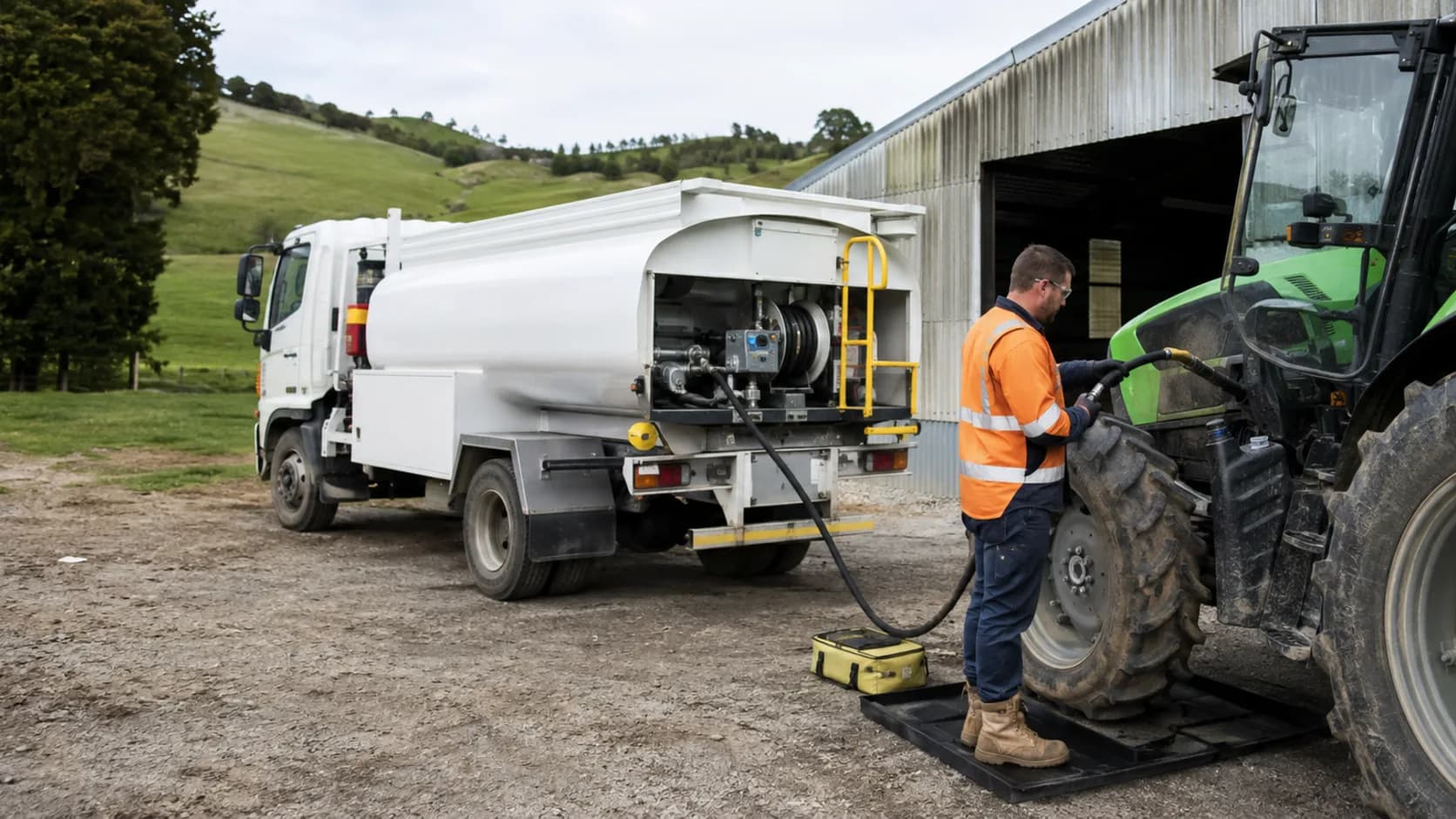
Booking software for mobile fuel delivery in New Zealand.
The shed tank runs dry on its own schedule and the price moved again overnight. The run still has to be up the road and back before the pumps are wanted.
 Start with Google
- A "from" figure and a callback, not a published rate
- Tank capacity, fuel type and fill point on the site
- Coverage drawn over the country you actually run
- The farm office billed while the manager books
Online booking
A standing drop beats a price list
The page takes the block, the product and the window and lands the enquiry with you. What it costs is yours to say on the day it goes on.
Learn moreSmart scheduling
Each drop carries its own hour
A duration and an address on every job, so a shed tank up a metalled road and a quick top-up in town are not the same block on the day.
Learn moreA number with a date, not a price list.
What you can commit to is a figure with litres behind it and a day it stops being true. Anything firmer is a promise the market will break.
It expires without you
Give it a valid-until date and it lapses on its own, rather than sitting in an inbox and being waved at you in a month’s time.
Litres are a line of their own
Quantity and rate sit on the document as one line, so the farm office can see exactly what makes up the number.
A yes turns into the drop
Accepting makes it a booking with the block, the product and the duration already on it, and the priced lines come across too.
- Bulk fuel deliveryVolume × rate$1,640
- Second tank, same visitVolume × rate$410
- Out of hours dropSite window$120
How far up the road you will go.
The drive is the cost in this trade. Where you will run should be a setting you made once, not a call you make at six in the morning.
Matched before it books
The address is checked against your areas before anything is accepted, so a small drop two hours out never confirms itself.
Outside them it waits
The far block is not turned away. It sits as a request while you weigh the litres against the road, which is the right order.
Areas sit with drivers
The coast and the inland runs are separate territories with separate names on them, so the truck already out there is offered it.
- Grey Lynn8 districts · 2 crew
- Devonport7 districts · 2 crew
- Auckland North7 districts · 2 crew
One invoice a drop.
Farm offices and site accounts settle against paper. Every delivery leaves its own document with the litres, the product and the date.
Cash and transfer are free
Write down what the office paid against that drop. That costs nothing on any plan and it never has.
Cards come with Pro
Send a payment request the account contact settles from the ute, and the receipt sends itself back.
It is your money, not ours
Card takings are paid out to your own Stripe account rather than sitting inside Bookables waiting on a cycle.
- Hemi WalkerP-1011 · 25 Jun · Bank transfer$380
- Sarah ColemanP-1012 · 25 Jun · Cash$240
- Mere SolomonP-1013 · 28 Jun · Card$380
- James FifitaP-1001 · 27 Jun · Card$190
We are down to about a quarter on the site tank and the crew starts at seven. Any chance of a drop tomorrow morning?
The call while you are on the hose.
A pump is down to the last of it and you have both hands full. That call should still land with the block and the product on it.
A record per site, not per customer.
One company can have four tanks in three places. Each address is its own record, holding the capacity, the fill point and where the truck has to stand.
- 2 JulTank top-upBooked · $1,180
- 18 JunPayment received$960
- 18 JunBulk fuel deliveryCompleted · $960
- 4 JunStanding drop quoteAccepted · $1,640
Every drop stays on the address.
What went in, when, and what the driver noted about the tank. The compliance question gets answered off a record instead of a folder in the cab.
Site windows move, and they move late.
Between the shift change and whatever the traffic plan allows, there is about an hour. Move the drop instead of ringing around.
Past your coverage. Decline politely, or make an exception.
The one past the end of the run.
A single drop a long way out is not automatically a no, but it should never book itself. It waits while you weigh the load against the road.
Built for your trade
Built for the tanks you actually fill
Dairy shed tanks
Diesel to the shed before the season gets busy, usually up a metalled road, usually needed before the next milking rather than next week.
Irrigation pump fills
A pump running flat out through a dry spell, topped up on a repeating drop rather than a phone call every time it gets low.
Frost fan season
Fans across a block fuelled before the cold nights, booked as a run of drops on the dates the forecast actually matters.
Forestry skid sites
Machines refuelled where they are working, up a track a truck has to be told about once and then never again.
Diggers on a civil job
Plant fuelled inside the hour the site gives you, between the toolbox meeting and whatever the traffic management plan allows.
Standby generator top-ups
Telecom huts and hospital tanks kept full, where getting through the access process takes longer than putting the fuel in.
Depot and fleet refuelling
A yard of trucks filled overnight on a standing arrangement so no driver starts the day queuing for a pump.
Marina and hardstand drops
Fuel down to a boat that cannot come to you, booked against a tide rather than a working day, and invoiced to the berth holder.
The tank that empties on a schedule.
Most of this work is not an emergency, it is arithmetic somebody keeps doing in their head. Set a standing arrangement on the site instead: weekly or monthly, a fixed day or a flexible one, ending on a date, after a set number of drops, or never. The visits are generated ahead, so the run already exists before the week starts and nobody has to ring to keep it going.
Starts free. Grows
only when you do.
Add your whole team and get booking for nothing.
As you grow with us you can go Pro.
One app for the whole job
Everything you need to run your mobile fuel delivery business.
Common questions.
No. Nothing here reads a wholesale market and nothing should pretend to. It carries the number you typed as litres times a rate on a quote with a date past which it lapses, and that is the honest version.
Yes, as a standing arrangement on that site. Weekly or monthly, a fixed day or a flexible one, ending on a date, after a set number of drops or never. The visits are built ahead so the run already exists.
On the block, not on the farmer. Each property is its own record with its own address, its own notes and its own delivery history, so a relief driver reads exactly what you would have told them.
You can. Coverage is claimed off official district boundaries, and an address outside them arrives as a request you weigh up rather than a booking that has already taken a slot.
It can. The drop records who asked for it and the payment request emails the account contact you nominate. Cash and bank transfer recorded by hand are free on any plan; card payments come with Pro.
That is what territories are for. Areas belong to people, so the coastal blocks and the inland ones sit with different drivers and the work is offered to whoever is already out that way.