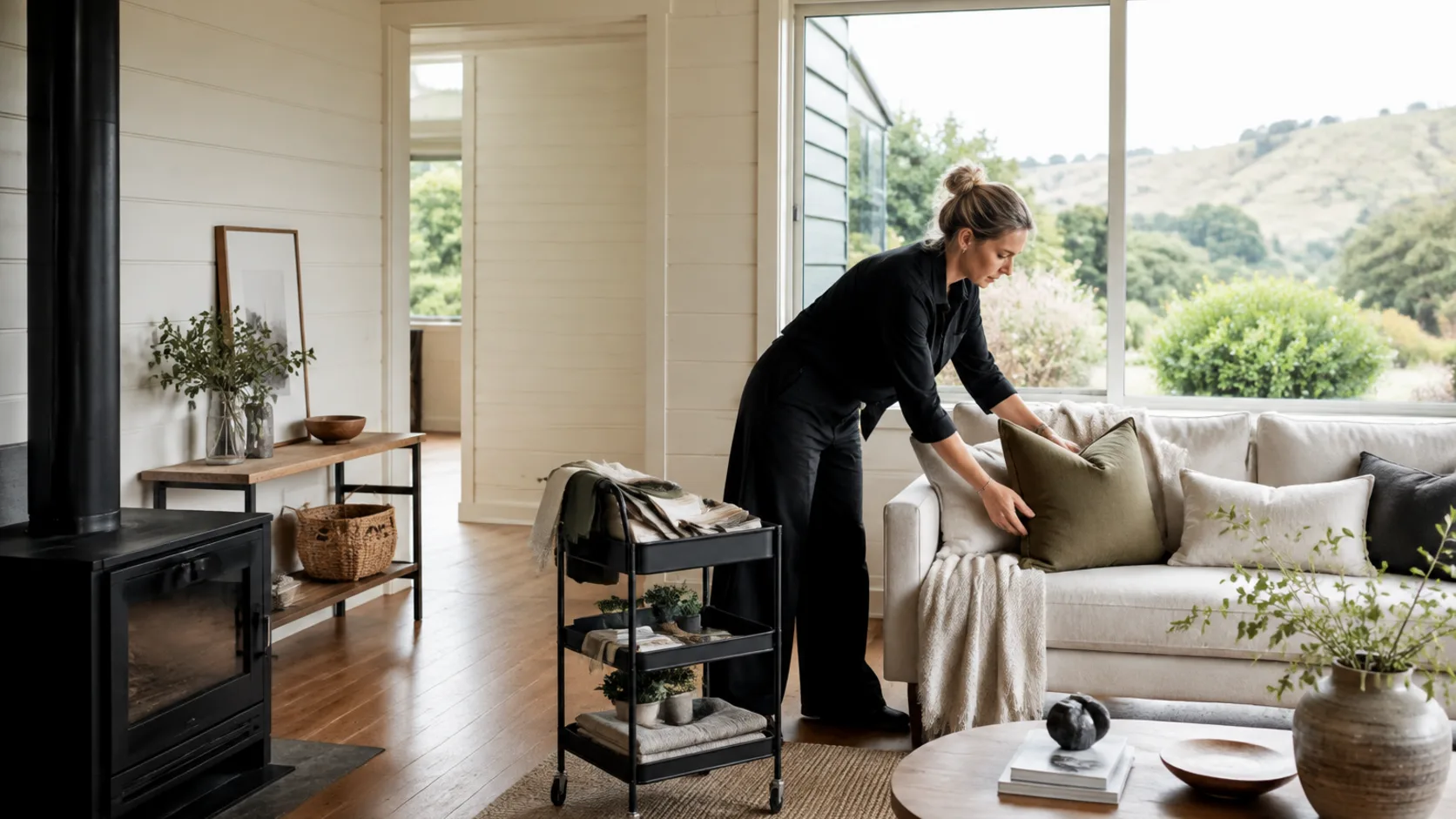
Booking software for home staging in New Zealand.
A four-week campaign priced as a period, the install and the uplift both booked, and the extra weeks charged when the property is passed in.
 Start with Google
- The hire period priced as a period, not a visit
- Install and collection as two booked crew days
- Stock committed to one property at a time
- An extension added as a priced period, not a favour
Online booking
Agents pick a time to walk it with you
The agent books a morning to go through the house. Quoting a staging still needs you in the rooms, so the walk-through books and the quote follows it.
Learn moreSmart scheduling
Install and uplift, booked on day one
Every campaign has two truck days weeks apart. Both go on the calendar when the job is won, so the uplift is a booking rather than a memory.
Learn moreThe hire, with a truck day at each end of it.
The furniture goes out for a period and comes back on a date somebody else's sale decides. Both truck days go on the board the day the job is won, so the collection is a booking rather than something you hope is remembered.
Whole house for a four-week auction campaign.
Three ways to stage the same listing: soft styling over what the vendor already has, the living areas and the main bedroom, or the house from empty.
Priced by the period, not the visit
Four weeks and six weeks are different numbers, because the hire is what you are selling. The dates you quote are the dates the job runs.
Room by room, so the vendor sees it
Beds, sofas, art and styling are separate lines, so when the agent asks you to bring the number down you both know what comes out.
Sent before you leave the drive
The quote goes from the phone while you are still parked out front, usually before the other stager has walked through it.
Extras priced as options · Pro
An art package, outdoor furniture, a fourth bedroom, another two weeks of hire. Each one moves the quoted total when the agent ticks it, so the vendor gets one number rather than a run of emails.
- Full-house styling4-week period$3,200
- Campaign extension+2 weeks$900
- CollectionCrew day$380
One office, six houses a year.
Almost every job arrives through an agent and is paid by someone who has never met you. Keep the office as the customer with each property as its own address underneath, so the whole relationship reads as one history.
The office is the customer
Every property you have dressed for them, what it was priced at and what is still out, on one card instead of in last year's emails.
The bill goes wherever it goes
Send the request to the office or to the person selling. Who books and who pays are two different people and always have been.
The property carries its own detail
Access, the lift window and the pieces you are dressing around live on that address, not in the head of whoever did the last one.
- 21 AugFull house, installBooked · $3,200
- 18 AugHire extension, 2 weeksInvoiced · $900
- 4 AugPartial styling quoteAccepted · $1,450
- 29 JulCollection, two moversCompleted · $380
Built for your trade
Built for the properties you actually dress
Whole-house staging for an auction campaign
An empty villa dressed before the first open home and uplifted after the deal goes unconditional, priced across the campaign rather than by the day.
Partial staging over the vendor’s furniture
They are still in the house and you are adding beds, art and soft styling. A shorter list, a smaller truck and a very different price.
Apartment with a booked service lift
The body corporate runs the lift in two-hour blocks. The install has to sit inside that window, so the window is on the booking.
Show home for a group builder
A staging that stands for months while the stage sells, then moves to the next release. A long hire with a known uplift at the end.
Extra weeks when it is passed in
The campaign runs on and goes to negotiation. Move the uplift, add the extra hire as its own priced line, and the agency is emailed the new date.
Estate clearance, then a staging
The house is emptied before the furniture goes in. Two crew days against one property, each with its own hours, both on the same job.
Restage for a relaunch
The first campaign missed and the agent wants it looking new. A short crew visit against furniture that is already in the house.
Uplift the week after it settles
A truck, two movers and a bay at the warehouse booked for the morning, so the stock is back on the floor and quotable again.
Art and cushions only
A styled bench, art on the walls and soft furnishings for a townhouse that already photographs well. An hour, and it books like an appointment.
Empty four-bed in Mount Eden going up next month. Can you dress it for six weeks from the 15th?
The best of the stock is already out.
Staging runs out of furniture well before it runs out of days. When nothing is free for those weeks, the page says so and still takes the enquiry.
- Mason King · Mount EdenEmergency call-out · Wed · 3:30pm$180
- Ava Baker · Grey LynnCallout +1 · Wed · 1:00pm$560
- Grace Walker · AucklandRepair visit · Wed · 11:30am$120
- Amelia Ryan · Mount EdenSecond visit · Tue · 2:00pm$190
A week of installs, collections and one restyle.
Four properties dressed, two coming back and a relaunch squeezed between them. One list, with the crew and the address on each, so the truck is loaded once for each of them.
It is passed in and the uplift moves.
Campaigns move. Drag the uplift to the new week, add the extra hire as a priced line, and the agency is told the date that changed.
Drag it to the new week
The uplift moves on the board and the job keeps its history, so the extension is a decision rather than something you find at month end.
Extra weeks are a line, not a favour
Add the fortnight to the job as its own priced line, so it turns up on the invoice instead of sitting in your head until you forget it.
The agency hears it from the job
The office is emailed the new uplift date when it moves, which saves the call you would otherwise make on Friday afternoon.
Paid before the truck loads.
Staging is furniture handed to someone you have never met for a month. Record cash and transfers by hand for nothing, or take cards on Pro.
Cash and transfer are free
Mark the job paid when the transfer lands from the vendor or the agency. That costs nothing on any plan and always will.
Cards come with Pro
Send a card link for the staging and another for the extra weeks, so it is settled before the truck leaves the yard.
Split it across the campaign
Ask for part when the job is booked and the rest at uplift. Staged requests come with Pro and go out after the booking, not at checkout.
- Hemi WalkerP-1011 · 25 Jun · Bank transfer$380
- Sarah ColemanP-1012 · 25 Jun · Cash$240
- Mere SolomonP-1013 · 28 Jun · Card$380
- James FifitaP-1001 · 27 Jun · Card$190
How far a loaded truck goes.
A full load has a sensible radius, and past it a two-truck job stops paying. Set the areas you cover and the page keeps to them.
Draw the patch around the warehouse
An address outside it is told straight away, rather than a week out from the first open home when the truck is already booked.
Second warehouse, second patch
If you hold stock in two sheds, each keeps its own area and the job falls to the shed that has the furniture in it.
Same rate right across it
Inside your area the price is the price. Bookables never quietly adds anything because the run happened to be longer.
- Grey Lynn8 districts · 2 crew
- Devonport7 districts · 2 crew
- Auckland North7 districts · 2 crew
Starts free. Grows
only when you do.
Add your whole team and get booking for nothing.
As you grow with us you can go Pro.
One app for the whole job
Everything you need to run your property styling business.
Common questions.
Yes. The job runs across the whole hire and is priced by it, so a six-week campaign and a three-week one are different numbers rather than the same fee with a later end date.
Move the uplift to the new week on the board and add the extra hire as a priced line on the same job. The agency is emailed the new date and the extension is on the invoice.
They can, and it is the only way to see your real truck load. Each is its own booking with its own hours and crew, both sitting against the same property.
Not if you set the staging set up as a bookable. Overlapping bookings against the same one are rejected at the database, so it is stopped rather than found on install morning.
Yes. Keep the agency as the customer with each listing as its own address underneath, then send the payment request to whoever is paying. Everything you have staged for that office stays in one place.
That depends on your turnover and your registration, not on us. Turn tax on per service and the rate is applied and shown on the quote and the invoice.





Property Styling & Home Staging guides
All articlesOnline booking vs phone booking: which one actually gets the job booked?
Compare online and phone bookings for service businesses, with a practical way to handle standard jobs, tricky enquiries and customers who prefer a call.
ReadHow to take bookings while you're doing the actual work
Set up online bookings around your services, prices, travel and availability so customers can book while you're busy doing the job.
ReadYour booking form is not a police interview: what should you actually ask?
Choose booking form questions that help you price, schedule and prepare for the work, without making customers complete an unnecessary questionnaire.
Read