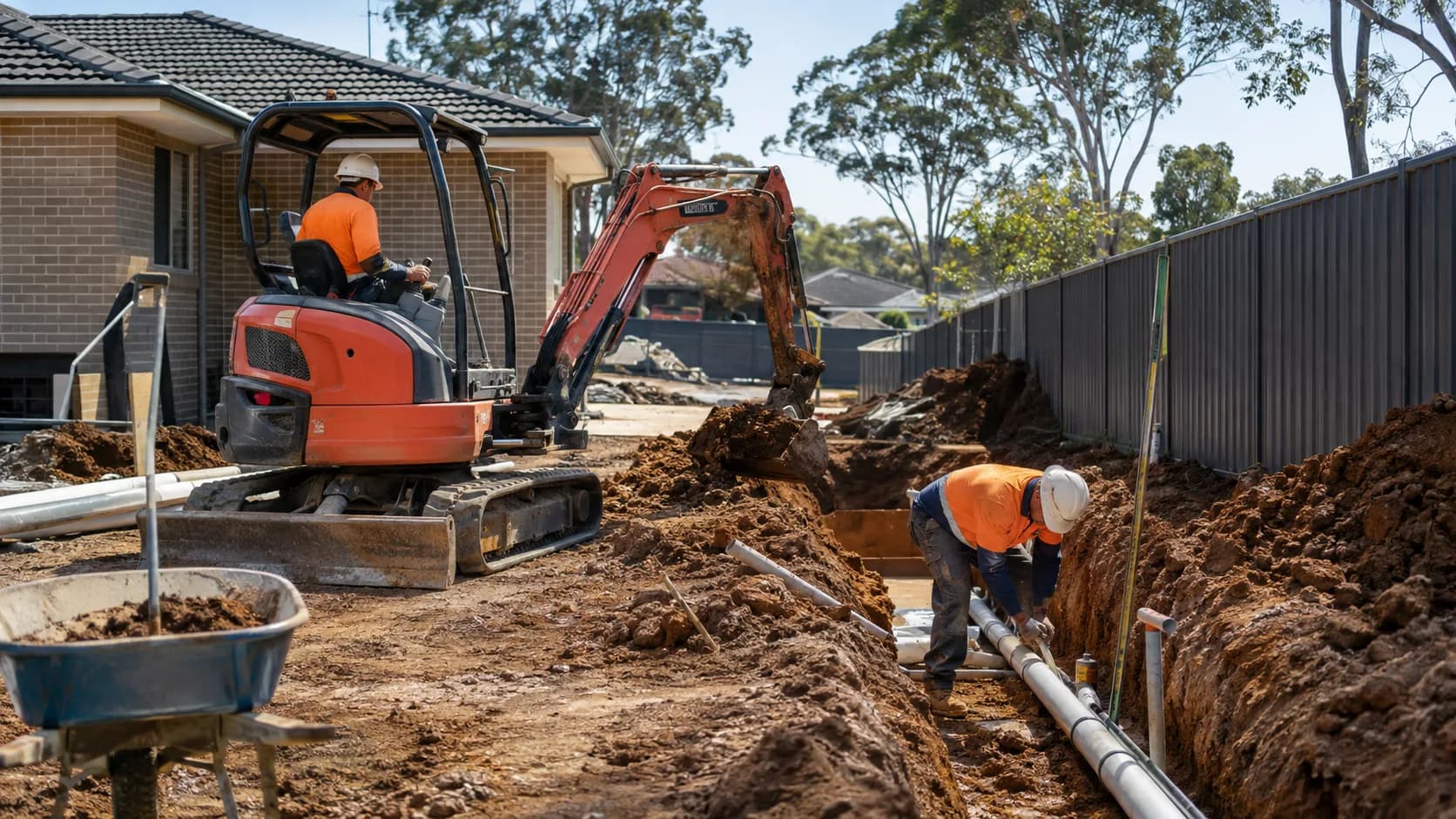
Booking software for excavation and earthmoving in Australia.
Price the dig after you have stood on the block, get it signed before the machine moves, and run the operators, the floats and the wet days off one week.
 Start with Google
- Site walks booked while you are still in the seat
- Two machine sizes priced side by side on one quote
- Signed quotes become booked machine days
- Move a wet dig and the crew moves with it
- Free, up to 200 bookings a month
Online booking
Site walks booked while you are in the seat
Builders do not ring back. Your own page takes the block address and the scope, and puts the walk in your diary while you are still on site.
Learn moreSmart scheduling
Machines, operators and floats on one week
Every excavator, every site and every float-on in one view, so the day the 5-tonne is booked twice shows up before the operator rings.
Learn moreNobody takes a call from the excavator seat.
You are in ear muffs with a bucket in your hands all day, which is exactly when builders ring. The ones who do not leave a message ring the next mob.
The enquiry waits, the builder does not
A page that takes the block address and the scope means the job is still there at five, written down, instead of a missed call you cannot place.
A walk, not a dig
What gets booked online is the site visit. The price is still yours to write once you have seen the ground, which is the only honest way this trade quotes.
Need a price on the site cut and the footings. There is a fair bit of fill across the back of it.
One block, two machines, two prices.
The builder wants to know if the cut is a week or a fortnight. Put both machines on one page with the cart-away under each and let them pick.
Two machines on one quote, with Pro
Machine size, rock and whether the spoil stays on site are option groups, so ticking cart-away moves the total on screen while the builder is reading it. Options on a quote come with Pro.
Machine days do the arithmetic
Put the days against the machine rate and the quote adds up the same on the tailgate as it would at the desk at eight that night.
Cart-away is its own line
Loads and tip fees sit apart from the digging, so nobody looks at one number and decides the excavator cost twice what it did.
The quote keeps its number
Document numbering is set once and does not move, so the quote the builder signed and the invoice you send later point at each other.
- Machine float on & off siteMobilisation$680
- Bulk cut · 5t excavator2 days$3,400
- Cart away spoil · 8 loadsTip fees$1,760
The quote a builder is sitting on.
A dig is priced against two or three others and nobody rings to say so. Knowing yours was opened twice on Thursday is the difference between a follow-up and a nag.
Sent, viewed, accepted
Every quote says which of the three it is and when it was last opened, so the ones worth a call on Friday are obvious.
Accepted becomes machine days
The moment it is signed it converts into a booking, so nobody re-types a site cut into the calendar at nine at night.
An expiry, because tip charges move
Put a date on the quote and a rate you wrote before the wet season cannot be held against you after it.
- Marco FerraroBooked just now$215Accepted
- Renee SalterOpened 2h ago$480Viewed
- The Oak CaféSent yesterday$120Sent
Every dig you take on
Built for site cuts, footings and everything trenched around them
Site cuts for a new build
Quoted in machine days after the walk, with the levels and the fall noted on the job, and booked the day the builder signs.
Footing and pad trenches
Booked with honest durations so the steel fixer is not standing at a half-dug trench on a Tuesday morning.
Driveway cut and fill
The small jobs that pay for the float, priced off area and days and slotted between the big digs.
Stormwater and sewer trenching
Quoted per run with the connection and the backfill as their own lines, so nobody thinks the pipe cost what the digging did.
Retaining wall excavation
Its own package with an expiry on it, because a rate you wrote in autumn should not be held against you in spring.
Cart-away and tip fees
Loads and tip fees itemised separately from the machine, which is what stops a variation turning into an argument.
Shed and slab pads
Level, compact, done in a day. Booked off the page with the address attached and paid before the float leaves.
Site clearing and grubbing
Trees, stumps and rubbish quoted as one line with the loads under it, so the builder sees where the money goes.
Wet weather reshuffles
A soggy Monday dragged to the next dry day, taking the operator and the truck with it instead of scrambling the fortnight.
- Renee Salter2mCan you come Thursday instead?
- Bookables1hA booking request needs your answer
- Anna Whitfield3hRunning 10 late on the Balmain job
Everything you need before the bucket goes in.
The utility plans, the drainage layout, the levels and the builder's programme all arrive in different places and end up on a phone. Kept in one thread against the job, they are still there on the morning of the dig.
- MarSite cut and level3 machine days
- JunFootings and service trenchQuote accepted
- JunPaid in fullBank transfer
The builder you dug three sites for.
Repeat work is most of this trade, and the second job always starts with someone trying to remember what you charged for the first. Every quote, dig and payment stays on the one record.
One week, every operator and every machine on it.
A dig runs long, an operator is on a second site by Wednesday, and the truck is booked against both. Laid out on one timeline, the day that does not add up is visible on Friday instead of at seven on Monday morning.
A wet week you can move in one go.
Clay does not care about your programme. When the site is under water the dig moves, and so do the truck, the operator and the bricklayer behind you.
Drag the dig, take the crew with it
Everything attached to that job moves at once. One drag beats four phone calls made from the side of a road.
The crew sees it change
The new start is on their phones straight away, so nobody drives an hour to a site that got stood down last night.
Free on every plan
Moving work around the week costs nothing. Automating what fills the gap is the part that sits on Pro.
The blocks a float will actually reach.
Putting a machine on a float costs you before it turns a bucket, and the further out the block, the more of the week it eats. Draw the line once.
Draw it, do not describe it
Suburbs and shapes on a map, not a paragraph on a contact page that nobody reads before they book.
Outside still gets to ask
A job past the line lands as an enquiry rather than a booking, so the big one up the highway is still yours to say yes to.
- Surry Hills8 suburbs · 2 crew
- Paddington7 suburbs · 2 crew
- Sydney North7 suburbs · 2 crew
Paid before the machine is back on the float.
Builders pay on their terms, not yours, and every week you leave it is another week the tip fees sat on your card.
Cash and transfer are free
Record what landed against the job on any plan. Nothing about the free plan stops you taking money for a dig.
Cards come with Pro
Send the link while the site is still being raked off and watch it clear, instead of posting an invoice into a site office.
Staged, when the job earns it
The float-on and the finished dig can carry their own payment requests on Pro. They sit after the booking, never at the point somebody picks a date.
- Marco FerraroP-1011 · 25 Jun · Bank transfer$380
- Renee SalterP-1012 · 25 Jun · Cash$240
- Anna WhitfieldP-1013 · 28 Jun · Card$380
- Danny PrasadP-1001 · 27 Jun · Card$190
One app for the whole job
Everything you need to run your groundworks business.
Starts free. Grows
only when you do.
Add your whole team and get booking for nothing.
As you grow with us you can go Pro.
Common questions.
You do not, and the software does not pretend otherwise. The online page books the site walk, not the dig: it takes the block address, the rough scope and a date. You stand on the dirt, build the quote from machine days, cart-away and float, and send it from the same job.
Quote it before you find it. Rock, made ground and a second machine can each sit on the quote as an option the builder ticks, so the price moves in front of them instead of turning into an awkward call from the site. Options on a quote come with Pro.
No. Before You Dig Australia is a free service you lodge yourself, and nothing here changes that. What Bookables does is keep the plans that come back, the drainage drawing and the builder’s programme in one thread against that job, so the day you dig you are not searching an inbox for a PDF from three weeks ago.
Drag the dig to the next workable day. The operator, the truck and the float-on move with it and the crew see the new time on their phones before you have put yours down. Moving work around the week costs nothing on any plan.
Draw the areas you will float a machine to and the booking page holds the line. Anything outside can still send an enquiry, so a job worth the trip is a decision you make rather than one you miss.
No. Cash and bank transfer are recorded by hand on any plan and that costs nothing. Cards come with Pro, and so do staged payment requests, which go out after the booking exists rather than at the moment somebody picks a date.

Excavation & Earthmoving guides
All articlesOnline booking vs phone booking: which one actually gets the job booked?
Compare online and phone bookings for service businesses, with a practical way to handle standard jobs, tricky enquiries and customers who prefer a call.
ReadFully booked? How to keep the lead without promising the impossible
Handle enquiries when your diary is full with clear requests, alternative times and a practical manual waiting list that avoids double bookings.
ReadBooking deposits: enough to make it real, not a hostage negotiation
Choose booking deposits that fit your work, explain the balance and cancellation terms, and understand how deposits differ from refundable security bonds.
Read