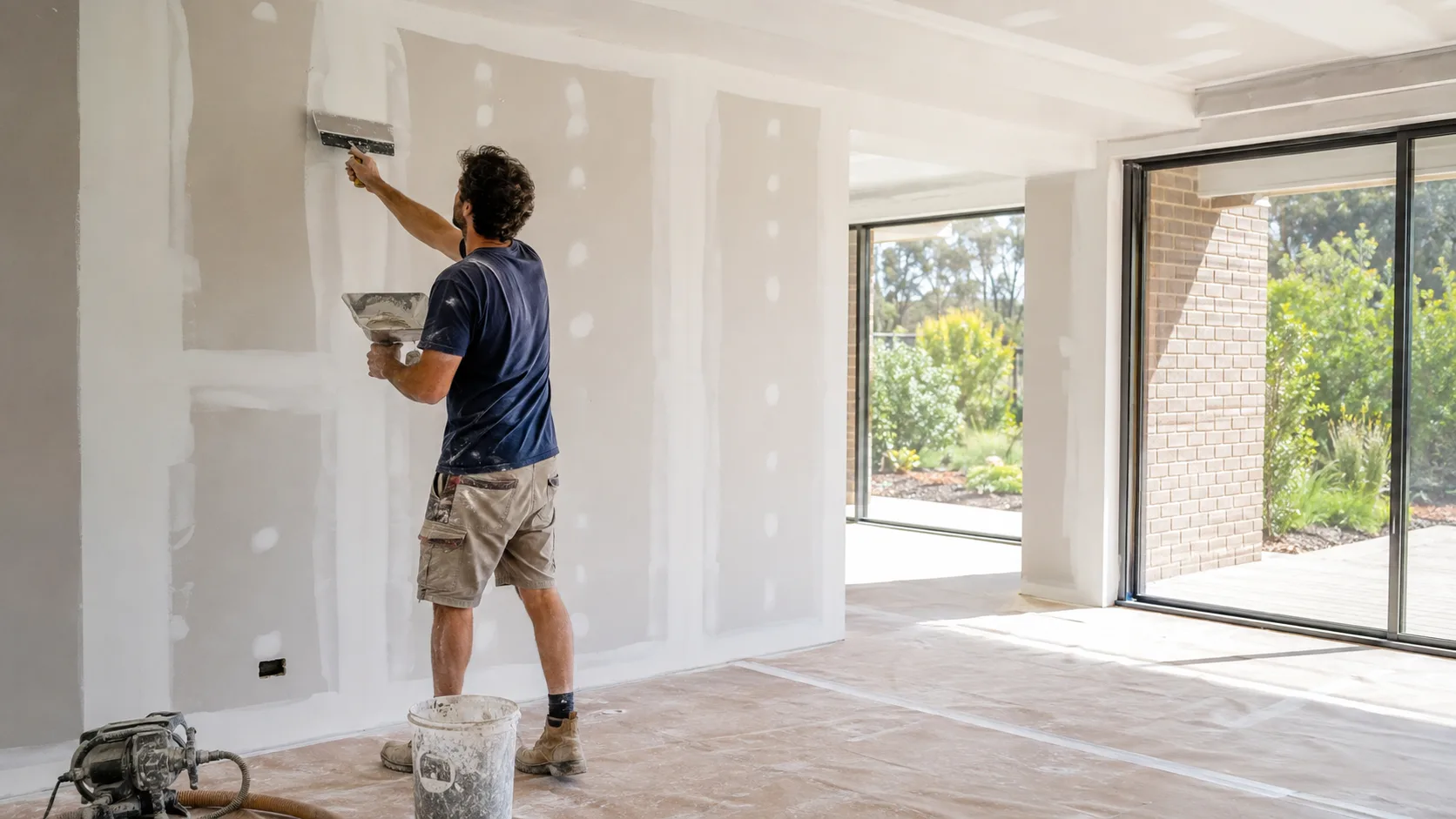
Booking and quoting software for plasterers in Australia.
From the first photo of a cracked ceiling to the sand and the final coat of the invoice, the whole job lives in one place.
 Start with Google
- Patch and repair jobs booked online
- Rooms quoted with online acceptance
- Return coats planned by drag
- Confirmations and reminders on autopilot
Online booking
Patch jobs and measure-ups book themselves
Most plastering starts with a look. Put the measure-up on your page with a real duration and let people take a slot while you are up on the trestles.
Learn moreSmart scheduling
Board, set and sand days that do not collide
A room gets lined, stopped, sanded and painted in that order, and the gap between coats is fixed. Give every stage its own duration on one calendar.
Learn moreBuilt for your trade
From a patch round a light switch to a whole house of walls and ceilings
Ceiling repair after a leak
The most common callout there is. Books as a short job with photos on the thread, priced by room, and the insurer gets a quote, not a text message.
Full house wall and ceiling lining
A new build or a big extension is a run of days, not a booking. Set it out board, stop, sand, and each stage carries its own duration and its own crew.
Overskim on tired walls
Priced by square metres or by room, with the finish level as an option. The customer sees what Level 5 adds before they agree to it, not after.
Cornice replacement
Profile is the whole conversation. Make it an option group with the price difference on each, so a 90mm cove and an ornate profile are not the same job.
Solid render on a new fence or blockwork
Wet work, weather dependent, priced by area. Sits on the calendar with enough duration to actually cure, and moves as a block when the rain comes.
Texture coat and finish
Sold as an option on the render service rather than a separate quote, because it is the same trip and the same scaffold.
Patch and make good after the sparky
Small, fast, and the job that ruins a day when it is booked badly. Give it a real duration and let it book straight in from your page.
Popcorn and stipple ceiling removal
Priced by room, with the make-good and the re-set as their own lines so the customer can see why it is not a morning.
Wet area sheeting before tiling
Booked to land between the plumber and the tiler. Everyone on that job sees the date move when it moves.
Arches, bulkheads and plaster mouldings
The work that needs a real look before a number. Books as a measure-up, comes back as an estimate with its own lines.
What the job carries before anyone loads up.
Room count, finish level, the profile to match, where the water is and how to get in. On the job when you take it, not remembered on the drive over.
- Renee Salter2mCan you come Thursday instead?
- Bookables1hA booking request needs your answer
- Anna Whitfield3hRunning 10 late on the Balmain job
The photos, the dust question and the yes, all one thread.
Half of plastering is quoted off pictures of a stain on a ceiling. Those pictures belong on the job, not three screens deep in a phone.
- 21 AugUnit 6, walls and ceilingsBooked · $2,150
- 9 AugUnit 5, ceilingsPaid · $1,340
- 1 AugTrim profile, units 5-8Accepted · $980
- 18 JulUnit 4, make goodCompleted · $420
The builder who is eleven rooms deep.
One customer, a long run of jobs and a payment history worth keeping, instead of eleven separate searches through last year's messages.
Re-skinning a room, quoted three ways.
Nobody wants one number for "plastering". They want patch and make-good, a full overskim, and stripping the lot to re-line. Build three tiers.
Square metres or rooms, your call
Price the way you already quote. Area works for walls and ceilings, rooms works for a re-skim, hours works for patch and make good.
The finish level is an option, not an argument
Level 4 and Level 5 sit as choices with a price difference on the higher one, so it is agreed in writing before the first coat.
Accepted online, on the record
They accept the estimate from the link. The job carries what they agreed to, which is the version that matters when the painter complains.
Extras priced as options · Pro
Pro adds the extras that ride on top: cornice profile, Level 5 finish, waterproof board in the wet areas, rubbish removal. Each carries its own price difference, so the total moves as they tick.
- Plaster & materialsSupply$260
- Prep & set-outLabour$340
- Skim & two coats6 hrs$680
When the weather moves the run.
Render will not go on in the wet and set will not sand before it dries. Every plasterer loses days to that, and the cost is the ringing around afterwards.
Drag it and it is done
Move the job on the calendar and the customer and the crew both know. Free, on any plan.
The whole run moves together
Push the boarding and the stopping behind it goes with it, instead of leaving a gap you find on Thursday.
Nobody has to be rung
The notification does the awkward part. You get on with the next room.
Booked out until the middle of next month.
Good plasterers always are. The page should say so rather than take a booking you cannot honour, and it should still catch the person who is happy to wait.
The page shows what is actually free
Slots come off your calendar, so nothing gets booked into a week you have already given to a builder.
Full does not mean gone
When there is nothing left they can still send the photos and the address, and it lands in the inbox as an enquiry rather than a missed call.
Quote now, book later
An estimate can go out and be accepted before there is a date on it. The date follows when the run in front of it clears.
Ceiling in the back bedroom has come down after a leak. Photos attached, is there anything before the end of the month?
Paid before you wash the tools.
Plastering money is usually a progress claim to a builder or a lump on completion. Both are easier when the invoice is already sitting on the job.
Cash and transfer, free
Record what landed by hand and the job closes. No plan required, no cut taken.
Cards come with Pro
A link on the invoice instead of a phone call two weeks later. That part is the paid plan.
Staged, when the job is staged
A big lining job can be billed in stages after the booking exists. Nothing is taken at the moment somebody books.
- Marco FerraroP-1011 · 25 Jun · Bank transfer$380
- Renee SalterP-1012 · 25 Jun · Cash$240
- Anna WhitfieldP-1013 · 28 Jun · Card$380
- Danny PrasadP-1001 · 27 Jun · Card$190
The suburbs worth the drive.
A sheet of board in the ute and an hour of freeway is the difference between a good day and a bad one. Say where you go once, not per enquiry.
Draw it, do not describe it
Mark the suburbs you cover. Anything outside gets told plainly instead of booking and then being cancelled.
Different crews, different patches
The solid render crew and the lining crew rarely work the same ground. Each can carry its own area.
What you will not do
Heritage lime work, three-storey render without scaffold, whatever it is. Better said on the page than on the phone.
- Surry Hills8 suburbs · 2 crew
- Paddington7 suburbs · 2 crew
- Sydney North7 suburbs · 2 crew
Starts free. Grows
only when you do.
Add your whole team and get booking for nothing.
As you grow with us you can go Pro.
One app for the whole job
Everything you need to run your plastering business.
Common questions.
It depends on the state and on the work. Queensland issues two separate QBCC trade classes, Plastering drywall for wall and ceiling lining and Plastering solid for render, float and set and texture coats. NSW issues Dry plastering work and Wet plastering work as separate trade contractor licences once residential work passes the state threshold. Check your own regulator before you quote, and put your licence number on the estimate template so it goes out on every quote.
Often, yes. Ask for photos in the thread, price the estimate by square metres or by room, and send it. When the ceiling has a stain on it or the walls are older solid plaster, book the measure-up instead. Both start from the same enquiry and end on the same job record.
Level 4 and Level 5 under AS/NZS 2589 are different amounts of work, and the difference is not a rounding error. Set the finish as an option group on the service with its own price difference, so the customer picks it, sees what it adds, and cannot later say they thought a flat wall under downlights was included.
Drag it. Move the job on the calendar and everyone attached to it is told, on any plan. That matters more in plastering than in most trades, because one wet day pushes the whole run of coats behind it.
Recording cash and bank transfer by hand is free and always will be. Cards come with Pro, which is what most people want for builder progress claims, because it turns a chase into a link. The plan cards on this page carry the numbers.
Yes. A builder who sends you eleven units this year is one customer with eleven jobs, so the history, the addresses and the quotes stay together. Strata managers work the same way, which saves the dig through email when a unit calls back about the same ceiling.


Plastering guides
All articlesOnline booking vs phone booking: which one actually gets the job booked?
Compare online and phone bookings for service businesses, with a practical way to handle standard jobs, tricky enquiries and customers who prefer a call.
ReadFully booked? How to keep the lead without promising the impossible
Handle enquiries when your diary is full with clear requests, alternative times and a practical manual waiting list that avoids double bookings.
ReadBooking deposits: enough to make it real, not a hostage negotiation
Choose booking deposits that fit your work, explain the balance and cancellation terms, and understand how deposits differ from refundable security bonds.
Read