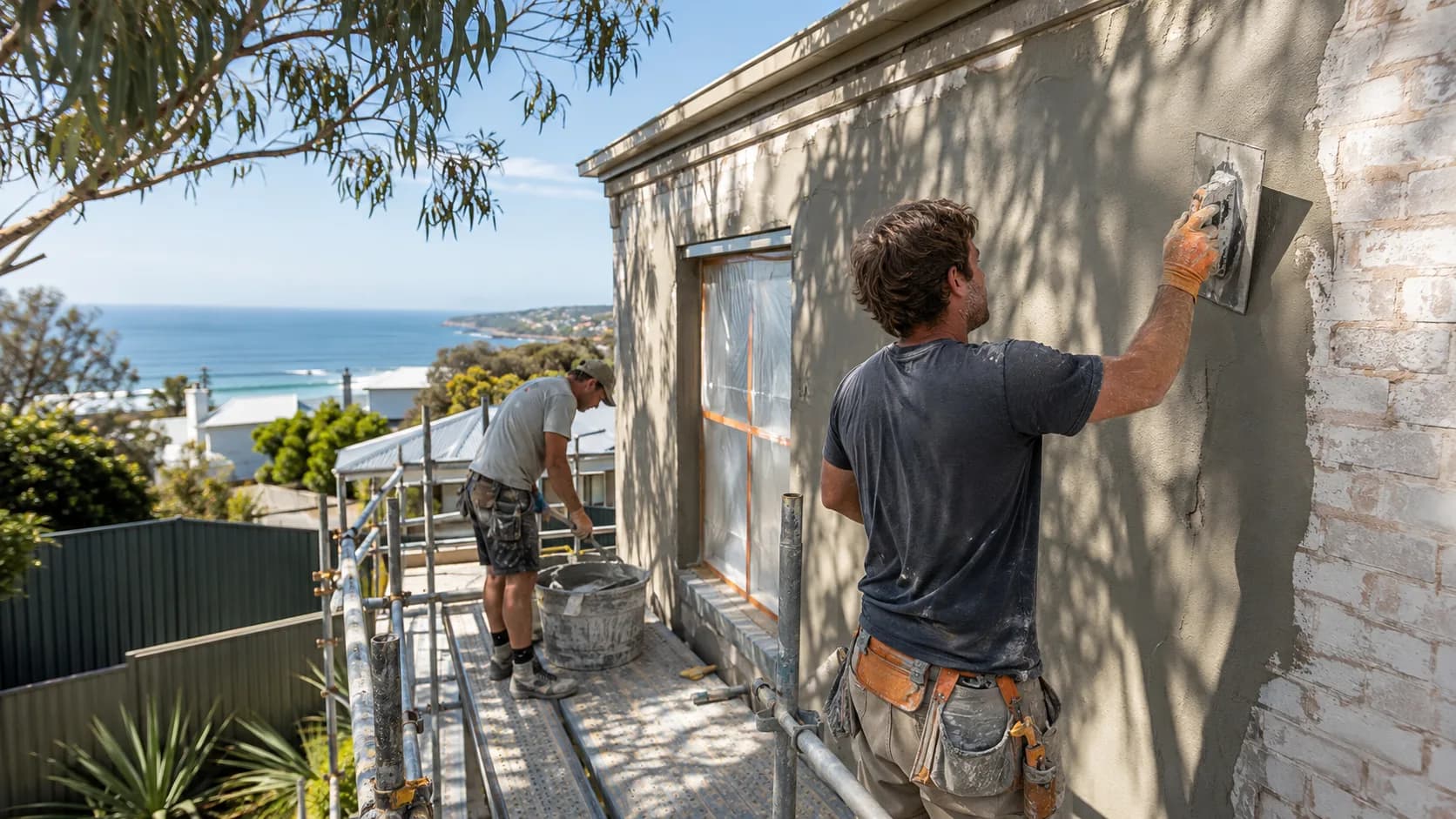
Job software for Australian rendering crews.
Take render work off voicemail. Price by wall area, hold the house while each coat goes off, and send the invoice the week you strike the scaffold.
 Start with Google
- Elevation quotes with options
- Accepted online with a signature
- Deposits before the scaffold goes up
- Rain days handled by drag, not ring-around
Online booking
A page that asks for the wall, not a time
Builders and owners give up the address first, then the wall area and the finish they are after. What comes through is a site measure worth driving to.
Learn moreSmart scheduling
Scratch, float and texture, in cure order
A render job is not one visit, it is a scaffold week. Book each coat as its own block on the one house and move the lot when rain stops the texture.
Learn moreRender a whole house, three ways.
Three answers on one estimate: bag-and-paint over sound brickwork, full sand-cement render with an acrylic texture, and render over insulated board.
Area does the arithmetic
Type the square metres and the base price is there. No calculator on the bonnet, no rate remembered wrong on a Friday.
Three lines beat three phone calls
Good, better and best on one estimate is how a render quote gets compared without the customer going out to find two more renderers.
What is not included, in writing
Scaffold, painting, making good the paths. Naming what is out of scope on the estimate is the cheapest argument you will ever avoid.
Finishes priced as options · Pro
Pro adds option groups to those lines, so the finish, the colour coat and the extra scaffold lift each carry their own difference against the square metre rate, and the total moves as the customer decides.
- Acrylic render system · 90m²Supply$2,700
- Wall prep & base coatLabour$1,850
- Scaffold hire & set-up3 days$980
The scaffold is booked out until spring.
Renderers do not lose work by being slow, they lose it by being full and silent. The page says so and takes the enquiry anyway.
Full is a sentence, not a dead end
The page names the first week you can be on the scaffold instead of showing an empty grid, so nobody assumes you have shut up shop.
The enquiry still lands
Wall area, finish and address arrive in the inbox even when there is no slot, which is what you want on the day someone drops out.
Cancellations get filled
A job that falls over leaves a hole in the run. The people who asked while you were full are already sitting in one thread.
New extension in Surry Hills — rear elevation and both side walls. Any chance of a texture finish before the end of the year?
Three coats on one house, in the order they can go on.
A render job is not an appointment, it is a scaffold week. Each coat is its own block on the same address, so nobody turns up to float a wall that is still green.
What the house is on, and what it is on next.
System, wall area, finish and the coats already on, held against the address rather than in a text thread from March.
Built for your trade
Built for the walls you actually render
Acrylic render over blueboard
A new extension clad in blueboard, priced on wall area with the base coat, mesh and texture as separate lines the builder can read.
Sand and cement render on brickwork
The old-school job. Two coats plus a finish, booked as three blocks on one house so nobody turns up to float a wall that is still green.
Hebel panel render
Panel joints, base coat and texture on an AAC-clad build. Books as a scaffold week rather than a single appointment.
Texture coat over existing render
A tired rendered facade brought back with a roll-on or trowel texture. Prices on area, with the finish as an option that changes the total.
Bagging a besser block wall
Garage walls, retaining walls and fences. Small, fast and profitable, so it takes the online booking page rather than a site measure.
Patch and re-render after new windows
Reveals made good and the wall blended back in. Priced by the hour rather than the metre, because half of it is matching what is there.
Render repair to cracked walls
Drummy sections cut out, rebonded and refinished. The job record keeps the photos, so the argument about what was already cracked is short.
Rendered fence and letterbox
The finishing touch on a new build, usually wanted the same week as handover. Slots into a gap in the run instead of becoming its own trip.
Painting the finish coat
Where you supply the colour rather than a through-coloured render, it goes on as its own line so the customer can drop it and paint it themselves.
Internal render and set
Solid plaster to internal walls in a rebuild. Books against the builder rather than the owner, and shares the same job record as the exterior.
The day the render will not go off.
Cold morning, wet afternoon, the base coat still soft at three. Every render week gets rearranged at least once and the calendar has to cope with it.
Move a block, not a day
Push the texture coat to Thursday and the rest of the house moves with it. The customer sees the new time without a phone call.
Rescheduling is free
Dragging work around the week is on every plan. Weather is not a premium feature and charging for it would be a strange thing to do.
The record keeps up
The job still knows which coats are on and which are not, so the hand who arrives tomorrow is not guessing at the wall.
Paid before you pack the scaffold.
The worst day to chase money is a fortnight after the last coat, when the house looks finished and nobody remembers the mess it was in.
Cash and transfer stay free
Mark it paid on the job and it is done. Recording money by hand is not a paid feature and never has been.
Cards come with Pro
For the owner standing on the driveway who would rather tap than remember your BSB when they get inside.
Stages sit on the booking
A long scaffold run can be split into stages on Pro, taken as the coats go on rather than demanded up front.
- Marco FerraroP-1011 · 25 Jun · Bank transfer$380
- Renee SalterP-1012 · 25 Jun · Cash$240
- Anna WhitfieldP-1013 · 28 Jun · Card$380
- Danny PrasadP-1001 · 27 Jun · Card$190
The suburbs worth putting a scaffold in.
Render is heavy, slow work and the drive is dead time. Say once where you go, and the enquiries that were never going to be worth it stop arriving.
Draw it, do not describe it
Pick the suburbs on a map rather than typing a radius that includes half a harbour and none of the streets you actually work.
Out of area is answered, not ignored
Someone outside the boundary gets told straight away instead of waiting three days for a quote that was never coming.
Crews can cover different ground
A second gang working the other side of town gets its own area, so the two do not cross the city past each other.
- Surry Hills8 suburbs · 2 crew
- Paddington7 suburbs · 2 crew
- Sydney North7 suburbs · 2 crew
- Renee Salter2mCan you come Thursday instead?
- Bookables1hA booking request needs your answer
- Anna Whitfield3hRunning 10 late on the Balmain job
The builder and the owner, on the same house.
One asks about set-out, the other about the colour, and both land on the job rather than across two phones and a text thread.
- 22 AugTexture coat, front elevationBooked · $3,400
- 15 AugRender, rear & sidePaid · $6,900
- 3 AugWhole-house render quoteAccepted · $10,300
- 28 JulSite measure · ManlyCompleted
The wall you rendered five years ago.
When a hairline crack brings someone back, the system, the finish and what you charged are already on the address.
- Marco FerraroBooked just now$215Accepted
- Renee SalterOpened 2h ago$480Viewed
- The Oak CaféSent yesterday$120Sent
Which render quotes went quiet.
Yours is sitting beside two others on a builder's phone. See what has been opened and what has been signed, so the one worth a call is obvious.
Starts free. Grows
only when you do.
Add your whole team and get booking for nothing.
As you grow with us you can go Pro.
One app for the whole job
Everything you need to run your rendering business.
Common questions.
That is set state by state, not nationally. In NSW, wet plastering is licensable trade work through NSW Fair Trading once the job passes the value threshold. In Queensland the QBCC class is Plastering solid, and its scope covers applying solid render and trowelled texture-coat finishes. Check your own state regulator, because Bookables does not check it for you.
Yes. Set the service to price on area, put your rate against it, and a two hundred square metre house prices itself the moment the number is typed in. Add option groups for the finish, so a fine texture and a coarse roll-on each carry their own difference against the base rate.
Drag the block to the next dry day. The customer sees the new time, the rest of the scaffold week moves with it, and nothing needs to be typed twice. Rescheduling is on every plan, including the free one.
Cash and bank transfer are recorded by hand and cost you nothing. Card payments come with Pro, for the owner who wants to tap and be done on the last day. Staged payments across a long scaffold run are a Pro thing too, and they sit on the booking rather than at checkout.
Draw the suburbs you take render work in and anything outside them can be turned away before it reaches your calendar. There is no charge for a longer drive, so if a distant job is worth doing you quote it the same way you quote a local one.
Tax is a switch per service, so GST rides on the line rather than being added at the end and argued about. Estimate and invoice numbers are set once, on purpose, and stay put after that.


Rendering guides
All articlesOnline booking vs phone booking: which one actually gets the job booked?
Compare online and phone bookings for service businesses, with a practical way to handle standard jobs, tricky enquiries and customers who prefer a call.
ReadFully booked? How to keep the lead without promising the impossible
Handle enquiries when your diary is full with clear requests, alternative times and a practical manual waiting list that avoids double bookings.
ReadBooking deposits: enough to make it real, not a hostage negotiation
Choose booking deposits that fit your work, explain the balance and cancellation terms, and understand how deposits differ from refundable security bonds.
Read