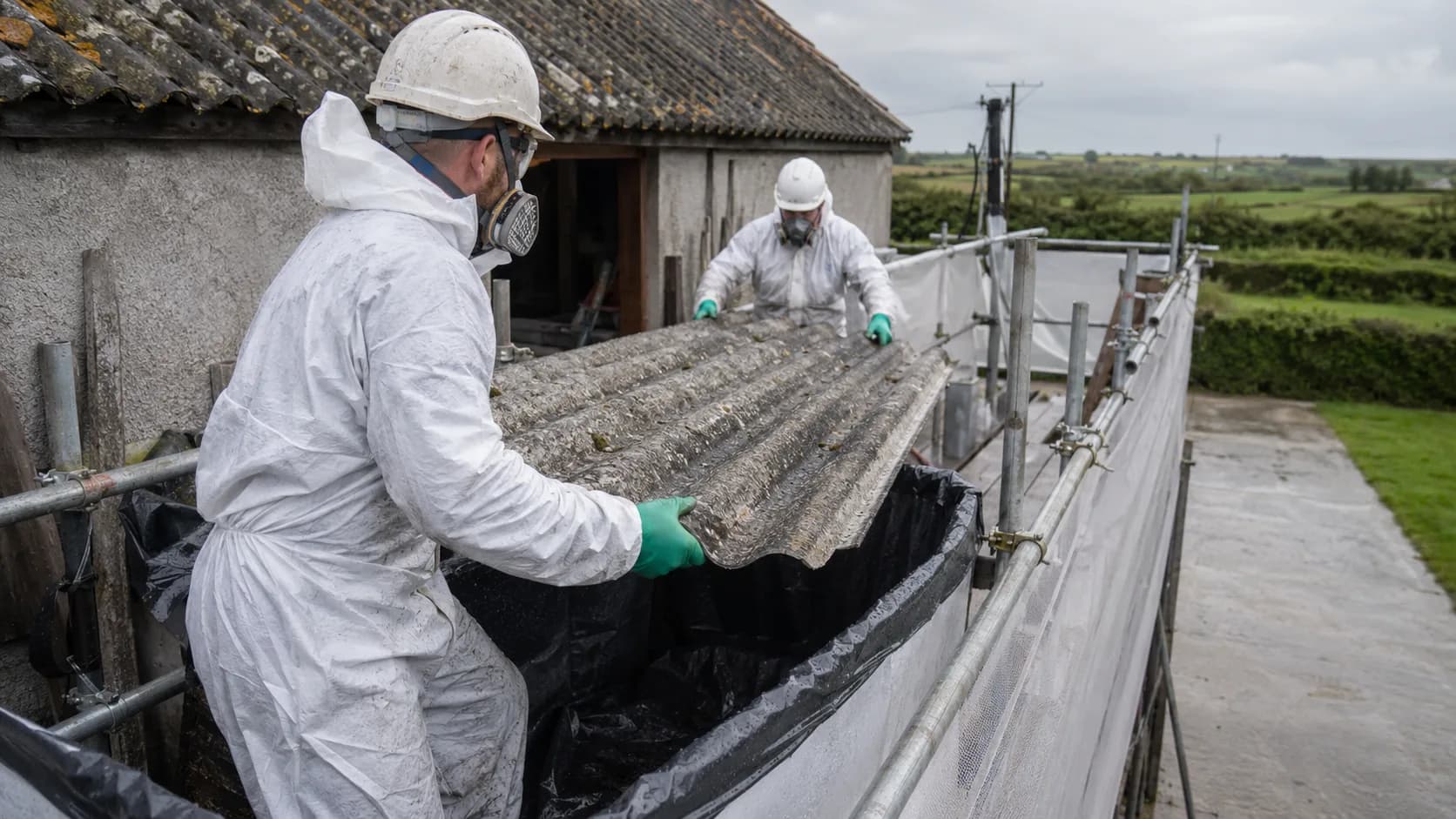
Asbestos removal software for Irish contractors.
The survey books itself, the removal is quoted with the notice period already sitting in front of it, and the record stays on the address for years.
 Start with Google
- Urgent inspections booked while the customer is worried
- Removal quotes signed online before work starts
- Deposits and payment requests through Stripe
- Job statuses from accepted through to completed
- Every job on the customer’s record, in writing
Online booking
Surveys book. Removals get a look first.
A farmer who has just had half a shed roof lift in the wind can take a survey slot this evening. The removal is priced once someone has seen it.
Learn moreSmart scheduling
A notified start tends to stay put
The date sits behind a notice given weeks back. If it does have to move, the lads, the analyst and the client all read the same new one.
Learn moreOnly the look can honestly book itself.
Nobody prices a strip down the phone, and pretending otherwise loses the job to whoever answers first. So the inspection carries a price and a length, and takes a gap you really have.
- MarInspection and sampleReport attached
- AprGarage roof quotedThree ways, accepted
- MaySheets removedLoad booked out
- MayClearance visitSigned off, paid
The address remembers, long after you do.
What came out of that garage in 2021, who signed it off and what the clearance said. Years later an agent asks and the answer is one search, not a box of folders.
A job that moves through gates, not through a morning.
Looked at, notified, sealed up, cleared, and gone to disposal. The gate a job is stuck behind tells you more than the hour it was meant to start.
Fully booked, and they still cannot touch it.
Nobody should be working around a broken sheet for a fortnight. With the diary full the page still takes the job and asks them to leave it be.
It arrives as a thread
Name, address, which building and a photograph of the sheet in one place, so you can judge whether it is Monday or the end of the month.
Answered once, from the job
Reply from the record rather than your texts. What you told them in March is still sitting there when they ring again in June.
Slotted the moment one frees
A cancelled survey is a gap you fill from the same screen, and the confirmation email sees itself out without your help.
Pulled the lining off the bathroom wall and it looks like the old sheeting. We have stopped and shut the door. How soon can someone look?
A shed roof, priced three ways.
The job that comes in most weeks: sheets off and taken away, sheets and the guttering with them, or the whole frame down and the base left clean.
Priced from what you measured
Sheet area, the skip, the haul and the clearance visit are separate lines, so a queried figure traces back to the part it came from.
The three sit side by side
Sheets only, sheets and guttering, or the frame down as well. The client reads all three rather than waiting on three separate quotes.
Sent before you leave the yard
The quote goes from the phone at the gate, which is generally before the next firm has rung back about their survey.
Extras priced as options · Pro
The soffit run as well, a second skip, a decontamination unit for a longer job, the clearance visit itself. Each is a priced line the client ticks and the total follows it. Priced options come with Pro.
- Asbestos removal · garage roofLabour€2,400
- Licensed disposal & tip feesDisposal€480
- Clearance inspection & certificateCompliance€350
Lead time in front, clearance behind.
A removal has a date given weeks ago and a clearance visit sitting after it. Both belong on the month rather than in your head.
The removal never books its own date
Only the survey takes a slot on your page. The removal comes in as a request and takes its day from you, once the notice has gone in. Surveys stay open to short notice.
Move it and everybody knows
Drag the job to the day you can be there and the client, the lads and whoever is monitoring all read the same new date.
The address keeps its own history
Every survey, removal and clearance stacks on the property, so five years later the story of that shed roof is one search away.
Built for your trade
Built for the jobs that actually come in
Cement sheet roofs on farm sheds
Long runs priced by the square metre with the skip and the haul beside them, so a big roof reads as lines rather than one alarming number.
Garage and outbuilding roofs
The steady work. Put a set price on a standard garage and the next one books like any other service instead of costing you an evening.
Soffits and fascias on a bungalow
The tower or the scaffold is its own line, because that is where a job like this quietly doubles and the client should see it first.
Textured ceiling coatings
Quoted by room with making good after as a tickable option, so nobody is ringing a plasterer for a second quote in the same week.
Attic water tanks and flue sections
Small, awkward and always wanted at short notice. A set price and a real slot beats three voicemails and a callback that never lands.
Floor tiles and the bitumen under them
Priced by floor area with the screed made good as its own line, which is the part clients forget and then query on the invoice.
Storm damaged sheeting after a bad night
The urgent ones arrive as a thread with a photograph and an address, so you can judge them instead of ringing back three times.
Pre-refurbishment and pre-demolition surveys
A builder wants a look and a sample before anything starts. Bookable at a price, with the report attaching to the same job afterwards.
Council and housing body void work
A date on the re-let and other trades queued behind you. The scope is agreed in writing before a single sheet is unscrewed.
Clearance and reoccupation visits
Booked at the point of signing, weeks out, sitting on the board like any other job so the last step is not the forgotten one.
- Aoife ByrneBooked just now€215Accepted
- Cian MurphyOpened 2h ago€480Viewed
- The Oak CaféSent yesterday€120Sent
Which quotes were opened, and which went quiet.
A removal quote sits on a phone beside two others for a fortnight. Seeing what has been read makes the one worth a call obvious.
- Renee Salter2mCan you come Thursday instead?
- Bookables1hA booking request needs your answer
- Anna Whitfield3hRunning 10 late on the Balmain job
One thread per address, not three phones.
The builder, the owner and the agent all message about the same roof. It is one conversation on one job, and it is still there next year.
- NDNiamh DoyleMon–Fri · 8–5On
- SGSeán GallagherTue–Sat · 9–6On
- OKOrla KavanaghMon–Fri · 9–5Off
Who is on it, and what each one holds.
Note what every hand on the crew holds and who runs the office. The job list is theirs; the money screens stay yours.
Where the van and the skip are worth taking.
A removal is a van, a skip and a haul rather than a service call. Draw the areas that is worth doing and the page holds the line for you.
Drawn on a map, not guessed
Shade the areas you cover or list the towns. An address outside them is told at the booking page rather than a week afterwards.
One rate across the lot
A longer run adds nothing quietly. If the drive changes what a job costs, that is a line you write and the client reads before signing.
Different crews, different patches
Give each crew the areas they actually work, so a job at the far end of the county does not land on the van that is already loaded.
- Drumcondra8 counties · 2 crew
- Clontarf7 counties · 2 crew
- Dublin North7 counties · 2 crew
Paid for the survey, paid for the removal.
Two payments a few weeks apart on most jobs. Record cash and transfers by hand for nothing, or send a card link on Pro.
Cash and transfer are free
Mark the survey paid when the transfer lands. That costs nothing on any plan and there is no plan on which it will.
Card links come with Pro
One for the survey fee, another once the site is clear and the client has the clearance paperwork in their hands.
A larger job split in stages
Part on mobilising, the rest when the load has gone. Staged requests come with Pro and go out after the job is booked.
- Aoife ByrneP-1011 · 25 Jun · Bank transfer€380
- Cian MurphyP-1012 · 25 Jun · Cash€240
- Niamh DoyleP-1013 · 28 Jun · Card€380
- Seán GallagherP-1001 · 27 Jun · Card€190
One app for the whole job
Everything you need to run your asbestos removal business.
Starts free. Grows
only when you do.
Add your whole team and get booking for nothing.
As you grow with us you can go Pro.
Common questions.
They can. The survey carries a set price and takes a real gap in the week, with a confirmation sent straight away. The removal comes in as a request instead, because nobody prices a shed roof from a photograph.
No, and it would be unwise to suggest otherwise. Those belong to you and to whoever the rules where you work allow to do them. Bookables holds the job — scope, dates, messages and money — and the paperwork attaches to it so the office and the van read the same file.
Yes, by keeping the removal off the booking page. Only the survey takes a slot; the removal arrives as a request, so its date is one you set once the notice has gone in rather than one a client picked out of next Tuesday. Surveys stay open to short notice, which is rather the point of them.
Move it to the day you can actually be there. The client is told, the lads see the same board, and the quote, the photographs and the messages stay attached rather than being typed out again.
Cash and bank transfer recorded by hand are free on any plan. Card links come with Pro, and staged requests go out once the job is booked rather than at checkout.
Yes. Draw the areas the van and the skip are worth taking and an address outside them hears about it at the booking page. The rate is the same right across the area you draw.


Asbestos Removal guides
All articlesOnline booking vs phone booking: which one actually gets the job booked?
Compare online and phone bookings for service businesses, with a practical way to handle standard jobs, tricky enquiries and customers who prefer a call.
ReadFully booked? How to keep the lead without promising the impossible
Handle enquiries when your diary is full with clear requests, alternative times and a practical manual waiting list that avoids double bookings.
ReadBooking deposits: enough to make it real, not a hostage negotiation
Choose booking deposits that fit your work, explain the balance and cancellation terms, and understand how deposits differ from refundable security bonds.
Read