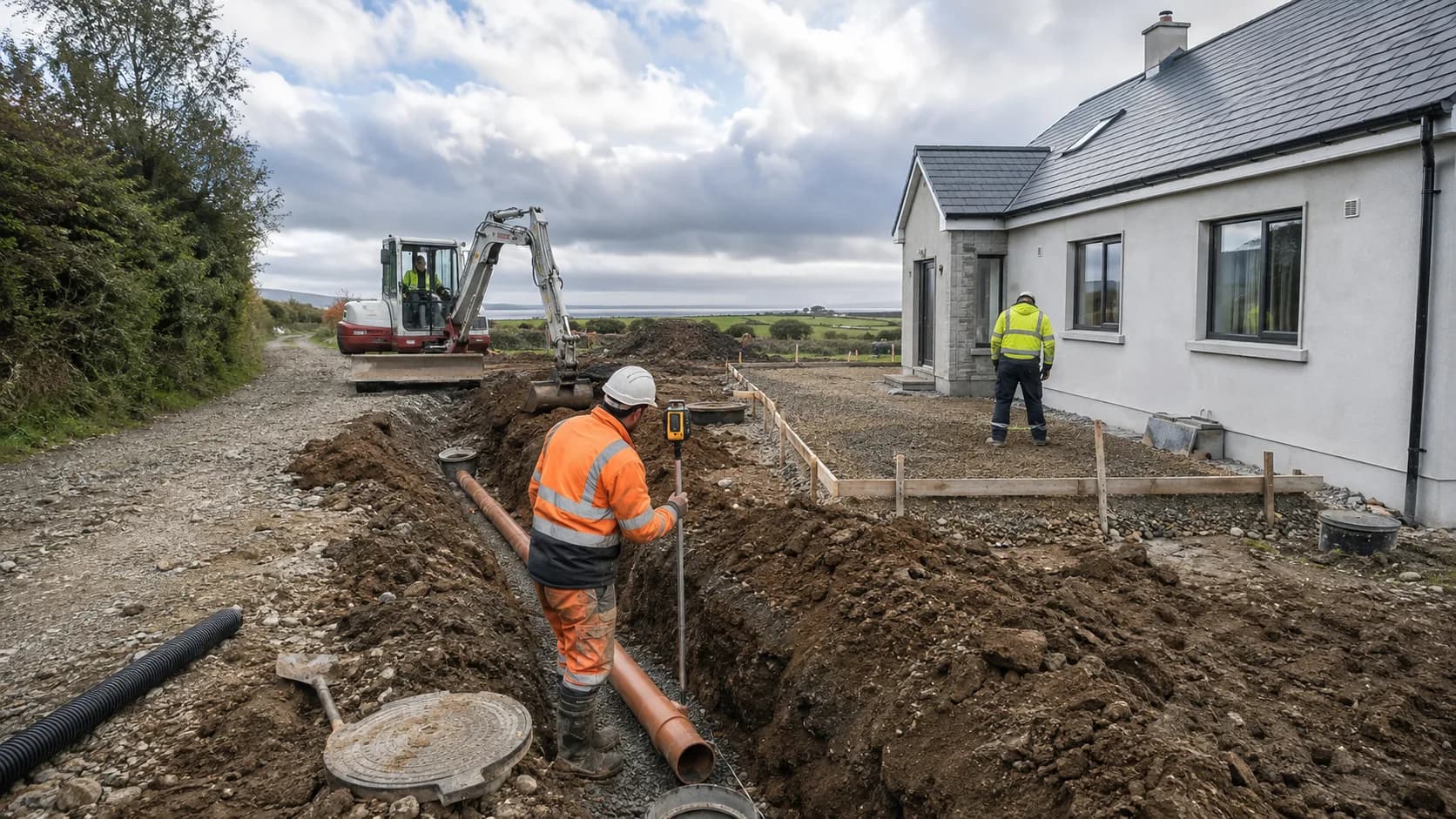
Booking software for groundworks contractors in Ireland.
Price the dig once you have walked the site, have it signed before the machine moves, and keep the operators, the lorries and the wet weeks on one board.
 Start with Google
- Site walks booked while you are still in the seat
- Two machine sizes priced side by side on one quote
- Signed quotes become booked machine days
- Move a wet dig and the crew moves with it
- Free, up to 200 bookings a month
Online booking
Site visits booked while you are in the cab
Builders rarely ring twice. Your own page takes the site address and the scope, and puts the visit in the diary at nine in the evening.
Learn moreSmart scheduling
Machines, operators and low-loaders on one week
Every digger, every site and every move in one view, so the morning the three-tonne is expected in two places is one you notice first.
Learn moreNobody answers the phone from a digger cab.
You spend the day in ear defenders with a bucket in your hands, which is precisely when builders ring. Those who leave no message ring the next crowd.
The enquiry waits; the builder would not have
A page that takes the site address and the scope means the job is still there at five, written down, rather than a missed number you cannot place.
A visit, not the works
What gets booked online is the site visit. The figure is still yours to write once you have seen the ground, which is the only honest way this trade prices.
Need a price on the site cut and the footings. There is a fair bit of fill across the back of it.
One site, two machines, two figures.
The builder wants to know if the strip is a week or a fortnight. Put both diggers on one page with the muckaway under each, and let them choose.
Two machines on one quote, with Pro
Machine size, rock and whether the spoil stays on site are option groups, so ticking muckaway moves the total on screen while the builder is reading it. Options on a quote come with Pro.
Machine days do the arithmetic
Set the days against the machine rate and the quote adds up the same on the tailgate as it would at the desk at eight that evening.
Muckaway sits on its own line
Loads and tip charges apart from the digging, which is what stops one figure being read as the cost of the digger.
The quote keeps its number
Document numbering is set once and does not shift, so the quote that was signed and the invoice that follows point at one another.
- Machine float on & off siteMobilisation€680
- Bulk cut · 5t excavator2 days€3,400
- Cart away spoil · 8 loadsTip fees€1,760
The quote a builder is sitting on.
A dig is priced against two or three others and nobody rings to say so. Knowing yours was opened twice on Thursday is the difference between a follow-up and a nag.
Sent, viewed, accepted
Every quote says which of the three it is and when it was last opened, so the ones worth a call on Friday are obvious.
Accepted becomes machine days
The moment it is signed it converts into a booking, so nobody re-types a site cut into the calendar at nine at night.
An expiry, because tip charges move
Put a date on the quote and a rate you wrote before the wet season cannot be held against you after it.
- Aoife ByrneBooked just now€215Accepted
- Cian MurphyOpened 2h ago€480Viewed
- The Oak CaféSent yesterday€120Sent
Every dig you take on
Built for site cuts, footings and everything trenched around them
Foundation trenches for a one-off house
Priced in machine days after the visit, with the depth noted on the job, and booked the day the drawings are signed off.
Site strip and reduced dig
Quoted with the muckaway underneath it, so the builder can see the lorries separately from the machine.
Hardcore fill and blinding
Area and days do the arithmetic, so the figure on the tailgate matches the one you would have written at the desk.
Percolation areas and septic tanks
Its own package with an expiry on it, because a rate written in autumn should not be held against you in spring.
Foul and surface water runs
Priced per run with the chambers and the backfill as their own lines, which is what keeps a variation civil.
Site entrances and splays
The smaller works that pay for the move, slotted between the big digs and visible to the whole crew.
Radon sumps and under-slab pipework
Booked with honest durations so the blocklayer is not stood at a half-finished oversite on a Tuesday morning.
Muckaway and tipping
Loads and tip charges itemised apart from the digging, because that is the line that gets queried first.
Weather reshuffles
A saturated Monday dragged to the next dry day, taking the operator and the lorry with it rather than the fortnight.
- Cian Murphy2mCan you come Thursday instead?
- Bookables1hA booking request needs your answer
- Niamh Doyle3hRunning 10 late on the Stoneybatter job
Everything you need before the bucket goes in.
The utility plans, the drainage layout, the levels and the builder's programme all arrive in different places and end up on a phone. Kept in one thread against the job, they are still there on the morning of the dig.
- MarSite cut and level3 machine days
- JunFootings and service trenchQuote accepted
- JunPaid in fullBank transfer
The builder you dug three sites for.
Repeat work is most of this trade, and the second job always starts with someone trying to remember what you charged for the first. Every quote, dig and payment stays on the one record.
One week, every operator and every machine on it.
A dig runs long, an operator is on a second site by Wednesday, and the truck is booked against both. Laid out on one timeline, the day that does not add up is visible on Friday instead of at seven on Monday morning.
A wet week that moves in one piece.
Clay has no interest in the programme. When the site is under water the dig moves, and with it the lorry, the operator and the blocklayers behind you.
Drag the dig; the crew comes with it
Everything attached to that job moves at once, which is rather better than four calls made from a lay-by.
The crew watch it change
The new start reaches their phones straight away, so nobody drives an hour to a site stood down the night before.
Free on every plan
Moving work around the week costs nothing. Automating what fills the gap is the part that sits on Pro.
The sites a low-loader will actually reach.
A machine costs money to move before it turns a bucket, and the further out the site the more of the week the move takes. Draw the line once.
Draw it rather than describe it
Towns and shapes on a map, not a paragraph on a contact page nobody reads before they book.
Beyond the line, they can still ask
Works past the boundary arrive as an enquiry rather than a booking, so the big one down the country remains yours to accept.
- Drumcondra8 counties · 2 crew
- Clontarf7 counties · 2 crew
- Dublin North7 counties · 2 crew
Settled before the machine leaves the site.
Builders pay on their terms rather than yours, and every week it sits unpaid is another week the tip charges sat on your card.
Cash and transfer are free
Record what has landed against the job on any plan. Nothing about the free plan stops you being paid for a dig.
Cards come with Pro
Send the link while the site is still being raked off and watch it clear, rather than posting an invoice into a site cabin.
Staged, where the works earn it
The move and the completed dig can each carry a payment request on Pro. They sit after the booking, never at the point a date is picked.
- Aoife ByrneP-1011 · 25 Jun · Bank transfer€380
- Cian MurphyP-1012 · 25 Jun · Cash€240
- Niamh DoyleP-1013 · 28 Jun · Card€380
- Seán GallagherP-1001 · 27 Jun · Card€190
One app for the whole job
Everything you need to run your groundworks business.
Starts free. Grows
only when you do.
Add your whole team and get booking for nothing.
As you grow with us you can go Pro.
Common questions.
You are not, and this does not pretend otherwise. The online page books the site visit rather than the works: site address, rough scope, a date. You walk the ground, build the quote from machine days, muckaway and the low-loader, and send it from the same job.
Price it before you find it. Rock, soft spots and a second machine can each sit on the quote as an option the builder ticks, so the figure moves while they are reading it rather than in a call from site. Options on a quote come with Pro.
No, and it should not claim to. Dial Before You Dig is run by Gas Networks Ireland and covers the gas network, and you request it yourself, as you do maps from the other utilities. What Bookables does is hold every map and reply in one thread against that job, so on the morning of the dig nobody is trawling an inbox for something from three weeks ago.
Drag the dig to the next workable day. The operator, the lorry and the move go with it, and the crew have the new start on their phones before you have put yours down. Shifting work around the week costs nothing on any plan.
Draw the areas a machine will travel to and the booking page holds that line. Anything beyond it still arrives as an enquiry, so the one that is worth the low-loader stays a decision rather than something you missed.
Not at all. Cash and bank transfer are recorded by hand on any plan and cost nothing. Cards come with Pro, as do staged payment requests, which go out after the booking exists rather than at the moment somebody picks a date.



Excavation & Earthmoving guides
All articlesOnline booking vs phone booking: which one actually gets the job booked?
Compare online and phone bookings for service businesses, with a practical way to handle standard jobs, tricky enquiries and customers who prefer a call.
ReadFully booked? How to keep the lead without promising the impossible
Handle enquiries when your diary is full with clear requests, alternative times and a practical manual waiting list that avoids double bookings.
ReadBooking deposits: enough to make it real, not a hostage negotiation
Choose booking deposits that fit your work, explain the balance and cancellation terms, and understand how deposits differ from refundable security bonds.
Read