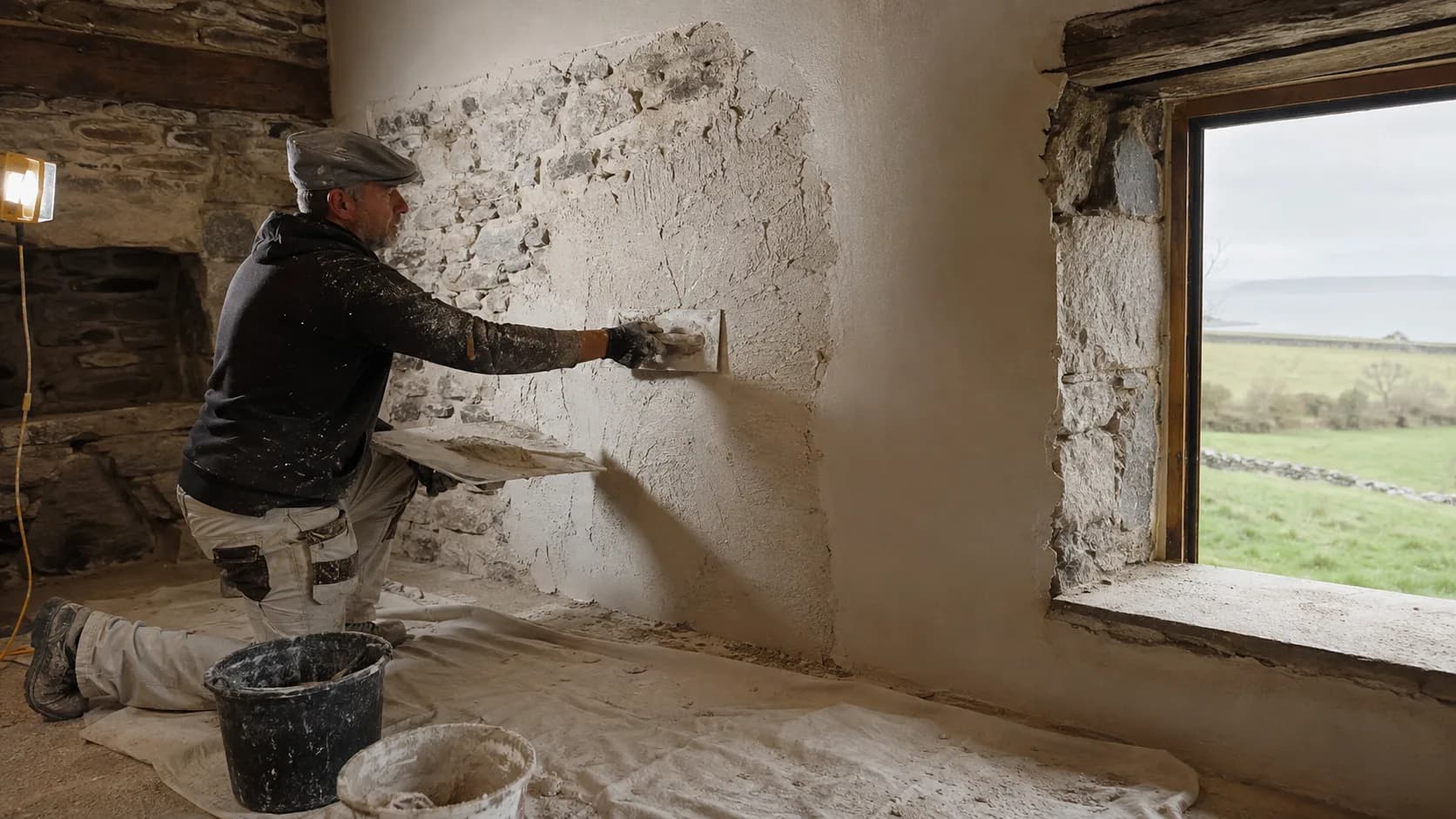
Booking and quoting software for plasterers in Ireland.
From the first photo of a blown ceiling to the finish coat and the invoice, the whole job sits on one record.
 Start with Google
- Patch and repair jobs booked online
- Rooms quoted with online acceptance
- Return coats planned by drag
- Confirmations and reminders on autopilot
Online booking
Quote visits that arrange themselves
Almost nothing is priced without seeing it. Put the quote visit on your page with a proper duration and let people take a slot while you are on a ceiling.
Learn moreSmart scheduling
Scratch, float and finish, in that order
Render goes on in coats and each needs its drying time. Give each stage its own slot and duration on one calendar and the order survives four jobs at once.
Learn moreBuilt for your trade
From a patch round a light switch to a whole house of walls and ceilings
Ceiling repair after a leak overhead
The everyday callout. Books short, priced by room, photos already on the thread, and the insurer gets a proper quote out of it.
Overskim on tired walls and ceilings
Priced by area or by room. Whether it needs a bonding coat first is an option with its own price, not a discovery on the day.
Dry lining a new extension
Board, tape and skim as separate stages with their own durations, so the second fix behind you is not left guessing at a date.
Sand and cement scratch coat
Weather dependent and priced by area. Takes a real block of days on the calendar and moves as a block when the forecast turns.
Wet dash or dry dash on a gable
A different rate and a different duration to internal work, so it earns its own service rather than a footnote on the quote.
Replastering after a damp problem
Its own service with the waiting time built in, so nobody books the finish coat before the wall is anywhere near ready.
Making good after the electrician
Small, quick, and a day-wrecker when the diary lies about it. Give it a real duration and let it book itself in.
Skim over an insulated slab or board
Sequenced after the insulation crew, with the tape and joint work quoted as its own line rather than folded into a rate.
Coving and cornice replacement
The profile is the whole conversation, so it is an option group with prices attached rather than a figure pulled from nowhere.
Lime work on an older house
Never quoted from a photograph. Books as a quote visit and returns as an estimate with its own lines and its own timescale.
What the job carries before anyone loads up.
Room count, finish level, the profile to match, where the water is and how to get in. On the job when you take it, not remembered on the drive over.
- Cian Murphy2mCan you come Thursday instead?
- Bookables1hA booking request needs your answer
- Niamh Doyle3hRunning 10 late on the Stoneybatter job
The photos, the dust question and the yes, all one thread.
Half of plastering is quoted off pictures of a stain on a ceiling. Those pictures belong on the job, not three screens deep in a phone.
- 21 AugUnit 6, walls and ceilingsBooked · €2,150
- 9 AugUnit 5, ceilingsPaid · €1,340
- 1 AugTrim profile, units 5-8Accepted · €980
- 18 JulUnit 4, make goodCompleted · €420
The builder who is eleven rooms deep.
One customer, a long run of jobs and a payment history worth keeping, instead of eleven separate searches through last year's messages.
Skimming a room, priced three ways.
Anyone asking what plastering costs wants three numbers, not one: patch and make good, an overskim on what is there, or take it back and re-board.
Metres, rooms or hours
Whatever unit you already work in. Square metres suit a whole house, rooms suit a skim, an hour suits making good after a socket.
The add-ons carry their own prices
Bonding, moisture board, coving. Each one is ticked or not, and the total moves in front of the customer while they decide.
What was accepted is what is kept
The accepted estimate stays attached to the job, so a disagreement six weeks later is read back rather than argued about.
Extras priced as options · Pro
Pro adds the extras that sit on top: coving, moisture board in the bathroom, bonding on bare block, taking the waste away. Each carries its own price difference, so the total moves as they choose it.
- Plaster & materialsSupply€260
- Prep & set-outLabour€340
- Skim & two coats6 hrs€680
A wet fortnight and the whole run slides.
Nothing about render argues with the forecast. The day itself is lost cheaply; the evening spent explaining it to eleven people is not.
Move it once, on the calendar
The customer and whoever is on the job both hear about it, and neither of them hears it from you. Free on any plan.
Everything behind it shifts too
Push the boarding out and the skim follows, so the gap does not turn up on Thursday as a crew with nothing to do.
No apologies to make
The notification takes the awkward part. You spend the wet day on the estimates instead.
The diary is full, which is the normal state.
A plasterer with next week free is a plasterer worth asking about. Say the wait out loud and still keep the people who will sit through it.
Only the free days are offered
Times come straight off the diary, so a week already sold to a contractor is never shown to somebody ringing about a bedroom.
A full week still earns the lead
When there is nothing to book the page asks for photos and an address instead, and that arrives as an enquiry you can price at eight at night.
Price it now, date it later
The estimate goes out, gets accepted, and sits there with no date until the run in front of it finishes.
Ceiling in the back bedroom has come down after a leak. Photos attached, is there anything before the end of the month?
Paid without the follow-up call.
A stage payment from a builder or the balance on a private job. Neither speeds up while the invoice is still a note in your phone.
Cash and transfer stay free
Mark down what came in and the job is closed. No plan behind it, and nothing skimmed off what you were paid.
Cards are the Pro part
The invoice carries a link, so paying takes a phone and half a minute instead of a trip to the bank.
Bill a long job in pieces
Once the booking is on the calendar the run can be invoiced in stages. Booking itself never takes money.
- Aoife ByrneP-1011 · 25 Jun · Bank transfer€380
- Cian MurphyP-1012 · 25 Jun · Cash€240
- Niamh DoyleP-1013 · 28 Jun · Card€380
- Seán GallagherP-1001 · 27 Jun · Card€190
Where the van is worth sending.
An hour up the motorway with a load of board eats a morning that never appears on the quote. Decide the boundary once and let the page hold it.
A line on a map beats a sentence
Mark what you cover and an enquiry outside it gets an honest answer the same minute, not a cancellation the week after.
The render lads keep their own ground
External work and interior skimming rarely share a patch, so each crew carries the area it actually drives.
The work you would rather refuse
Lime, gable render off a scaffold, whatever you have had enough of. Ruled out on the page instead of on the doorstep.
- Drumcondra8 counties · 2 crew
- Clontarf7 counties · 2 crew
- Dublin North7 counties · 2 crew
Starts free. Grows
only when you do.
Add your whole team and get booking for nothing.
As you grow with us you can go Pro.
One app for the whole job
Everything you need to run your plastering business.
Common questions.
Plastering itself is not a licensed trade, but under the Safety, Health and Welfare at Work (Construction) Regulations 2013 anyone working on a construction site needs a valid Safe Pass registration card, which SOLAS operates. Domestic jobs are a different matter; main contractors will ask. Put your card details and your public liability on the estimate template so they go out with every quote.
For a straight overskim, usually. Ask for pictures on the thread, price the estimate by square metres or by room, and send it. Anything with damp, blown plaster or an older solid wall behind it wants a look, and the quote visit books off the same page.
As its own service, with its own rate and its own duration. A wet dash on a gable is not the same animal as a two-coat skim on new board, and setting them up separately stops the calendar telling you they are.
Move it on the calendar and everyone attached is told, on any plan including the free one. Weather takes render days here constantly, and the expense was never the lost day, it was the ringing round afterwards.
Cash and bank transfer are recorded by hand and stay free. Cards come with Pro, which is what most people want when a builder owes them a stage payment. The plan cards further down carry the numbers.
Yes, and they are different creatures. A builder is one customer with a long run of jobs and a payment history worth having. A private job is one address and a lot of questions. Both live on the same records.

Plastering guides
All articlesOnline booking vs phone booking: which one actually gets the job booked?
Compare online and phone bookings for service businesses, with a practical way to handle standard jobs, tricky enquiries and customers who prefer a call.
ReadFully booked? How to keep the lead without promising the impossible
Handle enquiries when your diary is full with clear requests, alternative times and a practical manual waiting list that avoids double bookings.
ReadBooking deposits: enough to make it real, not a hostage negotiation
Choose booking deposits that fit your work, explain the balance and cancellation terms, and understand how deposits differ from refundable security bonds.
Read