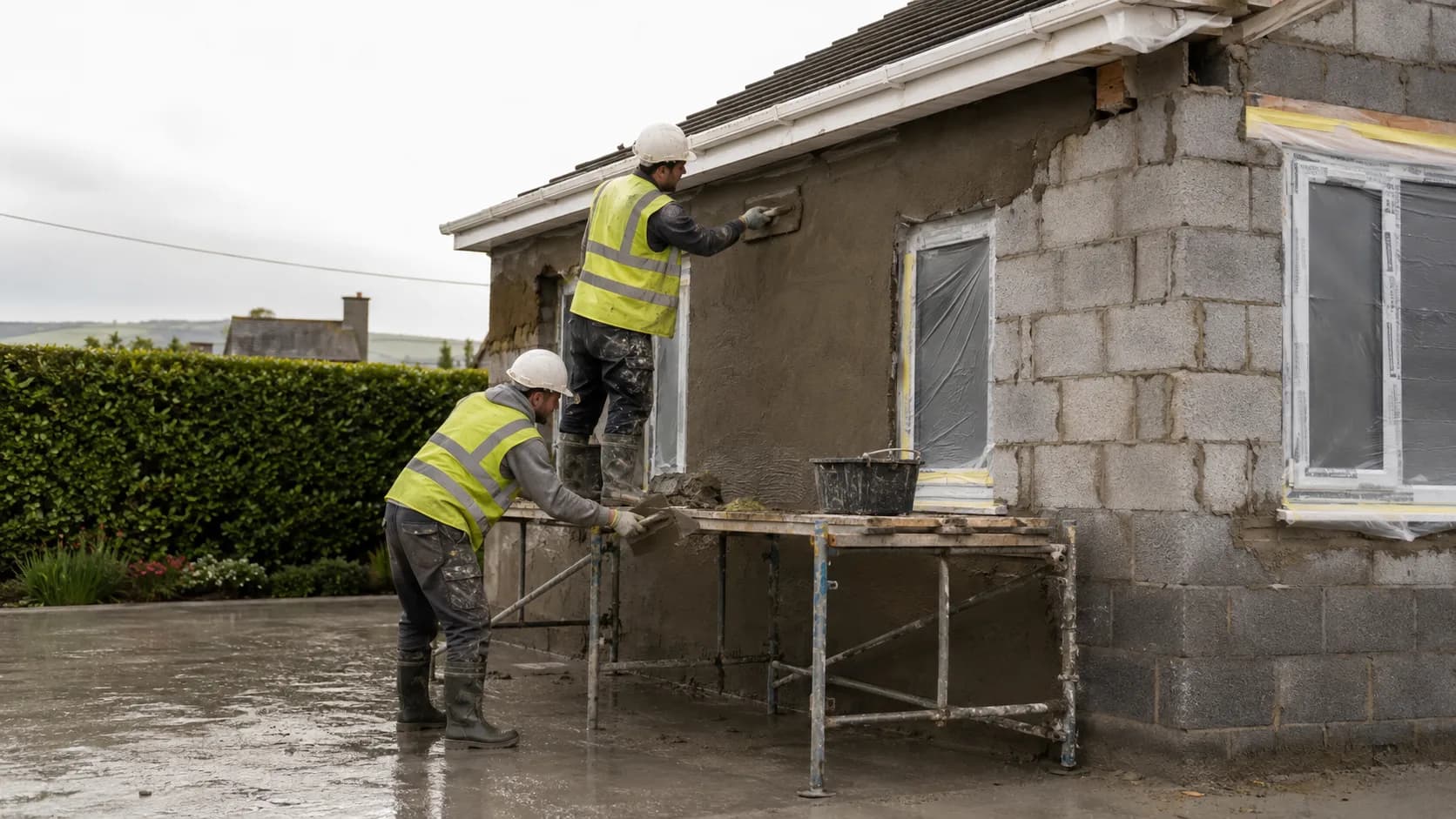
Job software for plastering firms in Ireland.
Price render by wall area, book the scratch and finish coats as separate blocks on the one house, and invoice while the scaffold is still standing.
 Start with Google
- Elevation quotes with options
- Accepted online with a signature
- Deposits before the scaffold goes up
- Rain days handled by drag, not ring-around
Online booking
The enquiry turns up with the house on it
The page asks for the address before the time, then the wall area and the finish. What lands can be priced, not a text asking what a dormer costs.
Learn moreSmart scheduling
Coats booked around the weather, not through it
Render is a sequence with drying, and a wet fortnight rearranges it whether you agree or not. Book each coat as a block and move the run in one go.
Learn moreDo the whole house, three ways.
Three answers on one estimate: patch and paint where it is sound, a scratch coat and silicone finish, and external insulation with a render finish.
The metres do the pricing
Put the wall area in and the base figure follows it. Nothing gets worked out on the back of a docket at the end of a wet day.
Patch, re-render, insulate
Three lines on the one page and the middle one usually wins. There is nothing left to ring around about, so the customer stops.
What you are not doing, in writing
Staging, painting, making good the piers. A line saying what is out settles it before anyone is standing in the drive arguing.
Finishes priced as options · Pro
Pro adds option groups to those lines, so the finish, the colour and an extra scaffold lift each carry their own difference against the square metre rate, and the total keeps up while the customer decides.
- Acrylic render system · 90m²Supply€2,700
- Wall prep & base coatLabour€1,850
- Scaffold hire & set-up3 days€980
Booked out until the weather settles.
A plasterer here fills the year on word of mouth, and word of mouth stops dead the moment a caller decides you have packed it in.
Being full can still say something
The page offers the first week you could have staging up, so the caller comes away with a date rather than deciding nobody answers.
The house gets written down anyway
Address, wall area and finish come into the inbox with nothing open, and that list is what you work through when a job falls in.
A slipped start date is not lost work
Jobs move a fortnight all the time. Everyone who rang while you were full is sitting in the one thread, in the order they asked.
New extension in Drumcondra — rear elevation and both side walls. Any chance of a texture finish before the end of the year?
Three coats on one house, in the order they can go on.
A render job is not an appointment, it is a scaffold week. Each coat is its own block on the same address, so nobody turns up to float a wall that is still green.
What the house is on, and what it is on next.
System, wall area, finish and the coats already on, held against the address rather than in a text thread from March.
Built for your trade
Built for the walls you actually render
Wet dash on a new build
Scratch coat and nap finish, priced by wall area with the gables and the chimney costed as their own lines rather than assumed in.
Silicone thin-coat render
Base coat, mesh and a through-coloured top coat. Books as a scaffold week with the colour as an option that moves the total.
External insulation on a bungalow
Boards, base coat, mesh and finish. Priced on area with the board thickness as an option, and grant paperwork kept on the job record.
Dry dash pebbledash repair
Patching a dashed gable so the repair does not stand out. Priced by the hour, because matching the stone is most of the work.
Sand and cement on a garage or shed
Two coats and a float finish. Small enough to book straight from the page instead of costing an evening drive to measure.
Lime render on an old cottage
Breathable coats on solid walls, booked with the long gaps the material wants rather than squeezed to suit the diary.
Dormer and chimney render
The parts that leak first. Booked with the access they need, so it does not turn into a second visit and a second hire charge.
Making good after new windows
Reveals and sills reinstated once the joinery crew have gone. Slots in as a short block on the same house record as the main job.
Plastered piers and boundary walls
Entrance piers, capping and a boundary wall. Quick money that books itself online rather than costing you a site visit to price.
Internal skimming and float coats
Skim work on the same house you rendered outside, kept on one record so the customer gets a single estimate rather than two.
The soft day that stops the finish coat.
Dry at eight, misting by eleven, a nap finish that will not take. A plastering week here gets rebuilt around the sky more than once.
Push the coat, keep the house
Move the finish coat to Thursday and the coats behind it come along. The customer is shown the change without a phone call.
Weather is not billable
Dragging work across the week sits on every plan. Charging for a wet Tuesday would be an odd thing to sell a plasterer.
The job knows where you got to
Which coats are on stays on the record, so whoever opens the gate tomorrow is not reading the wall to work it out.
Paid while the staging is still up.
Render looks dear on the day it goes on and cheap a month later. Ask while the wall is new and the invoice reads as fair.
Cash and transfer stay free
Mark it paid against the job and that is the end of it. Recording money by hand has never been a paid feature.
Cards come with Pro
For the customer standing on the drive who would sooner tap a card than go inside and find their bank details.
Stages sit on the booking
A long run can be split into stages on Pro, taken as the coats go on rather than requested the moment it is booked.
- Aoife ByrneP-1011 · 25 Jun · Bank transfer€380
- Cian MurphyP-1012 · 25 Jun · Cash€240
- Niamh DoyleP-1013 · 28 Jun · Card€380
- Seán GallagherP-1001 · 27 Jun · Card€190
The counties worth scaffolding.
An hour each way with a mixer on the back eats the day the work was meant to pay for. Set the ground once and stop deciding it call by call.
Pick the ground on a map
Choose the areas you plaster rather than a radius, which around here reaches across an estuary to get at nothing much.
A no today beats a no next week
Someone outside the ground hears it straight away, so nobody waits on a price you were never going to sit down and write.
Each gang gets its own ground
One crew north of the town and one south, with areas that keep them apart instead of sending both up the same road at seven.
- Drumcondra8 counties · 2 crew
- Clontarf7 counties · 2 crew
- Dublin North7 counties · 2 crew
- Cian Murphy2mCan you come Thursday instead?
- Bookables1hA booking request needs your answer
- Niamh Doyle3hRunning 10 late on the Stoneybatter job
The builder and the owner, on the same house.
One asks about set-out, the other about the colour, and both land on the job rather than across two phones and a text thread.
- 22 AugTexture coat, front elevationBooked · €3,400
- 15 AugRender, rear & sidePaid · €6,900
- 3 AugWhole-house render quoteAccepted · €10,300
- 28 JulSite measure · BlackrockCompleted
The wall you rendered five years ago.
When a hairline crack brings someone back, the system, the finish and what you charged are already on the address.
- Aoife ByrneBooked just now€215Accepted
- Cian MurphyOpened 2h ago€480Viewed
- The Oak CaféSent yesterday€120Sent
Which render quotes went quiet.
Yours is sitting beside two others on a builder's phone. See what has been opened and what has been signed, so the one worth a call is obvious.
Starts free. Grows
only when you do.
Add your whole team and get booking for nothing.
As you grow with us you can go Pro.
One app for the whole job
Everything you need to run your rendering business.
Common questions.
For plain render, no. External insulation is different: NSAI Agrément runs a registered installer scheme for external insulation and ETICS, and SEAI registers contractors for its home energy grants. Ordinary sand and cement work needs neither. Bookables runs your diary and certifies nobody.
Yes. Price the service on wall area and set your rate against it. Option groups carry the finish, so a wet dash and a silicone thin coat each show their own difference against the base rate instead of being settled on site.
Drag the block to the next dry day and the rest of the run moves with it. The customer sees the new time without you ringing them. Rescheduling is on every plan, including the free one.
Cash and bank transfer are recorded by hand and cost nothing at all. Cards come with Pro. A long job can be split into stages on Pro, taken as the coats go on rather than asked for at the time of booking.
Draw the areas you take plastering work in and anything beyond the line is turned away before it reaches the diary. There is no charge for a longer drive, so a distant job is quoted the same way a local one is.
Tax is a switch per service, so VAT sits on the line rather than appearing at the bottom unannounced. Estimate and invoice numbers are set once, on purpose, and stay put after that.



Rendering guides
All articlesOnline booking vs phone booking: which one actually gets the job booked?
Compare online and phone bookings for service businesses, with a practical way to handle standard jobs, tricky enquiries and customers who prefer a call.
ReadFully booked? How to keep the lead without promising the impossible
Handle enquiries when your diary is full with clear requests, alternative times and a practical manual waiting list that avoids double bookings.
ReadBooking deposits: enough to make it real, not a hostage negotiation
Choose booking deposits that fit your work, explain the balance and cancellation terms, and understand how deposits differ from refundable security bonds.
Read