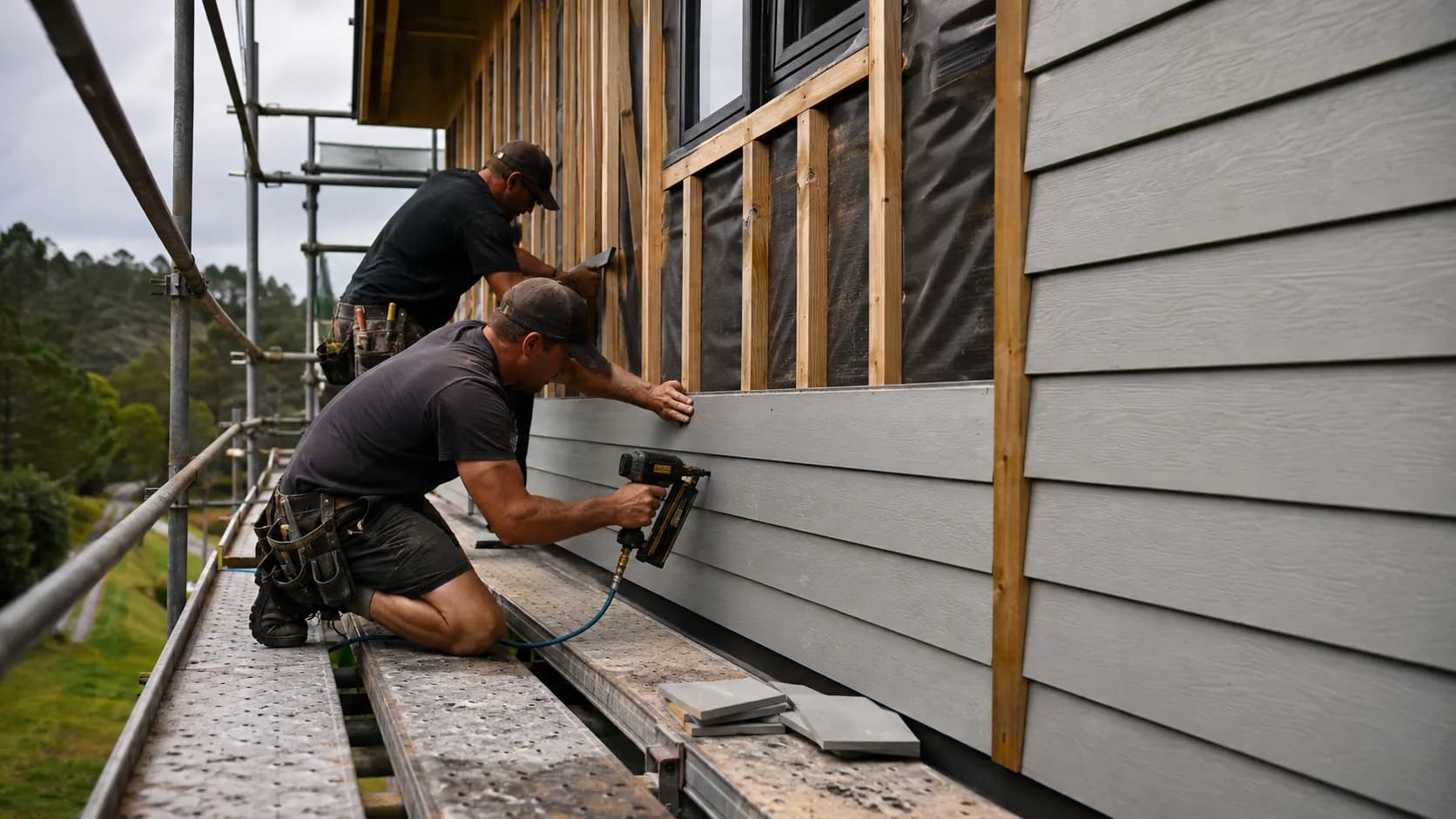
Job software for New Zealand cladding crews.
Price the elevation off a measure rather than a photo, keep the quote alive while the owner waits on the bank, and block the house out from the scaffold going up to the last flashing.
 Start with Google
- Homeowners book the site inspection themselves
- Quotes with weatherboard, Hebel and composite options priced
- Customers accept and sign on their phone
- Signed quotes become booked jobs automatically
- Expiry dates keep your quote pipeline honest
Online booking
The measure books itself, the re-clad never does
Owners pick a site look time off your real diary. A monolithic re-clad comes in as a quote request instead, because nobody prices that off a photo.
Learn moreSmart scheduling
A house held for weeks, not a slot for an hour
Strip, wrap, batten, clad. It is a month with scaffold around it, so the job books as the run it is and moves as one block when the southerly arrives.
Learn moreMonolithic wall coming off a 1990s two-storey.
Three ways to price one elevation: recoat what is there, re-clad in bevel-back weatherboard on a drained cavity, or go cedar and stain it.
Priced off the metres you measured
Board area, strip-out and cavity work are separate lines, so when the owner queries the total you can show them which part it came from.
Signed in the kitchen, on the phone
They accept where they are standing, and the accepted quote turns itself into a booked run rather than a note to ring back.
Sent before you leave the driveway
The quote goes out from the ute, which is generally before the next crew has returned the owner’s call.
Materials priced as options · Pro
Cavity battens, head flashings, a stain upgrade, soffit linings. Each option moves the quoted total when the owner ticks it, rather than sending you back to write quote number three.
- Composite cladding · 90m²Supply$8,100
- Strip & dispose old fibroLabour$2,400
- Install, flashings & seal4 days$5,400
The diary is full until after Christmas.
Re-clads book months out and the good ones ring anyway. When there is nothing left on the board, the page takes the enquiry instead of losing it.
The enquiry still lands
Address, elevation and what they are after, sitting in your inbox as a job waiting on a date rather than a missed call.
One thread per house
The message, the photos of the plaster and the quote live on the same job instead of across a phone and an email account.
Book them when a run frees up
A consent drags on and a month opens. Give them the date from inside the thread and it is booked there and then.
The back wall of the house in Mount Eden is past patching. What would the whole elevation look like, and when could you start?
Built for your trade
Built for the walls that come off before they go back on
Monolithic re-clad on a leaky two-storey
Priced by elevation with the strip-out, the wrap and the new cavity on their own lines, so the owner reads where six figures actually goes.
Bevel-back weatherboard replacement
Quote the run you can see and put the wall you cannot see behind an option, so nothing gets renegotiated in the driveway once it is open.
Cedar boards with a stained finish
Board, batten cavity and coating priced separately, because the owner who wants cedar always wants to know what the stain costs on its own.
Fibre cement board on a new build
Booked against the builder as a run of days rather than a slot, and dragged as one block when the frame is not ready on the Monday.
Colorsteel wall cladding on a shed or sleepout
Two days, priced by the sheet run, booked from the measure while you are still standing at the wall with the tape out.
Rotten sill and framing found behind the boards
The variation every re-clad has. Add it to the live quote as a priced option so the owner accepts it on their phone instead of over the fence.
Brick veneer patched around new joinery
A short job on a house you have already worked, with the original re-clad sitting on the same customer card so you know what is behind it.
Soffit and fascia relining
Sold off the back of the scaffold being there. Book it while the gear is up rather than pricing a second scaffold in the spring.
Storm damage to flashings and cap
Books as an inspection, never as a price. Nothing gets quoted until somebody is up there looking at what the wind took.
The first look books itself. The wall never does.
A site measure carries a price and a slot, so it fills your diary while you are up a ladder. The elevation itself waits for a tape, and the page is honest about that.
- Hemi WalkerBooked just now$215Accepted
- Sarah ColemanOpened 2h ago$480Viewed
- The Oak CaféSent yesterday$120Sent
The quote that has sat since the spring.
A whole-wall number waits on a bank, an insurer or a committee. See which quotes were opened and which went quiet, so the one worth a call is obvious.
The whole run blocked out, from the drop to the last trim.
The house is open to the weather from the strip-out until the boards are closed up, so it is booked as the week it is rather than as an hour on a Tuesday.
- 22 SepRear elevation stripped and re-boardedBooked · $15,900
- 4 SepWall quote, three optionsAccepted · $15,900
- 28 AugSite measureCompleted · $180
- 3 MarSoffit & fascia liningPaid · $1,240
What is behind these boards, and who paid for it.
This work is sold to a building, not to a person. The last elevation you did, what it came to and the soffits after it, all on the one record.
The southerly does not get to run your week.
You cannot wrap a wall in horizontal rain. Drag the run to the following week and everyone hears about it without you making six calls.
Drag the run, not each day
Move the whole block on the timeline and the dates update everywhere the customer reads them.
Free on every plan
Shifting your own work around your own week costs nothing. That is the diary, not an upgrade.
Status they can see
On the way, on site, done. The owner living behind building wrap gets told without having to ring you.
How far the truck and the scaffold go.
A month on site and a load of boards has a sensible radius, and past it the job stops paying. Set what you cover and the page holds it.
Draw the patch
Draw the area, set a radius from the yard, or list the suburbs. Outside it, no times are offered at all.
Two crews, two patches
If one crew works the shore and one the south, each keeps its own area and jobs fall to the right one.
Same rate right across it
Inside your area the price is the price. Nothing is quietly added on for a longer drive.
- Grey Lynn8 districts · 2 crew
- Devonport7 districts · 2 crew
- Auckland North7 districts · 2 crew
Paid through the job, not at the end of it.
A re-clad is serious money in stages. Record cash and transfers by hand for nothing, or send a card link on Pro.
Cash and transfer are free
Mark it paid when the transfer lands. That costs nothing on any plan and always will.
Cards come with Pro
Send a link the day the scaffold comes down rather than posting an invoice and waiting a fortnight.
Split it across the run
Part when the boards land, the rest at completion. Staged requests come with Pro and go out after the job is booked.
- Hemi WalkerP-1011 · 25 Jun · Bank transfer$380
- Sarah ColemanP-1012 · 25 Jun · Cash$240
- Mere SolomonP-1013 · 28 Jun · Card$380
- James FifitaP-1001 · 27 Jun · Card$190
Starts free. Grows
only when you do.
Add your whole team and get booking for nothing.
As you grow with us you can go Pro.
One app for the whole job
Everything you need to run your cladding business.
Common questions.
Yes. Your page offers site look times from your real availability, and only to addresses inside the area you cover, drawn on a map, set as a radius or listed by postcode. The re-clad itself arrives as a quote request rather than a booked slot.
One quote, with the tiers you genuinely offer and the extras as priced options: cavity battens, flashings, a stain upgrade. The owner picks, signs on their phone, and the accepted quote becomes a booked run. Priced options come with Pro.
Set an expiry on it. Board and freight pricing moves over a winter, and an expiry date means an old number is not held against you when the owner finally hears back from the bank.
Yes. The job is booked as the run it actually is, and you drag the whole block a week later when the weather stops you wrapping and battening. Moving your own work costs nothing on any plan.
Once the job is booked you can send a payment request, so part lands when the boards arrive and the rest at completion. Card payments come with Pro. Cash and bank transfer you record by hand are free on any plan.
Yes. Invite the crew, give each person a role with the right permissions, and set individual weekly hours plus date overrides for wet days and holidays.



Cladding guides
All articlesOnline booking vs phone booking: which one actually gets the job booked?
Compare online and phone bookings for service businesses, with a practical way to handle standard jobs, tricky enquiries and customers who prefer a call.
ReadFully booked? How to keep the lead without promising the impossible
Handle enquiries when your diary is full with clear requests, alternative times and a practical manual waiting list that avoids double bookings.
ReadBooking deposits: enough to make it real, not a hostage negotiation
Choose booking deposits that fit your work, explain the balance and cancellation terms, and understand how deposits differ from refundable security bonds.
Read