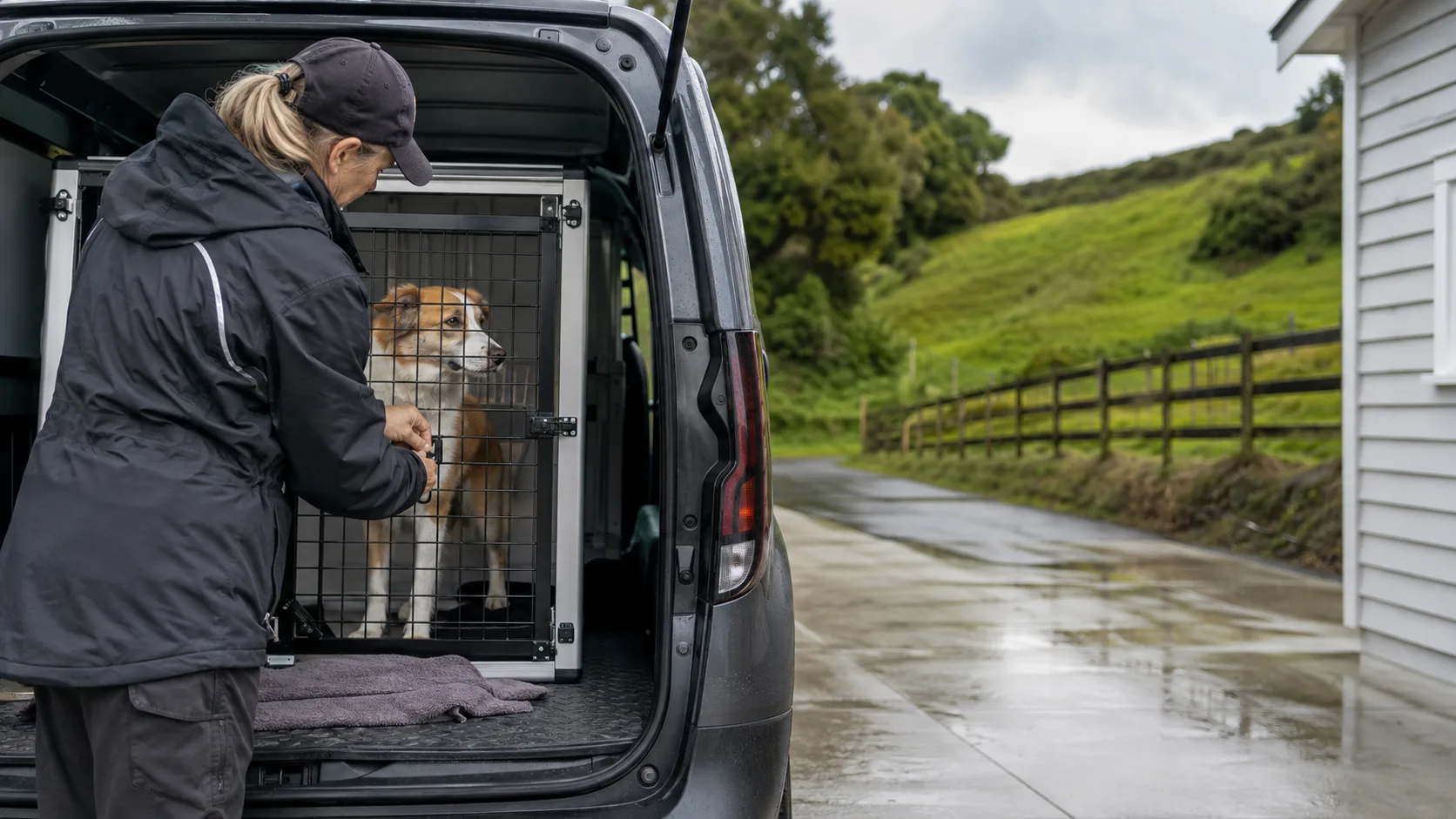
Booking software for pet transport in New Zealand.
Two addresses on one job and a living thing in the back. Price the round trip properly, carry one animal at a time, and tell the owner it arrived.
 Start with Google
- The whole round trip, wait included, set as the job length
- One animal per booking, so nothing overlaps by accident
- Carrier size and temperament notes kept on the pet
- The destination appointment time built into the booking
Online booking
The clinic run books itself, the move asks
A there-and-back to the vet drops into a genuine gap on your day. A run the length of the island arrives as a request, not a form question.
Learn moreSmart scheduling
Out, the wait and back, as one block
The job is the drive plus the appointment plus the drive home. Set it that way and nothing lands on top of a van still parked outside the clinic.
Learn moreOne booking, and the address on it is the pickup.
The collection point is what the coverage check reads and what the driving is measured from. Where it is going travels with the job: the service, the appointment time at the other end, and the notes on the animal's record.
We are moving at the end of the month and cannot take her on the plane. Two dogs, one crate each. Can you do the whole run?
The move that should never self-serve.
Nobody should click their way into a three-day run with a crossing in it. It arrives as a request with both ends on it and you answer in the thread.
- 12 AugVet run · there and backBooked · $95
- 2 AugPayment received$140
- 28 JulRelocation quoteAccepted · $1,180
- 14 JunGrooming drop-offCompleted · $60
The animal has a record, not a line in a diary.
Crate size, temperament, what it is on and who the vet is. Every trip it has taken with you sits under it, so the second booking starts from what you already learned on the first.
Out, the wait, and the way back are one block.
A run to an appointment is not the twenty minutes of driving, it is the driving plus however long the appointment takes plus the driving home. Set the job length to the whole of it and the page stops offering a pickup that was never going to make it back. Nothing else can be booked on top of it either, because overlapping jobs on one van are refused by the database rather than flagged for you later.
Built for your trade
Built for the runs you actually take
Vet and after-hours clinic runs
Collection, the appointment and the trip home, timed and priced as one job so the slot at the other end is a promise the day can keep.
Island to island relocations
A crossing in the middle and a night either side. Quoted as a document with a line at each end, so accepting it dates both days at once.
Ferry crossings with the animal aboard
A sailing time nobody can move. The booking is anchored to the check-in, not to whenever the van feels ready to leave.
Airport and cargo transfers
A hard cut-off at the freight counter, with the crate and the paperwork checked before you set off rather than at the counter.
Cattery and boarding kennel runs
Out the morning they fly and back the afternoon they land. Two bookings, two prices, both under the same animal record.
Grooming and daycare drop-offs
The standing Thursday run, set up once as a repeating arrangement and generated ahead instead of typed in every fortnight.
Rescue and foster transfers
A shelter to a foster home, often paid by somebody who never meets the animal. The payment request goes to whoever is actually paying.
Lifestyle block and rural collections
Long metal driveways and a gate code that matters. Kept on the property so the next driver arrives already knowing it.
Post-surgery collections
A groggy animal, a discharge time you do not control and a crate that has to suit. Noted on the record before you pull out.
Multi-animal households
Two dogs from the one gate, booked as two jobs rather than one crowded trip, so the van never carries more than the price assumed.
A long move is a document, not a phone call.
Two ends, two dates and a crossing in between. Put the lot on one page they can read twice, then accept without ringing you back.
Three versions of the move, with Pro
On Pro one document carries the straight run, the run with a night either side of the crossing and the door-to-door with a settling visit. They pick one and type their name to accept it.
A line can carry its own address
Collection at one end, delivery at the other, each attached to where it happens instead of buried in a paragraph nobody reads twice.
Accepting it makes both jobs
Lines grouped by address become one dated booking each, so the collection day and the delivery day land together the moment they say yes.
The reference is stamped once
The quote number comes off the system and is never retyped, which matters when the animal travels with paperwork that has to match it.
- Collection & settlingPonsonby$180
- Transit & overnight stop2 nights$820
- Delivery & handoverNewmarket$180
Paid without a chase.
A clinic run is settled the same afternoon. Three days on the road should not still be owing a fortnight after the dog walked into its new house.
Cash and transfer are free, always
Record it by hand against the job in a few taps. That costs nothing on any plan and it never has.
Cards come with Pro
Send a payment request the owner settles from wherever they are, which on a long move is rarely the same place as the animal.
Straight into your own account
Card money is paid out to your own Stripe account rather than sitting inside Bookables waiting on a payout cycle.
- Hemi WalkerP-1011 · 25 Jun · Bank transfer$380
- Sarah ColemanP-1012 · 25 Jun · Cash$240
- Mere SolomonP-1013 · 28 Jun · Card$380
- James FifitaP-1001 · 27 Jun · Card$190
Four states, and one of them is nobody home.
Accepted, on the way, on site, done, moved by hand as the run happens. And when you pull up to a locked door with an appointment thirty minutes away, the job closes as a no show rather than being deleted, so the trip you made still shows on the record and on the invoice.
- Sarah Coleman2mCan you come Thursday instead?
- Bookables1hA booking request needs your answer
- Mere Solomon3hRunning 10 late on the Newmarket job
The person paying is usually at neither end.
A neighbour hands the animal over, a nurse takes it, and the owner is at work wondering. Write the note and take the photo on the job as your own record of the condition it travelled in, and send the owner a line in the thread when it is in and settled. Switch on the status moments and the same news goes out by email without you typing it twice.
How far you will actually go.
The everyday runs come out of a patch you know. The ones that do not should reach you as a question, not as a booking you ring back to undo.
Checked before it books
The collection address is matched against your areas first, so nothing confirms itself at a gate you were never going to drive to.
Past them it becomes a request
The long one is not turned away. It waits on a yes from you, which is the right answer for a job you need to think about anyway.
Areas belong to people
With a second driver, the far side of the harbour goes to whoever covers it rather than to whoever happened to answer.
- Grey Lynn8 districts · 2 crew
- Devonport7 districts · 2 crew
- Auckland North7 districts · 2 crew
When the other end runs late.
Still in the waiting room at half eleven with three animals in the afternoon. Moving the rest of the day is dragging, not ringing around.
Drag it, then commit it
Push the whole afternoon back an hour as one change and let it save together, rather than editing four bookings one at a time.
The weekly ones repeat themselves
A standing daycare run is a pattern, not forty bookings you type. Move one visit and the ones after it follow it along.
Tell them, if you want to
A moved booking can email the owner once you have switched that moment on. Off out of the box, so nothing goes out you did not choose.
- Mason King · Mount EdenVet run · there and back · Wed · 3:30pm$180
- Ava Baker · Grey LynnRelocation · collection day · Wed · 1:00pm$560
- Grace Walker · AucklandGrooming collection · Wed · 11:30am$120
- Amelia Ryan · Mount EdenBoarding transfer · Tue · 2:00pm$190
Starts free. Grows
only when you do.
Add your whole team and get booking for nothing.
As you grow with us you can go Pro.
One app for the whole job
Everything you need to run your pet transport business.
Common questions.
The booking holds one address and it is the collection point, because that is what the coverage check and the drive times are worked out from. The other end travels with the job: the service name, the appointment time and the notes on the animal. A drop now and a collect later is two bookings, and a long move is quoted as lines with their own addresses, which becomes one dated booking per address when it is accepted.
Yes. Set the job length to the whole round trip with the wait inside it, and the booking page will only offer slots that genuinely leave time to get back. Anything overlapping is refused by the database rather than flagged later.
No. There is no live tracking and no map link for customers, and it would be dishonest to imply one. What there is: a status you move as the run happens, a note and a photo on the job record, and a message in the thread when the animal is handed over. Turn the status moments on and the same news goes out by email.
Yes. One animal per booking is the default because the job occupies the whole block, and a second booking on the same van for that span is rejected at the database rather than quietly accepted.
Cash and bank transfer are recorded by hand on the job and cost nothing on any plan. Cards come with Pro, and on Pro a long move can be split into stages with their own due dates and pay links, so the whole thing is not still owing a fortnight after delivery.
No software does that for you. Moving a live animal is covered by the Code of Welfare: Transport within New Zealand, issued under the Animal Welfare Act 1999, and by its own words it applies to everyone transporting any live animal, not only a livestock operator. What Bookables does is hold the evidence: notes and file attachments on the job record, the condition photo from collection, and a stamped time against every status you moved.




Pet Transport & Taxi guides
All articlesHow to take bookings while you're doing the actual work
Set up online bookings around your services, prices, travel and availability so customers can book while you're busy doing the job.
ReadHow much booking notice should you require?
Choose a booking lead time that allows for preparation, staff and travel, with practical examples for mobile services, venues and classes.
ReadHow to reduce appointment no-shows without becoming their mum
Reduce appointment no-shows with clear confirmations, useful reminders and easy rescheduling. Includes a sample reminder and a simple measurement method.
Read