Scheduling software for carpenters across the US.
A deck takes most of a week, a sticking door takes twenty minutes, and both want the same Thursday. Quote it, book it and get paid without juggling three apps and a notepad.
 Start with Google
- Tiered quotes signed from a phone
- Accepted quotes become booked jobs
- Repairs booked online with true durations
- Card payment requests at handover
Online booking
Small jobs book themselves online
A door that dropped, a rotten porch board, baseboard to patch after the plumber. Give the short work a real duration and customers grab the gaps.
Learn moreSmart scheduling
A five-day deck is one block
Footings Monday, framing Tuesday and Wednesday, decking Thursday, rail Friday. One block on the calendar, so nothing else lands in the middle of it.
Learn moreThe work is booked in weeks, not hours.
Framing days, boarding days, a fit-out that eats a Thursday. A carpentry diary is read across weeks, so the honest question is never what time you are free — it is which week is still open.
When the week is already full.
Carpentry books out in weeks, so once the days are gone the page stops offering them and asks instead.
No slot you cannot work
If the deck took Monday through Friday, none of it shows. Your calendar decides what is offered, every time.
You still get the lead
They leave the job, the address and a photo of the rot instead of calling the next carpenter on the list.
Quote it that evening
It is waiting in your inbox with the detail already attached, so the estimate takes four minutes, not a callback.
Photos attached. Happy to wait for a week that suits you — how far out are you booking at the moment?
How far you will pull the trailer.
A week of framing forty minutes out pays for the drive. A twenty-minute door adjustment does not. Draw the areas you cover and the site holds the line.
Drawn, not guessed
Mark the ZIPs on a map. Inside, people book. Outside, they get a request form and you decide.
Different work, different reach
You will drive further for a deck than for a sticking door, and your areas can say exactly that.
No charge for the drive
We never add money for a longer trip. Where you will and will not go is a boundary, not a surcharge.
- Hyde Park8 counties · 2 crew
- Zilker7 counties · 2 crew
- Austin North7 counties · 2 crew
A backyard deck, quoted three ways.
Every deck call is the same: how big, what decking, does the old one come out. One estimate carrying pressure-treated, cedar and composite options.
Let them pick the timber, with Pro
Pro: option groups. Railing or open edge, one step or a full stair run, stained or left natural. Each carries a price difference and the total updates, so the number they accept is the number you invoice.
Quantities and rates, not one number
Square feet of decking, linear feet of railing, days of labor. The customer can see exactly what they are buying.
One address per line
The deck at the house and the fence at the rental on one estimate, each line keeping its own address when it books.
Numbered once, for good
Estimate numbers get set behind a confirmation and never change, so your books and the customer copy always match.
- Spotted gum decking · 18m²Supply$2,700
- Subframe, bearers & joistsLabour$1,450
- Lay, fix & oil2 days$1,850
Built for your trade
Built for every kind of carpentry and joinery
Deck building
Priced by square footage with the decking material as an option, booked as the run of days framing and decking take.
Deck repair and reboarding
Old boards off, framing checked, new boards down. Quoted hourly with a materials line until you see what is under it.
Trim and crown molding
Finish work priced by the room, so a whole-house trim package is one number you can send from the driveway.
Built-ins and bookcases
Shop days and install days on separate lines, booked as two blocks instead of one date that means nothing.
Cabinet installation
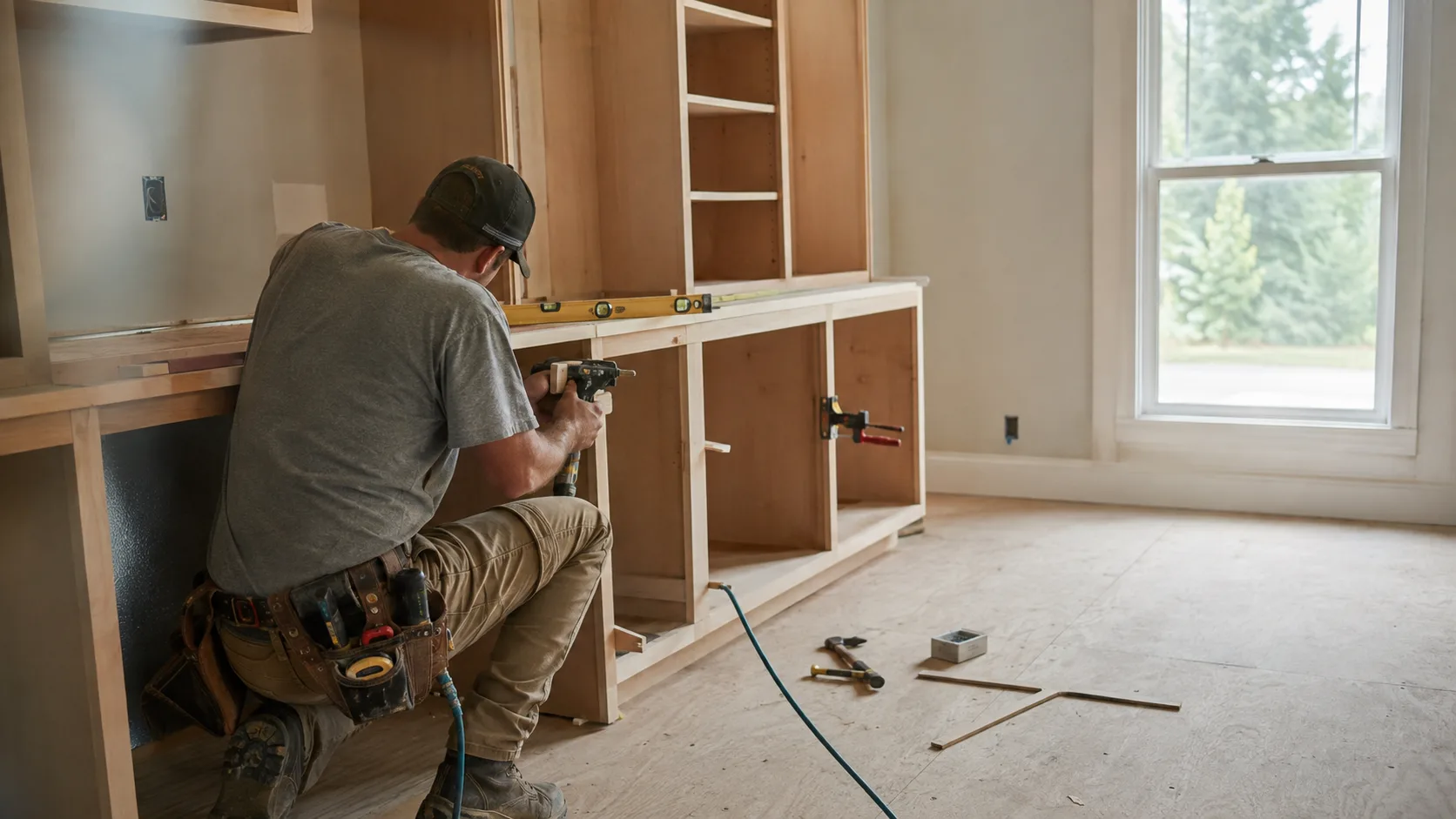
The shop delivers, you hang. Book the install against the delivery date and keep both on the same job record.
Interior and exterior doors
Prehung units, hardware and the twenty-minute adjustment call that fills the gap between two bigger jobs.
Basement and garage framing
A week of framing booked in one block, with the electrician and the drywaller reading the same schedule you are.
Stairs and railings
Stringers, treads and railing on their own lines, with the code work priced in rather than sprung on the customer.
Pergolas and porch rebuilds
Posts, beams and roof on separate estimate lines, so the customer can see what skipping the roof would save.
Window and door replacement
Measured, ordered and installed. Book the install for the day the units land, not the day you took the call.
Fences and gates
Priced by the linear foot from a photo, booked into the half day it takes, paid before you pull out of the driveway.
The forty-minute job books itself.
A sticking door or a gate that needs rehanging is too small to quote and too easy to lose. Put it on your page with its own price and its own length and it lands in the gap on its own.
- 11 AugDeck buildingBooked · $6,000
- 2 AugDeck building quoteAccepted · $6,000
- 17 JulPayment received$420
- 17 JulInterior and exterior doorsCompleted · $420
The address remembers the timber.
Every deck, robe and rehung door at that property on one record. When they ring three years later about matching the boards, you are reading what you actually used rather than guessing.
When the material is late.
The composite did not ship, the concrete is green, the electrician is still in the wall. Move the day and everything downstream moves with it.
Drag it, do not retype it
Push the block to Thursday and every day inside it moves too. On any plan, including the free one.
One schedule for the crew
Your lead opens the app on site and reads the exact same calendar you are looking at in the shop.
The customer hears it once
The change goes out on the job thread, so nobody is standing in the backyard at seven waiting on your truck.
Get paid before you load up.
Plenty of this money still shows up as cash or a bank transfer, and recording that by hand is free forever. Cards are the piece that comes with Pro.
Cash and transfer, free
Mark it paid on the job and you are done. No fee, no plan required, nothing waiting to clear.
Cards on Pro
Text the link from the driveway and the small job is paid before the miter saw is back in the truck.
Stage the big ones
Staged payments come with Pro: ask at framing and again at completion, after the job is booked, never at checkout.
- Marcus BellP-1011 · 25 Jun · Bank transfer$380
- Ashley NguyenP-1012 · 25 Jun · Cash$240
- Tyler BrooksP-1013 · 28 Jun · Card$380
- Jasmine CarterP-1001 · 27 Jun · Card$190
Starts free. Grows
only when you do.
Add your whole team and get booking for nothing.
As you grow with us you can go Pro.
One app for the whole job
Everything you need to run your carpentry business.
Common questions.
No. This is scheduling and invoicing software, not a licensing body. Requirements vary a lot by state and city. California, for example, issues a C-5 for framing and rough carpentry and a C-6 for cabinet, millwork and finish carpentry through its contractors board, while other states leave it to the county. Booking works the same either way.
Yes, and that is the point. Book the deck across the days it actually takes and it shows on the calendar as one block, so a Wednesday request lands next week instead of on top of your framing. Drag the block and every day inside it comes along.
That is the normal path for anything bigger than a repair. Put framing, decking, railing and stairs on their own lines with quantities and rates, send it, and let the customer sit with it. Nothing hits your calendar until they accept and you pick the week.
With Pro you build option groups: pressure-treated, cedar or composite, each carrying its own price difference. The customer picks, the total updates, and you skip writing the same estimate three times.
Recording cash and bank transfer by hand is free and always will be. Card payments come with Pro, so a trim repair gets paid before you load up, and the money goes to you. We never hold your money.
Yes. He sees the jobs he is assigned to and nothing else. Your rates, your customer list and anything to do with money stay with you.





Carpentry & Joinery guides
All articlesOnline booking vs phone booking: which one actually gets the job booked?
Compare online and phone bookings for service businesses, with a practical way to handle standard jobs, tricky enquiries and customers who prefer a call.
ReadFully booked? How to keep the lead without promising the impossible
Handle enquiries when your diary is full with clear requests, alternative times and a practical manual waiting list that avoids double bookings.
ReadBooking deposits: enough to make it real, not a hostage negotiation
Choose booking deposits that fit your work, explain the balance and cancellation terms, and understand how deposits differ from refundable security bonds.
Read