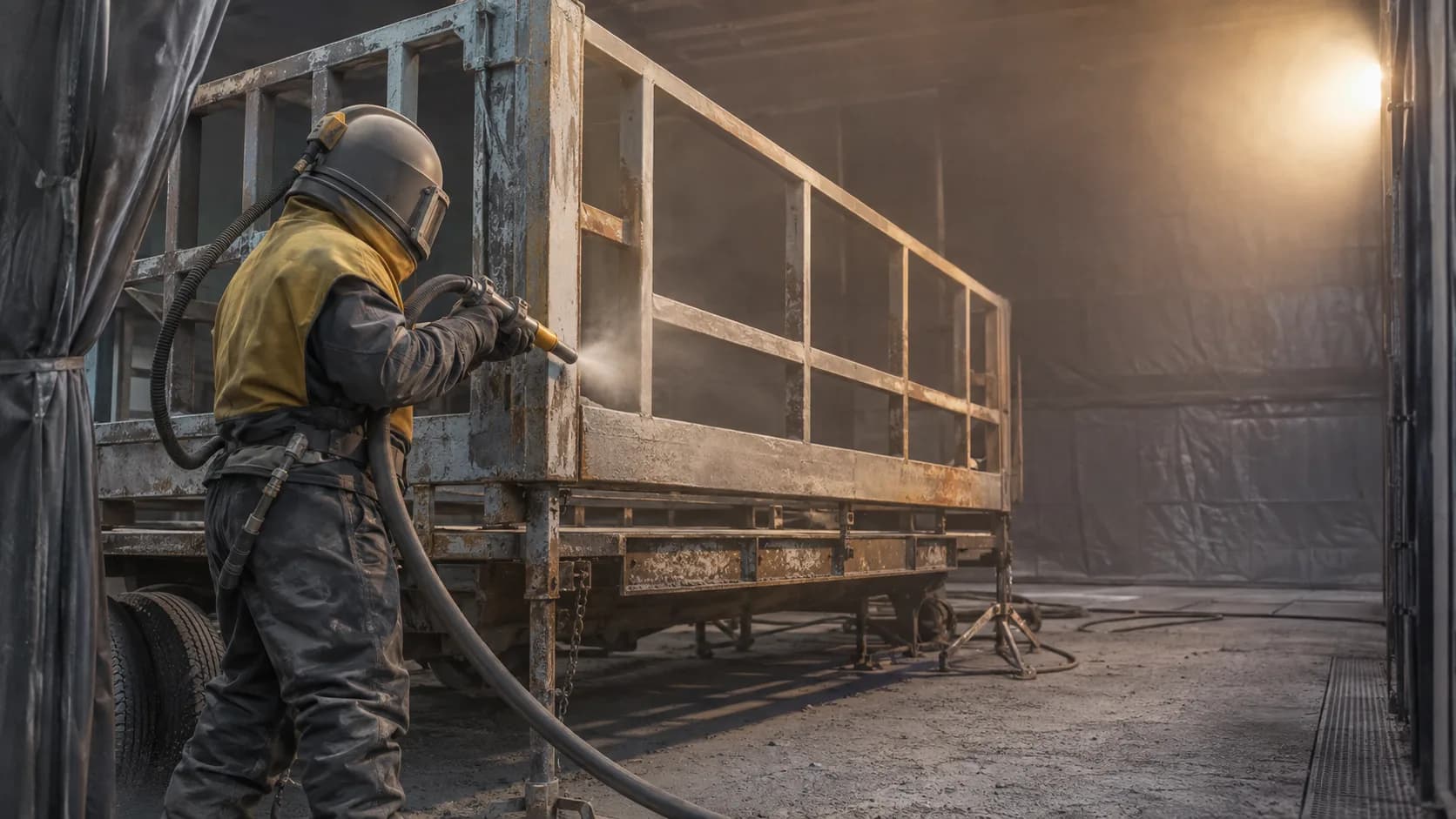
Booking software for sandblasting businesses in the US.
From the request that shows up with photos of a rusted frame, to the soda-or-garnet quote, to the day the pot rolls out and you get paid.
 Start with Google
- A details and photos request instead of a straight booking
- Soda strip and garnet blast offered as priced options
- Containment and site protection as their own quote lines
- Media covered by a deposit before you order it
Online booking
Requests that show up with the surface
Two photos and a guess at the size is not a quote. Your page asks what the substrate is and what is on it before it ever becomes a job.
Learn moreSmart scheduling
Shop days and job site days together
Work customers bring to the shop and work you haul the rig out for share one week, so the pot never gets promised to two jobs at once.
Learn moreBooked solid for the next two weeks.
Blasting books out in blocks, not hours. When there is nothing left this month your page still takes the request, and takes the photos with it.
It asks the hard questions for you
Substrate, rough size, how many coats and whether anyone has blasted it before. It all lands before you have to put a number on it.
The photos land on the job
That hole under the enamel is on the record from the first message, so you are not discovering it with the pot already unloaded.
One place to answer from
The request and the quote you sent back sit together, so nothing gets lost three screens deep in a text thread on the other phone.
Trailer chassis back to bare steel. Photos of the pitting attached, plus what I think is on it. Can you price soda and grit both ways?
A classic frame taken back to bare steel.
Two ways to do the same frame: a soda strip that leaves the metal alone, or a garnet blast that cuts a profile for the primer.
Priced off the surface, not a hunch
Square footage, media, primer and containment are separate lines, so when the price gets questioned you can show exactly where it came from.
Containment is a line, not a freebie
Screening, shrouding and hauling off spent media is quoted where the customer can see it, which is the only way it ever gets paid for.
Sent before you pull off the curb
The quote goes out from your phone while you are still parked out front, which is usually before the next shop calls them back.
Media and extras priced as options · Pro
Containment, spent media hauled off, epoxy primer before it leaves the shop, pickup and delivery. Each one is a priced option, so when the customer checks it the quoted total moves and nobody retypes anything.
- Soda stripOption A$680
- Garnet blastOption B$920
- Containment & site protectionFixed$260
The morning the wind picks up.
Outdoor blasting stops when it blows and the whole week shifts behind it. Drag the job to Thursday and everyone behind it gets told.
One record, first photo to final coat.
What the substrate is, what came off it, which media you used and what it cost, all on the job rather than in a folder on the office phone.
Built for your trade
Built for the surfaces you actually strip
Classic car frames and body shells
Soda on the panels, garnet on the frame rails. The owner remembers two coats and you find five once the gun is running.
Wrought iron fencing and gates
On-site work along a property line, where the screening and the cleanup take up as much of the quote as the blasting does.
Pool interiors
Confined work with its own setup and its own crew, and a day length that has very little to do with the square footage.
Truck beds and trailer decks
Road salt gets under the coating and stays. Back to bare steel and primed the same day, priced off the length.
Structural steel for a GC
Beams and columns blasted before the coating crew shows up, where access and containment drive the price more than the tonnage.
Water tanks and tank exteriors
Big square footage, tight containment and a schedule built around whatever else is running on that site.
Graffiti removal on brick
Tags off a wall without ghosting the brick, quoted off the area and the substrate instead of off the photo you were texted.
Log homes and timber
Soda or a soft media to strip old stain off logs without fuzzing them. Slow work, billed by the day for good reason.
Farm and ag equipment
A shop full of implements over the winter, quoted as one job with a run of lines rather than eight separate phone calls.
Boat hulls and marine steel
Bottom paint taken back in the yard, where your slot is booked weeks out and the day length sets the number.
- 18 AugGarnet blast, trailer chassisBooked · $1,180
- 11 AugContainment & media disposalInvoiced · $260
- 2 AugSoda strip, gatesAccepted · $680
- 9 JulStructural steel, prep onlyCompleted · $2,400
The shop that sends you work every winter.
Every job you have blasted for them, what was on the steel last time and the rate you gave, on one card instead of in last year's book.
- Marcus BellBooked just now$215Accepted
- Ashley NguyenOpened 2h ago$480Viewed
- The Oak CaféSent yesterday$120Sent
The soda quote they never came back on.
Two media, two prices, and then silence. See which quote was opened and which was signed, so you know whether to order the pallet or make the call.
Get paid for the blast without chasing.
You buy media before the job, so the money should not show up a month after it. Record cash and transfers free, or take cards with Pro.
Cash and transfer are free
Mark the job paid when the transfer lands. That costs nothing on any plan and it is going to stay that way.
Cards come with Pro
Send a card link when the frame is back on their trailer. The money goes to your account, and we never hold it on the way.
Ask for part of it early
Once the job is booked you can request part before the pallet of garnet is ordered and the rest at completion. Staged requests come with Pro.
- Marcus BellP-1011 · 25 Jun · Bank transfer$380
- Ashley NguyenP-1012 · 25 Jun · Cash$240
- Tyler BrooksP-1013 · 28 Jun · Card$380
- Jasmine CarterP-1001 · 27 Jun · Card$190
How far the rig actually travels.
Half this trade comes to your shop and half of it does not. Set what the rig covers so a job three hours out cannot book itself in.
Draw the area around the shop
Addresses outside it hear back right away instead of a week later, which is better for them and a lot better for you.
Shop work travels nowhere
Drop-off jobs book to your address instead of theirs, so they never count against a day the rig is already out on a site.
Same rate across the whole area
Inside your area the price is the price. Bookables never quietly tacks anything on for a longer haul out.
- Hyde Park8 counties · 2 crew
- Zilker7 counties · 2 crew
- Austin North7 counties · 2 crew
Starts free. Grows
only when you do.
Add your whole team and get booking for nothing.
As you grow with us you can go Pro.
One app for the whole job
Everything you need to run your sandblasting business.
Common questions.
Yes, and it is the right way to run this trade. Route blasting to a details-and-photos request instead of an instant booking and set your own questions: the substrate, rough size, what is on it and whether it has been blasted before. The request arrives ready to price.
You can, and customers like choosing. Both go on the same quote as options with their own prices, and the total updates when they pick one. The option they signed for is right there on the record instead of in somebody’s memory of a call.
Yes, each with its own quantity and rate. Screening a driveway, protecting the neighbor’s windows and hauling off spent media is real labor and real disposal cost, and itemizing it is how it stops getting absorbed into one number.
Once the job is booked you can send a payment request for part of it and another for the balance when the work is done. Staged requests and card payments come with Pro. Cash and bank transfer you record by hand are free on any plan.
It works well. Drop-off jobs are booked to your own address, so they take no travel and never count against a day the rig is out. Your service areas then only govern the work that actually goes somewhere.
Drag the job to another day and everyone booked behind it gets told automatically. Moving work around the day is on every plan, including the free one, because a blasting schedule you cannot rearrange is not worth having.
Sandblasting & Soda Blasting guides
All articlesOnline booking vs phone booking: which one actually gets the job booked?
Compare online and phone bookings for service businesses, with a practical way to handle standard jobs, tricky enquiries and customers who prefer a call.
ReadFully booked? How to keep the lead without promising the impossible
Handle enquiries when your diary is full with clear requests, alternative times and a practical manual waiting list that avoids double bookings.
ReadBooking deposits: enough to make it real, not a hostage negotiation
Choose booking deposits that fit your work, explain the balance and cancellation terms, and understand how deposits differ from refundable security bonds.
Read