Scheduling and estimating software for US scaffold companies.
From the first walkthrough on a siding replacement to the day the last frame comes off the truck ramp and the rental clock stops.
 Start with Google
- Package quotes signed online
- Erect and dismantle booked as separate visits
- Crews across sites on one timeline
- Payment requests when the gear comes down
Online booking
Let the walkthrough book itself online
Nobody prices a three-story frame job from a text message photo. Put the walkthrough on your page and estimate after you have seen the tie-in points.
Learn moreSmart scheduling
Erection and teardown, scheduled together
Every scaffold is two crew visits with rental weeks in between. Book both when you estimate and the teardown is on the calendar from day one.
Learn moreNeed a full wrap on a two-storey in Hyde Park for the renderers. Anything free before the end of the month?
The yard is out of frames until the fourteenth.
Scaffolding runs out of inventory long before it runs out of hours. When nothing is free, your page says so and still captures the lead.
The erect and the strip, both on the board from day one.
A scaffold stands for weeks, so the dismantle is a date you set while you are quoting rather than something you hope somebody remembers in March.
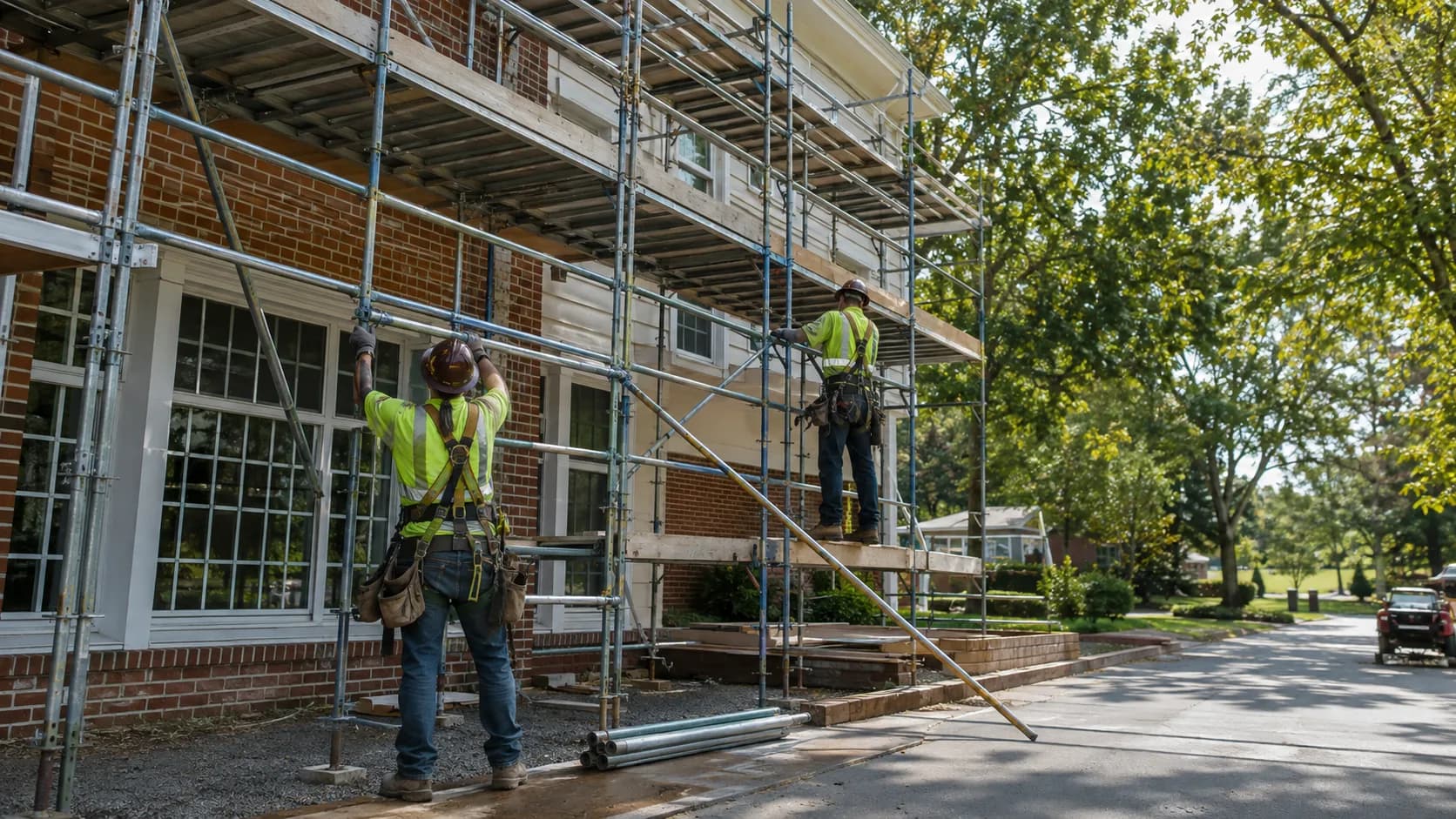
Frame scaffold for a siding replacement.
Three ways to price it: access to one elevation, the full wrap to the eave line, or that plus debris netting and a materials landing.
Priced off the elevation
Bays, lifts, netting and rental weeks are separate lines, so when the number gets questioned you can show exactly where it came from.
A total that keeps up with you
Add the stair tower or another month of rental and the total moves with it. No math on the tailgate, no number to walk back later.
Sent before you pull away
The estimate goes out while you are still parked at the curb, which is usually before anyone else has returned the call.
Extras priced as options · Pro
Pro: put the add-ons on as priced options. Netting, shrink wrap, a stair tower, four more weeks of rental. The estimate total moves the moment the GC picks, so you are not retyping anything.
- Full wrap erect & edge protectionLabour$4,200
- Scaffold hire · 4 weeksHire$1,600
- Dismantle & cart awayLabour$1,400
One record from the site look to the last bay.
Where it is, what is going up, what it costs and when it comes down, all attached to the job before the truck is loaded.
- 19 AugFull wrap, erectBooked · $4,200
- 12 AugHire, 4 weeksInvoiced · $1,600
- 2 AugEdge protection quoteAccepted · $1,180
- 14 JulDismantle & cart awayCompleted · $1,400
The same builder, four scaffolds a year.
Every site you have wrapped for them, what you charged and what is still standing, on one card instead of in last year's notebook.
- Marcus BellBooked just now$215Accepted
- Ashley NguyenOpened 2h ago$480Viewed
- The Oak CaféSent yesterday$120Sent
Which quotes were opened, and which went quiet.
A scaffold quote sits with three others on a builder's phone. See what has been read and what has been signed, so the one worth a call is obvious.
Built for your trade
Built for the scaffolds you actually put up
Siding replacement access
A full wrap to a three-story building, estimated elevation by elevation with the rental period stated so the siding crew knows their window.
Roof edge protection
Guardrail and perimeter protection for a reroof, on the calendar the day before the roofers start and torn down the day after they finish.
Masonry and tuckpointing
A frame scaffold up a brick elevation with a mortar landing, priced by bay and lift so the mason can question one line at a time.
Stair tower rental
A stair tower for crew access on a long job, rented by the week with the pickup date on the record so the yard knows what is out.
Sidewalk canopy
Overhead protection on a storefront, where the permit conversation runs right alongside the estimate and belongs on the same job.
Interior birdcage
A work deck across a lobby or gym floor, priced on the square footage and usually built overnight while the building is closed.
Painting access
Access and containment for an exterior repaint, with the netting sold on top of the base scaffold rather than baked into one number.
Chimney and gable work
The small tricky one on a steep pitch, estimated after a walkthrough because the photo the homeowner sent never shows the ground.
Rental extensions
The build slips and the scaffold stays. Extra weeks go on the open job and get invoiced from it, so billed weeks match standing weeks.
Teardown and haul off
The teardown scheduled as its own visit with its own crew, because the guys who erected it are two jobs across town by then.
Get paid for the build and for the rental.
Two payments on every job, and chasing either is time you never bill. Record what comes in for free, or take cards with Pro.
Cash and check are free
Mark it paid when the check clears. That costs nothing on any plan and it is not going to change.
Cards come with Pro
Send a card link for the erection, and another for the weeks the schedule ran long.
Split it across the job
Part at handover, the rest at teardown. Staged requests come with Pro, and they go out after the job is booked.
- Marcus BellP-1011 · 25 Jun · Bank transfer$380
- Ashley NguyenP-1012 · 25 Jun · Cash$240
- Tyler BrooksP-1013 · 28 Jun · Card$380
- Jasmine CarterP-1001 · 27 Jun · Card$190
How far your trucks go.
A truckload of frames has a sensible radius, and past it the job stops paying. Set what you cover and your page holds that line.
Your ZIP codes, your call
Draw the area around the yard. Anything outside it hears right away instead of after a week of silence.
Two yards, two areas
Inventory in two yards means two areas, and the job lands with the yard that can actually service it.
Same rate across the area
Your rate is your rate anywhere inside it. Bookables never quietly adds anything for a longer drive.
- Hyde Park8 counties · 2 crew
- Zilker7 counties · 2 crew
- Austin North7 counties · 2 crew
Starts free. Grows
only when you do.
Add your whole team and get booking for nothing.
As you grow with us you can go Pro.
One app for the whole job
Everything you need to run your scaffolding business.
Common questions.
No. Subpart L requires a competent person to inspect before each work shift, and Bookables is not that record and never signs anything off. It holds the job: the address, the erection and teardown dates, your notes and your photos.
You can note it. Everyone on your team has their own record, so you can keep who has been trained on what and when it was refreshed. It is a note for you, not a certification, and Bookables issues nothing.
The job stays open as long as the scaffold is standing. Add the extra weeks when the GC calls and invoice them from the same record, so the rental you billed matches the rental that actually stood on the building.
It does not, and you would not trust one that claimed to. You price the bays, the lifts, the netting and the rental period. Bookables keeps that estimate tied to the dates and the payments instead of living in a separate spreadsheet.
Yes. Estimating, the schedule, the booking page, your customer list and the inbox are all free, with a monthly allowance most two-crew shops never reach. Card payments and the automatic pieces come with Pro.
No. Cash and check you record yourself are free on any plan, and when you turn on card payments the money goes to your own account. We never hold your money for you.


Scaffolding guides
All articlesOnline booking vs phone booking: which one actually gets the job booked?
Compare online and phone bookings for service businesses, with a practical way to handle standard jobs, tricky enquiries and customers who prefer a call.
ReadFully booked? How to keep the lead without promising the impossible
Handle enquiries when your diary is full with clear requests, alternative times and a practical manual waiting list that avoids double bookings.
ReadBooking deposits: enough to make it real, not a hostage negotiation
Choose booking deposits that fit your work, explain the balance and cancellation terms, and understand how deposits differ from refundable security bonds.
Read