Booking software for garden clearance in New Zealand.
Book the look before you price the section, quote the clear in loads with the transfer station fee sitting on the line, and get paid before the trailer leaves.
 Start with Google
- Quotes signed the day they ask
- Deposits make the booking real
- Paid as the last load leaves
- Every property kept on record
Online booking
Book the look before you name a number
Two photos make any section look manageable. Your page sells a quote visit at a time you have free, so the price gets written standing in it.
Learn moreSmart scheduling
Full trailer, half the section, gate shuts
Greenwaste days run long. Drag the rest onto tomorrow and whoever is on those days sees the new start without being rung about it.
Learn more- Mason King · Mount EdenEmergency call-out · Wed · 3:30pm$180
- Ava Baker · Grey LynnCallout +1 · Wed · 1:00pm$560
- Grace Walker · AucklandRepair visit · Wed · 11:30am$120
- Amelia Ryan · Mount EdenSecond visit · Tue · 2:00pm$190
When the season is already spoken for.
Everyone wants it down before the grass dries off and there is not a day left. The page takes the job as a request rather than losing it.
Nobody has been through the back in three years. Photos attached. How soon can you look at it?
It arrives as three photographs.
Pictures flatten it. The request lands with the images and the address on them, which is enough to tell a morning from two days, and nowhere near enough to name a price.
Built for clearance work
The work a clearance crew actually gets called for
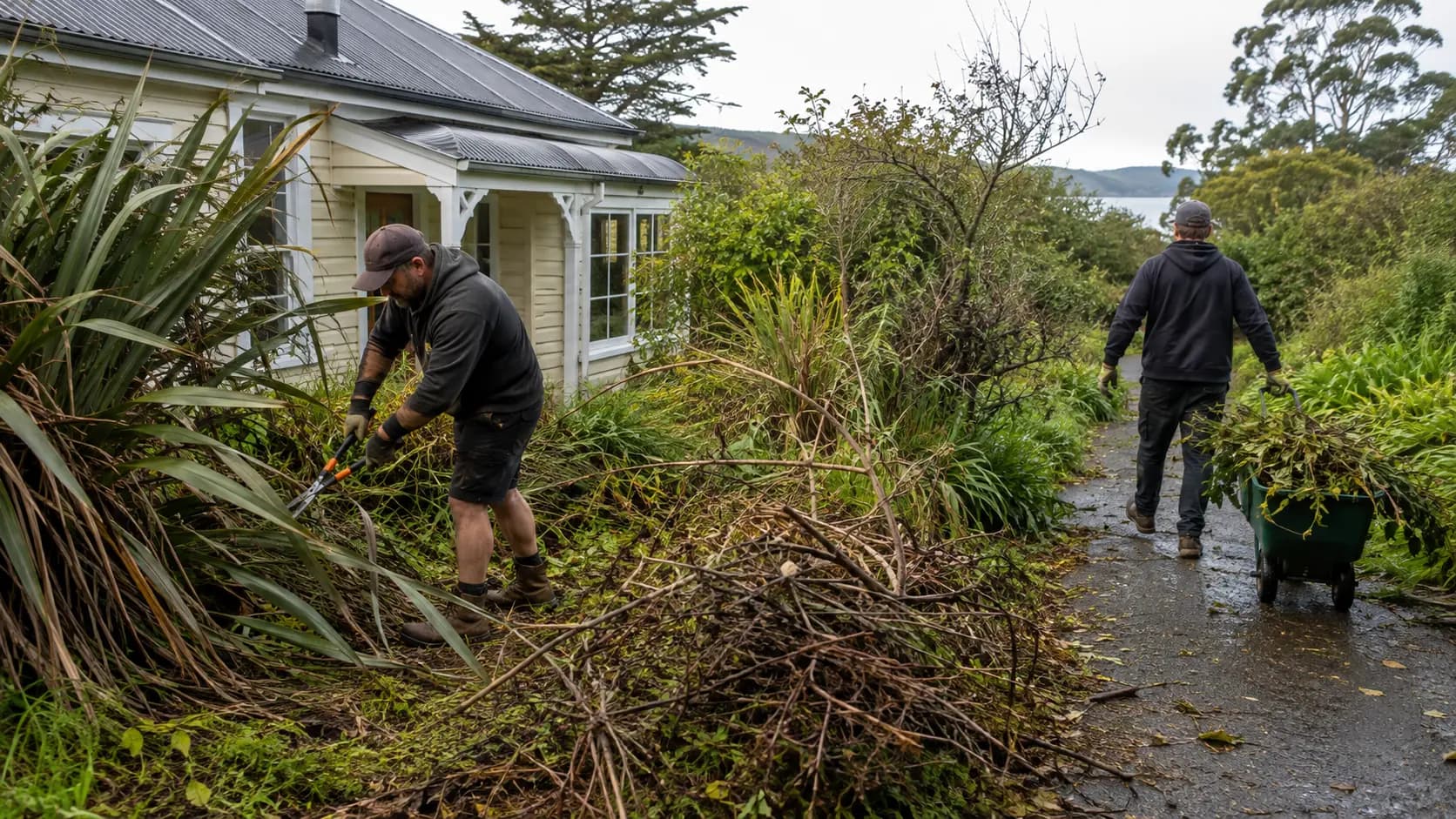
Overgrown section clears
Two summers of nobody touching it. Book the look, quote the loads off what you actually saw, and hold the days the job genuinely needs.
End-of-tenancy garden resets
A hard handover date and a bond in play. The property manager books, the tenant is at the address, and the receipt lands where it will be asked for.
Greenwaste trailer runs
Someone else did the cutting and the pile has been there a month. Priced by the load, with the levy on the line rather than swallowed.
Storm and windfall clean-ups
The page keeps taking work while you are on the chainsaw, and anything you cannot fit queues up as a request with the photos on it.
Gorse and blackberry knockdowns
Slash, rake out and cart. Weed loads price differently to clean prunings, so they go on separate lines instead of one hopeful number.
Agapanthus and privet strip-outs
Dug out rather than cut back, which is a different job and a different quantity of loads. Quoted as its own line on the same document.
Deceased estate gardens
Years of growth and a family who live somewhere else. Quote it from the photos on the record and send the after shots when it is done.
Fire season cut-backs
Long grass down and the scrub pulled off the boundary before it dries out. Two days, two on the crew, both held on the one job.
Rental turnover tidy-ups
Three empty sections for one manager, quoted on one document with an address against each line, and accepted as three separate bookings.
Old shed and decking removals
The moment treated timber is in the trailer the rate changes, so it is quoted as its own line rather than folded into the greenwaste.
One overgrown section, three ways to leave it.
Cut down and hauled off, cut down and the boundary pulled back, or cleared right out with the dead hedge and the rotten decking gone as well.
Loads are a line, not a hunch
A load is a quantity against a rate with its own unit on the estimate, so four instead of two re-prices the job rather than quietly eating the day.
Disposal sits on the line that made it
Clean greenwaste, dug-out weed and the wire fence somebody left in the gorse each carry their own extra, so the yard fee is priced not absorbed.
The visit fee comes back off
Where you charged for the look and the service is set up for it, that fee lands as a credit line on the estimate the moment you write it up.
Three versions of it come with Pro
Options are the Pro part: three versions of the same clear on one estimate, one of them marked as the one you would pick. Cash and bank transfer stay free on every plan.
- Slash & clear overgrowth2 crew · full day$1,200
- Green waste removal3 loads + tip fees$540
- Whipper-snip & rake-outFinish$260
When two loads turns into four.
The trailer is full, the yard is about to close and a third of the section is still standing. What is left moves rather than being rewritten.
Drag it onto tomorrow
The address, the access notes and the photos stay attached to the job. Only the date and whoever is on it move with the drag.
The crew see it themselves
Anyone on those days sees the new start on their own screen, so nobody is sending a group message at half six in the morning.
Free on any plan
Shifting work around the calendar was never the part you pay for, and it does not become the part you pay for later.
Paid before you drop the ramps.
Most clears settle on site. Recording cash or a bank transfer costs nothing at all, and the receipt sends itself once you mark it paid.
Cash and transfer are free
Mark it paid, the receipt emails itself, and no plan was involved in the part of the job that happens at the letterbox.
Cards come with Pro
For the owner who would rather tap than go inside and find their account details while the trailer is sitting on the verge.
Stages, after the booking
Pro can split a two-day clear into a leg at the start and the balance at the end. It happens on the job, never at a checkout.
- Hemi WalkerP-1011 · 25 Jun · Bank transfer$380
- Sarah ColemanP-1012 · 25 Jun · Cash$240
- Mere SolomonP-1013 · 28 Jun · Card$380
- James FifitaP-1001 · 27 Jun · Card$190
Your cleaner Mark is on the way.
A window, not a day.
There is a viewing at noon and a photographer booked for one. Work that travels comes back with a tight arrival window, and it is the same window the day is planned around.
- Grey Lynn8 districts · 2 crew
- Devonport7 districts · 2 crew
- Auckland North7 districts · 2 crew
How far a full trailer is worth towing.
A clear only pays if the yard is roughly on the way home. Claim the areas you work once and an address past the line has to ask before it books.
The greenwaste run that fits the drive.
A single-trailer job only pays if it sits near the section you are already on. Pro scores the open slots by the driving each one adds.
Ranked, not rearranged
You still pick the day. The ranking only lifts the times sitting near a job you already have, and it never moves anything on its own.
Small work that pays
A kerbside pile, a one-trailer greenwaste run and a hedge dump are what fill a gap that would otherwise have been nothing.
Pro
The ranking is the Pro part. The calendar, the bookings and the people on them are not, and never have been.
- MSMere SolomonToday · 15:45Best+8 min
- JFJames FifitaToday · 14:30+22 min
- ARAna RangiTomorrow · 09:15+35 min
It grows back, and they ring you.
What you cleared, how many loads it genuinely took and the photographs from the day all stay on the address, so the call two years later starts from something written down rather than a fresh guess.
- 14 SepPayment received$1,840
- 14 SepFull clear · 5 loadsCompleted · $1,840
- 3 SepClear and cut backAccepted · $1,840
- 2 SepQuote visitPhotos and access notes
One app for the whole job
Everything you need to run your clearance business.
Starts free. Grows
only when you do.
Add your whole team and get booking for nothing.
As you grow with us you can go Pro.
Common questions.
You can guess. The page sells a look instead, which is a booking of its own kind, and where the service is set up for it the visit fee comes back off the estimate as a credit line.
A load is a line with a quantity, a rate and its own unit label, so four loads instead of two is one number changed. The transfer station fee rides on that line as an extra.
Yes. Claim the areas you cover and anything past the line arrives as a request rather than booking itself in. With no areas claimed the page lets every address through.
It does. One customer can hold several properties, each with its own address, and an estimate covering three of them becomes one booking per section once it is accepted.
Cash and bank transfer are recorded by hand on any plan and the receipt goes out on its own. Cards come with Pro, taken on site or from a payment request link.
Onto the job. Photos and files attach to the booking record, so the docket and the before-and-after shots sit against the address rather than in the glovebox.