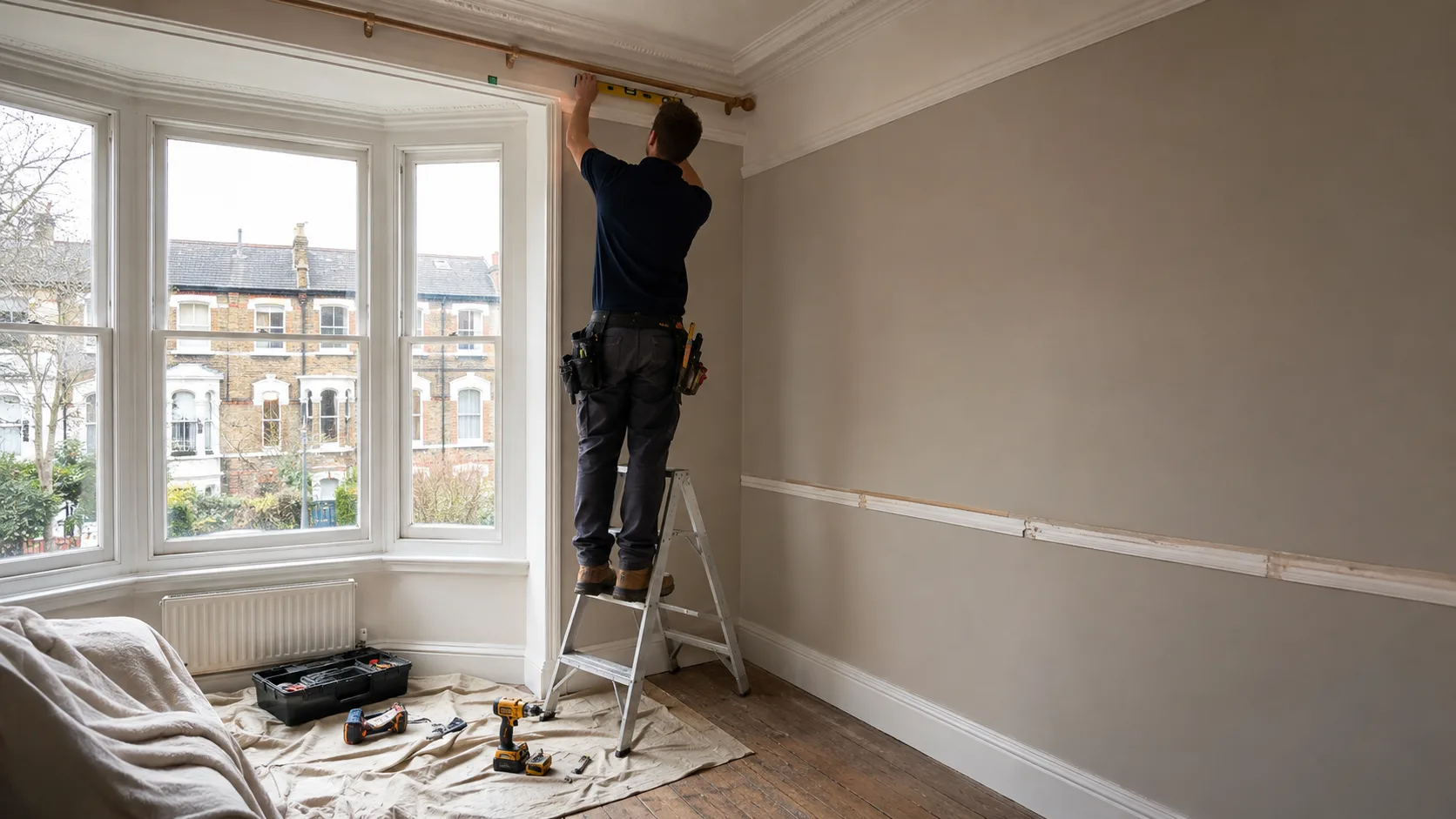
Booking software for UK handymen.
The small jobs book themselves at a price you set, and the longer lists go out as a quote.
 Start with Google
- Every job has a price
- Odd jobs quoted fast
- Six stops, one day
- Paid before you leave
One page, forty small jobs
Put a number on the small stuff, once.
The work that pays a handyman is forty different jobs that are all too small to drive out and quote. List them once, with a price and a length against each, and the little ones book themselves.
A real number, not a bloke guessing on the doorstep
The customer sees what the job costs before they confirm it, which is most of what earns you the work in somebody's house.
Each job knows how long it takes
A forty-five minute job only offers forty-five minute gaps, so a fly screen cannot quietly eat the afternoon you were saving for a fence.
- Door adjustment & latch45 min£110
- TV & shelf mounting1 hr£160
- Flat-pack assembly2 hrs£220
- Leaking tap or flick mixer45 min£120
- Fly screen re-mesh30 min£85
- Picture & mirror hanging30 min£85
- Fence & gate repair3 hrs£340
- Gutter clean, single storey2 hrs£240
- Odd-job half day4 hrs£460
Six little things, quoted as one visit.
Somebody has a list and no idea what any of it costs. Itemise the lot on one quote, send it the same afternoon and let them sign it off on their phone.
Every little thing on its own line
Price each job separately, so nothing gets forgotten on the day and nothing gets argued about after it.
Signed while they are still deciding
They accept and sign on their phone, so the shortlist stops at you rather than running on to the next three handymen.
Accepting books the visit
The signed quote becomes a job in the diary at that address, with every line already on it.
- Door adjustment & latchHallway£110
- Flat-pack wardrobes× 2£220
- Leaking flick mixerKitchen£120
- Fly screen re-mesh× 3£150
- Curtain rail & mirrorLounge£140
The one job that is not on your list.
Nobody can list everything a handyman gets asked for. When somebody wants something you have never priced, it turns up as a message with the times that suit them.
It lands as a request, not a missed call
Their preferred times come into your inbox, and you accept one into a slot or decline it without leaving the conversation.
Accepting makes it a booking
It drops onto the day and the confirmation email goes out on its own.
Or price it once and it joins the list
Add it as a service with its own price and its own length, and the next person who asks books it without troubling you at all.
Any chance you could re-hang a sticking back door and put up a clothesline? Not sure what that costs.
Built for your trade
Built for every kind of handyman work
Flat-pack furniture assembly
A set price per item, with how many they bought picked as an option, so a wardrobe and two bedsides book at the right price and length.
TV brackets and wall mounting
Priced as its own job with the bracket and the cable trunking as extras that move both the price and the time you have held for it.
Shelves, curtain poles and blinds
Priced per run or per window as an option the customer chooses, so the figure on the page is the figure you would have given on the phone.
Doors that stick and failing hinges
The classic fifteen minute job, priced as fifteen minutes, dropped into a gap beside work you are already at.
Plasterboard patching and filling
Two visits on one job because the filler has to dry, both held in the diary at the same address so the second is not quietly forgotten.
Sealant around baths and worktops
A set price for stripping and resealing, with the ones that turn out to be a leak left off your page entirely.
Fence panels, gates and sheds
The ones nobody prices unseen: a survey first, then options the customer signs online before you buy a single panel.
Gutter clearing and downpipes
A two-storey semi books at a fixed price, and anything higher or over a conservatory comes through as a request you price yourself.
Loft hatches and draught-proofing
The winter jobs booked as their own service, with the ladder and the boarding as extras that lengthen the slot as well as the price.
A half day of odd jobs
Sold as time rather than tasks, with the list they typed sitting on the booking so you know what you are walking into.
Letting agent turnaround work
An agent with a book of properties sits on one customer record, every address and what you last did there kept apart from the rest.
A day of small pieces
Six jobs, and an hour still going spare.
Every job sits on the day at the time it actually runs. So the hour between the fence and the flick mixer is something you can see at eight in the morning and sell, instead of something you notice at four in the afternoon.
Move it yourself, on any plan
Grab a job and drop it somewhere better on the day, or across to your offsider on the team timeline. Nothing commits until you let go, and it costs nothing to do.
Six unrelated stops, nothing in your head
Each one carries its own address, its price and whatever the customer told you, so the fourth job of the day needs no phone call to work out what you are turning up to.
- Ancoats8 counties · 2 crew
- Prestwich7 counties · 2 crew
- Manchester North7 counties · 2 crew
Only the work worth driving to.
Draw the counties you cover on a map, and an hour of work forty minutes the wrong way never lands on your day in the first place.
- Gemma WhitfieldBooked just now£215Accepted
- Danny OkoroOpened 2h ago£480Viewed
- The Oak CaféSent yesterday£120Sent
Which quotes have been opened, and which have gone quiet.
Small quotes go cold in a day. See what has been sent, what has been read and what has been accepted, so the two worth a nudge are obvious.
The job turns up with everything on it.
Where it is, what it is, what it costs and when you said you would be there, attached to the booking before you have spoken to anybody.
- 12 AugDoor adjustment & latchBooked · £110
- 4 AugPayment received£240
- 2 AugGutter cleanCompleted · £240
- 19 MarFence & gate quoteAccepted · £1,210
One agent, fourteen rentals.
A property manager is one customer holding many addresses, so the door you re-hung in March is still on the record when the next tenant reports it.
The next small job lands near the last one.
On Pro, every open time is scored on the driving it adds, so a forty-five minute job goes in beside work you are already doing rather than half an hour away from it.
Scored on the driving it adds
Live drive times rank your open slots, so the short job that would have cost you an hour behind the wheel is not the one offered first.
Automatic scheduling is Pro
On Free you get exactly the same real availability, the same counties and the same people, and put the work into the day yourself.
- AWAnna WhitfieldToday · 15:45Best+8 min
- DPDanny PrasadToday · 14:30+22 min
- JYJack YoungTomorrow · 09:15+35 min
A £85 job should not need chasing.
Set the small ones to be paid as they are booked and the bigger ones to settle after, then send the payment request the minute the last screw is in.
Cards come with Pro
Taking the booking, quoting the job and running the day are all on the Free plan. Card payments are the one part that needs Pro.
Paid up front, or paid later, per job
Each service decides for itself. The half hour jobs take the money on the way through; the fence rebuild waits for a payment request, and the receipt sends itself when it clears.
Into your own account
The money is paid out to your own Stripe account, not held somewhere inside Bookables.
- Gemma WhitfieldP-1011 · 25 Jun · Bank transfer£380
- Danny OkoroP-1012 · 25 Jun · Cash£240
- Aisha PatelP-1013 · 28 Jun · Card£380
- Liam DochertyP-1001 · 27 Jun · Card£190
Starts free. Grows
only when you do.
Add your whole team and get booking for nothing.
As you grow with us you can go Pro.
One app for the whole job
Everything you need to run your handyman business.
Common questions.
From your own booking page. They choose the job, see the price you have set for it, and take a slot you are genuinely free for. The address and their notes are on it before you set off.
Yes, and it tends to suit this trade better than pricing each job. All three sit on one quote with your recommendation marked, itemised so they can see what fits in each before choosing.
Book a quote visit rather than the work. You look at the fence, the visit turns into a draft quote with what you found already on it, and the visit fee can come off the job if you set it up that way.
Wherever you decide, and your booking page only offers what you have published. Gas is Gas Safe work whatever else is on the list, and a new circuit, a consumer unit or anything inside the zone around a bath or shower is notifiable, so those simply are not on the page.
Yes. One customer record holds any number of addresses, each with its own notes and job history, so the agent sending you five flats is one record rather than five.
Record cash or a bank transfer against the job on the Free plan, which is how most of this work is paid for. Card payments come with Pro, and the money is paid out to your own Stripe account.


Handyman guides
All articlesOnline booking vs phone booking: which one actually gets the job booked?
Compare online and phone bookings for service businesses, with a practical way to handle standard jobs, tricky enquiries and customers who prefer a call.
ReadFully booked? How to keep the lead without promising the impossible
Handle enquiries when your diary is full with clear requests, alternative times and a practical manual waiting list that avoids double bookings.
ReadBooking deposits: enough to make it real, not a hostage negotiation
Choose booking deposits that fit your work, explain the balance and cancellation terms, and understand how deposits differ from refundable security bonds.
Read