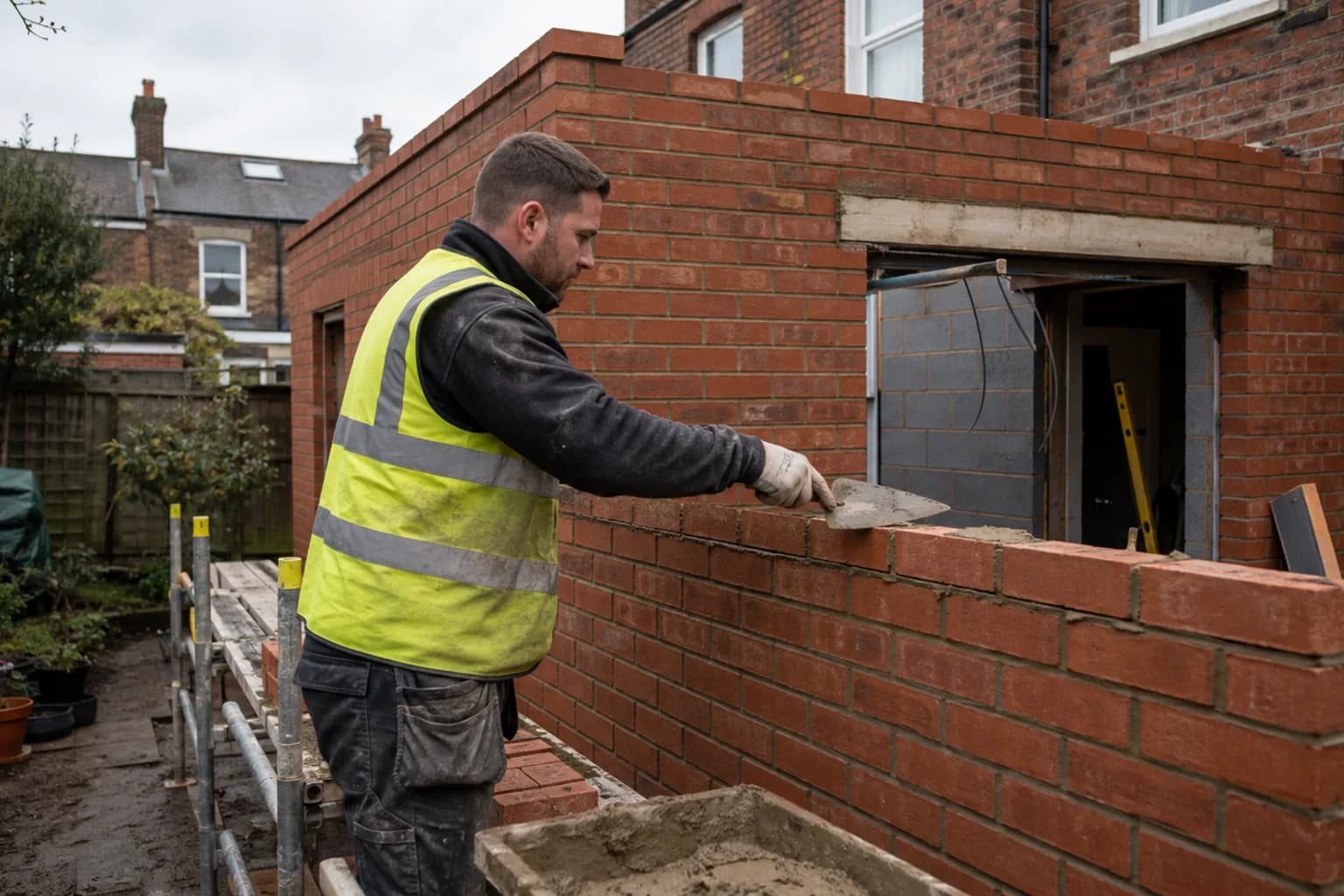
Job software for UK bricklayers.
From the first call about a bowing garden wall, through the quote for a rebuild in a matching London stock, to the invoice that goes out before the scaffold comes down.
 Start with Google
- Quotes accepted with an online signature
- Signed quotes convert to booked jobs
- Small jobs bookable from your page
- The whole gang on one timeline
Online booking
An enquiry page that asks the right things
A photograph of a failed joint and the height of the wall answers most of what you would otherwise ring back to ask. The page collects both.
Learn moreSmart scheduling
Two stages, weeks apart, one job
Footings and brickwork above the damp course rarely happen the same week. Two dates on the same job keeps the gap visible, and unfilled.
Learn moreWhen the diary is full until spring.
Bricklayers book further ahead than almost anyone, and a calendar with nothing free on it looks, to a stranger, like a business that has stopped trading.
The enquiry still arrives
With no slots left the page asks rather than closes, and the job lands with the photographs already attached.
Offer a week, not a date
Most people will wait for the right bricklayer. They would simply like to know how long.
Boundary wall is bowing at the far end. Can you rebuild it? Photos attached.
A garden wall, quoted three ways.
The same forty feet of wall: a machine-made facing, a reclaimed stock to match the house, or a rebuild on new footings with a proper coping.
Measured on site, priced on site
Enter the square metres at the wall and the estimate is finished before the tape is back in the van.
Three answers, one document
Machine-made, reclaimed stock, or the version with new footings, each carrying its own price change.
A number set once
The quote number is fixed the moment it is issued, so your copy and theirs are unmistakably the same document.
Staged payments come with Pro
Pro adds staged payments once the job is booked: one leg at the footings, the balance on completion. Cash and bank transfer remain free on every plan.
- Face bricks · 1,800 unitsSupply£2,160
- Footings & piersLabour£1,480
- Lay & point 18m fence3 days£3,960
When the carpenter runs over.
The frame slips a week and the days you held for the elevation are suddenly worth nothing. Moving them is a drag rather than a rebuild.
Drag it along
The address, the brick and the notes stay attached. Only the date moves.
The gang sees it
Whoever was on those days sees the change without a message at half six in the morning.
Free on any plan
Moving work around the week was never the part you pay for.
Built for brickwork
Built for every kind of wall
Garden and boundary wall rebuilds
Measured by run and height on site, quoted with coping and a new footing as separate options rather than buried in one figure.
Repointing in lime mortar
A half day of its own, booked with a photograph of the existing joint so the mix and the colour are settled before you arrive.
Chimney stack rebuilds
Priced per stack with the scaffold noted on the job, and the flaunching and pot booked as the same visit rather than a return trip.
Facing brickwork on extensions
Quoted by elevation square metres with the brick match photographed at survey, so the pallet that turns up is the right one.
Lintel replacement and crack repair
A look first, then the work, both held on one job so the second visit already knows what the first one found.
Cavity wall and cill repairs
Booked as a short visit with the photographs attached, and priced per opening rather than pretending it is a square metre job.
Block and beam and internal blockwork
Priced by area with the opening count noted, and the delivery day held on the calendar beside the days you are laying.
Brick arches, soldier courses and detail
Quoted as its own line because it is a day of setting out, not a rate per metre, and sold as the option that lifts the elevation.
Conservation and listed brickwork
Held as a job with the survey photographs, the mortar analysis notes and every message from the architect in one place.
Patios, paths and brick paving
Measured by area, quoted with the edging as a line, and booked for the week after the base has gone in.
- Ancoats8 counties · 2 crew
- Prestwich7 counties · 2 crew
- Manchester North7 counties · 2 crew
How far a pallet is worth carrying.
Bricks are heavy and the margin thins with every mile. Draw the ground you cover once and let the page hold the line.
- 12 AugRepoint · south elevationBooked · £640
- 4 AugBrick match photographedReclaimed stock · lime mix
- 22 JulGarden wall quoteAccepted · £7,600
- 9 MayPayment received£1,240
The house remembers its own brick.
What you matched, what the mortar was and when it was last pointed stay on the property, so the call about the second crack starts from something written down.
The repoint that fits the drive you already have.
A half day of pointing only pays if it sits near the wall you are already on. Pro scores the open slots by the driving each one adds.
Ranked, not rearranged
You still choose the day. The ranking simply lifts the slots near the site you are on tomorrow.
Small work that pays
Pointing, a cill and a cracked lintel are what fills a gap that would otherwise be nothing.
Pro
The ranking is the Pro part. The calendar and the bookings are not.
- APAisha PatelToday · 15:45Best+8 min
- LDLiam DochertyToday · 14:30+22 min
- SMSophie MarshTomorrow · 09:15+35 min
The invoice sees itself out.
Most brickwork is still settled by bank transfer, and recording one costs nothing at all. Cards are the part that sits on Pro.
Cash and transfer are free
Mark it paid and the receipt goes out on its own, without a plan being involved.
Cards come with Pro
For the customer who would rather tap than find their account details.
Staged, after the booking
Pro can split a rebuild into footings and completion. It happens once the job exists, not at checkout.
- Gemma WhitfieldP-1011 · 25 Jun · Bank transfer£380
- Danny OkoroP-1012 · 25 Jun · Cash£240
- Aisha PatelP-1013 · 28 Jun · Card£380
- Liam DochertyP-1001 · 27 Jun · Card£190
One app for the whole job
Everything you need to run your bricklaying business.
Starts free. Grows
only when you do.
Add your whole team and get booking for nothing.
As you grow with us you can go Pro.
Common questions.
Yes. Wall area is the pricing driver on the service, so the estimate is built from the square metres you measure on site. A single-skin garden wall and a two-storey elevation come off the same rate without any arithmetic.
As a short booking of its own, with the photograph of the joint attached. Knowing whether it is a lime mortar repoint on a solid wall or a cement joint on a nineteen-seventies extension before you set off is the whole point.
No, and it does not store them. Your blue skilled worker CSCS card stays where it is, along with whichever qualification sits behind it: the Level 2 NVQ Diploma in Trowel Occupations, or the SVQ in Bricklaying if you trained in Scotland. This is the quoting, scheduling and invoicing side of the business.
Yes. Put the brick choice on the estimate as options with their own price change, so a reclaimed stock, a machine-made facing and the cheapest thing on the pallet each show a figure rather than a conversation.
Recording cash or a bank transfer by hand is free, which covers most brickwork. Cards come with Pro, as does splitting a larger job into a payment at the footings and the balance on completion.
Yes. Add them to the team and they see the addresses and start times for the days they are on. The value of the job is not on their screen, which tends to keep site conversations shorter.




Bricklaying guides
All articlesOnline booking vs phone booking: which one actually gets the job booked?
Compare online and phone bookings for service businesses, with a practical way to handle standard jobs, tricky enquiries and customers who prefer a call.
ReadFully booked? How to keep the lead without promising the impossible
Handle enquiries when your diary is full with clear requests, alternative times and a practical manual waiting list that avoids double bookings.
ReadBooking deposits: enough to make it real, not a hostage negotiation
Choose booking deposits that fit your work, explain the balance and cancellation terms, and understand how deposits differ from refundable security bonds.
Read