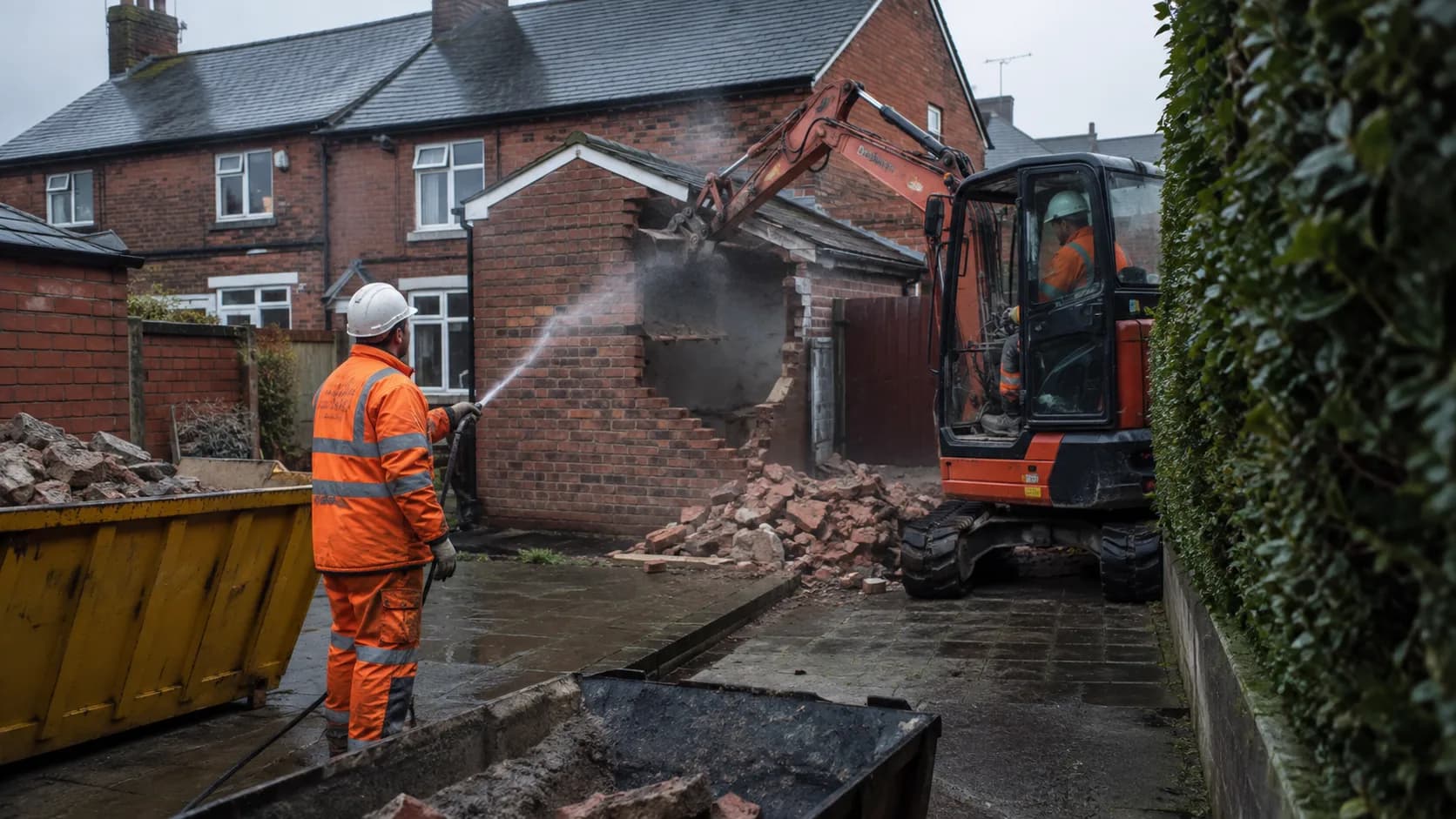
Demolition software for UK contractors.
The site visit books itself, the scope is written down before anything mobilises, and the strip, the muck away and the make good all sit on one job.
 Start with Google
- Site inspections booked against real availability
- Quotes signed online before you mobilise
- Deposits taken through Stripe at acceptance
- Team timeline shows which crew is on which site
- A full diary never costs you the lead
Online booking
Soft strips book. Demolitions get seen.
A chimney breast or a bathroom strip has a price you already know, so it takes a real slot. Anything structural arrives as an enquiry to be looked at.
Learn moreSmart scheduling
The date shifts, and the news travels.
The supply was not capped on Friday, so Monday moves. Drag the job across and the client and the lads have the new date without a round of calls.
Learn moreBooked up, and the enquiry still arrives.
Demolition books weeks out and the client has a completion date. With no slot to offer, the page takes the enquiry and the week the site has to be clear.
They ask rather than leave
The enquiry arrives with the address, what is coming down and the date the site has to be handed over.
The photographs arrive with it
Clients send pictures of the garage and the sheeting from their phone, so you know what you are walking into before you drive out.
What was said stays on the job
Every message from the enquiry through to the quote sits on the record, so nobody is guessing in March what was agreed in July.
Garage and the old slab in Chorlton have to be gone before settlement. Anything in the next three weeks?
A garage down: three ways to price it.
The job most demolition firms quote weekly: take it down and leave the slab, take it down and clear the lot, or that plus levelling the ground.
Priced on what stays as much as what goes
The retaining wall, the drive and the neighbour’s fence appear on the quote as staying, so the disagreement six weeks later is a document rather than a memory.
The tip is a line, not a surprise
Grab loads and tip charges sit beside the machine and the operator, so the client sees what the waste costs before agreeing to it.
Sent from the kerb, not the office
The scope goes out while you are still parked outside, which is generally before the second firm has rung the client back.
Extras priced as options · Pro
Sheeting dealt with before anything starts, the slab up as well as the walls, a further grab load for the hardcore. Each is a priced line the client ticks, and the total follows on its own.
- Excavator & operator1 day£1,850
- Bin hire & tipping feesDisposal£1,240
- Site clear & make good4 hrs£560
Two machines, three sites, one week.
Who is on the strip-out, who is on the knockdown and who is loading bins, on one timeline. When a job runs into a second day, you can see what it pushes before you promise anyone a morning.
Built for your trade
Built for the jobs you actually take down
Soft strip of a flat or house
Priced room by room, with the kitchen, the linings and the muck away as separate lines so nobody disputes what went in which skip.
Chimney breast removal
A set price on your page for the job the builders send you weekly, so the next one books a real slot while you are still on site elsewhere.
Garage or outbuilding demolition
Seen, scoped and quoted three ways: slab stays, slab up, or slab up and the ground levelled. The client ticks and the total follows on its own.
Conservatory removal and make good
The base, the glazing and the brickwork made good afterwards are separate lines, because the making good is the bit that gets argued about.
Back-to-brick strip before a refurb
One record from the first visit to the last grab load, holding the scope, the dates, the photographs and every message the builder sent.
Asbestos garage roof: what you exclude
The quote states plainly what is being dealt with separately and what is not, so the exclusion is on paper months before anyone goes looking.
Patio and garden wall break-out
The half-day jobs that fill the gaps between the big ones, booked at a set price without a call and dropped into the day that suits the lorry.
Shop unit strip out
Overnight work for an agent who wants it done by Monday. Dates, access and the sign-off all sit on the booking instead of in a text thread.
Derelict outbuilding clearance
Quoted as separate lines for the take-down, the grab lorry and the tip, so the client can drop one without the whole quote being rewritten.
- Gemma WhitfieldBooked just now£215Accepted
- Danny OkoroOpened 2h ago£480Viewed
- The Oak CaféSent yesterday£120Sent
The quote that went quiet in March.
Demolition quotes sit for months while an owner waits on approval. See which have been opened and which never were, so the one worth a call on Friday is obvious.
- Mason King · ChorltonEmergency call-out · Wed · 3:30pm£180
- Ava Baker · AncoatsCallout +1 · Wed · 1:00pm£560
- Grace Walker · ManchesterRepair visit · Wed · 11:30am£120
- Amelia Ryan · ChorltonSecond visit · Tue · 2:00pm£190
Everything on, and what it is worth.
The strip-outs, the knockdowns and the half-day clears in one list, with the week's total under them. It answers the only question worth asking on a Sunday night.
The strip-out already has a price.
The jobs you do every week carry a set price, so the builder books a real gap without a call while you are still sitting on a machine.
- Danny Okoro2mCan you come Thursday instead?
- Bookables1hA booking request needs your answer
- Aisha Patel3hRunning 10 late on the Sale job
The photos and the paperwork on the job.
Messages from the builder, shots of the sheeting and the report you were sent all hang off the booking, so the crew and the office read the same file.
- 19 AugGarage knockdownBooked · £3,650
- 11 AugBathroom strip-outPaid · £780
- 30 JulDriveway break-outAccepted · £2,180
- 9 JulShed removal & clearCompleted · £1,240
The builder who books you monthly.
Every site you have pulled apart for them, what it came to and what is still open, on one card instead of in last year's diary.
When the supply is still live on Monday.
Demolition dates slip because somebody else was late: the cap-off, the survey, the skip. Move the job on the board and no one has to ring around.
Move it to the week that works
Pick the job up and drop it where the machine is genuinely free. The client has the new date without you making the call.
The lads read the same board
Whoever is on that site sees it change, so nobody takes a machine to an address that was pushed a fortnight.
Free on every plan
Moving work around the day and the week costs nothing. It is not the part we charge for, and it is not going to be.
Paid to mobilise, paid on clearance.
A low-loader, a machine and two labourers cost money before a wall comes down. Record the transfer by hand for nothing, or send a card link on Pro.
Cash and transfer cost nothing
Mark it paid when the transfer lands. Recording money by hand is free on any plan, and it stays that way.
Cards come with Pro
Send a card link once the job is booked. The money goes to your account rather than sitting with us waiting on a payout.
Split across the job
Ask for part before you mobilise and the rest once the site is clear. Staged requests are a Pro feature and go out after the job is booked.
- Gemma WhitfieldP-1011 · 25 Jun · Bank transfer£380
- Danny OkoroP-1012 · 25 Jun · Cash£240
- Aisha PatelP-1013 · 28 Jun · Card£380
- Liam DochertyP-1001 · 27 Jun · Card£190
How far the low-loader is worth taking.
A machine on a low-loader has a sensible radius, and beyond it the job stops paying. Draw what you cover and the page holds the line for you.
Your patch, your decision
Draw the area around the yard. An address outside it is told at once rather than a week after enquiring.
Two yards, two areas
If the lorry runs out of a second yard, each yard keeps its own patch and jobs fall to the right one.
The same rate throughout it
Within your area the price is the price. Bookables adds nothing quietly for a longer run out.
- Ancoats8 counties · 2 crew
- Prestwich7 counties · 2 crew
- Manchester North7 counties · 2 crew
Starts free. Grows
only when you do.
Add your whole team and get booking for nothing.
As you grow with us you can go Pro.
One app for the whole job
Everything you need to run your demolition business.
Common questions.
They can book the site visit, and your set jobs — a soft strip, a garage demolition — can be booked outright. A structural job arrives as an enquiry with the address and their dates, so no number is given before anyone has seen it.
It does not, and it would be unwise to suggest otherwise. Bookables holds the job: the scope, the dates, the messages and the money. The survey and the paperwork stay where they are, attached to the booking so the office and site read the same file.
Once the job is booked, yes. Send a payment request for the mobilise and a second when the site is cleared. Cash and bank transfer recorded by hand are free on any plan; card links are part of Pro and go out after the booking rather than at checkout.
Move the job to the day the machine is genuinely free. The client is told, the lads see the same board, and the quote, the photographs and the messages stay attached rather than being rebuilt from a text thread.
Yes. Draw the patch the low-loader is worth taking and addresses beyond it are told at once rather than a week later. Within your area the rate does not move — nothing is quietly added for a longer run.
Yes. Add the operator, the labourers and whoever runs the office, give each of them the job list they need, and keep the money screens to the people who ought to be in them.





Demolition guides
All articlesOnline booking vs phone booking: which one actually gets the job booked?
Compare online and phone bookings for service businesses, with a practical way to handle standard jobs, tricky enquiries and customers who prefer a call.
ReadFully booked? How to keep the lead without promising the impossible
Handle enquiries when your diary is full with clear requests, alternative times and a practical manual waiting list that avoids double bookings.
ReadBooking deposits: enough to make it real, not a hostage negotiation
Choose booking deposits that fit your work, explain the balance and cancellation terms, and understand how deposits differ from refundable security bonds.
Read