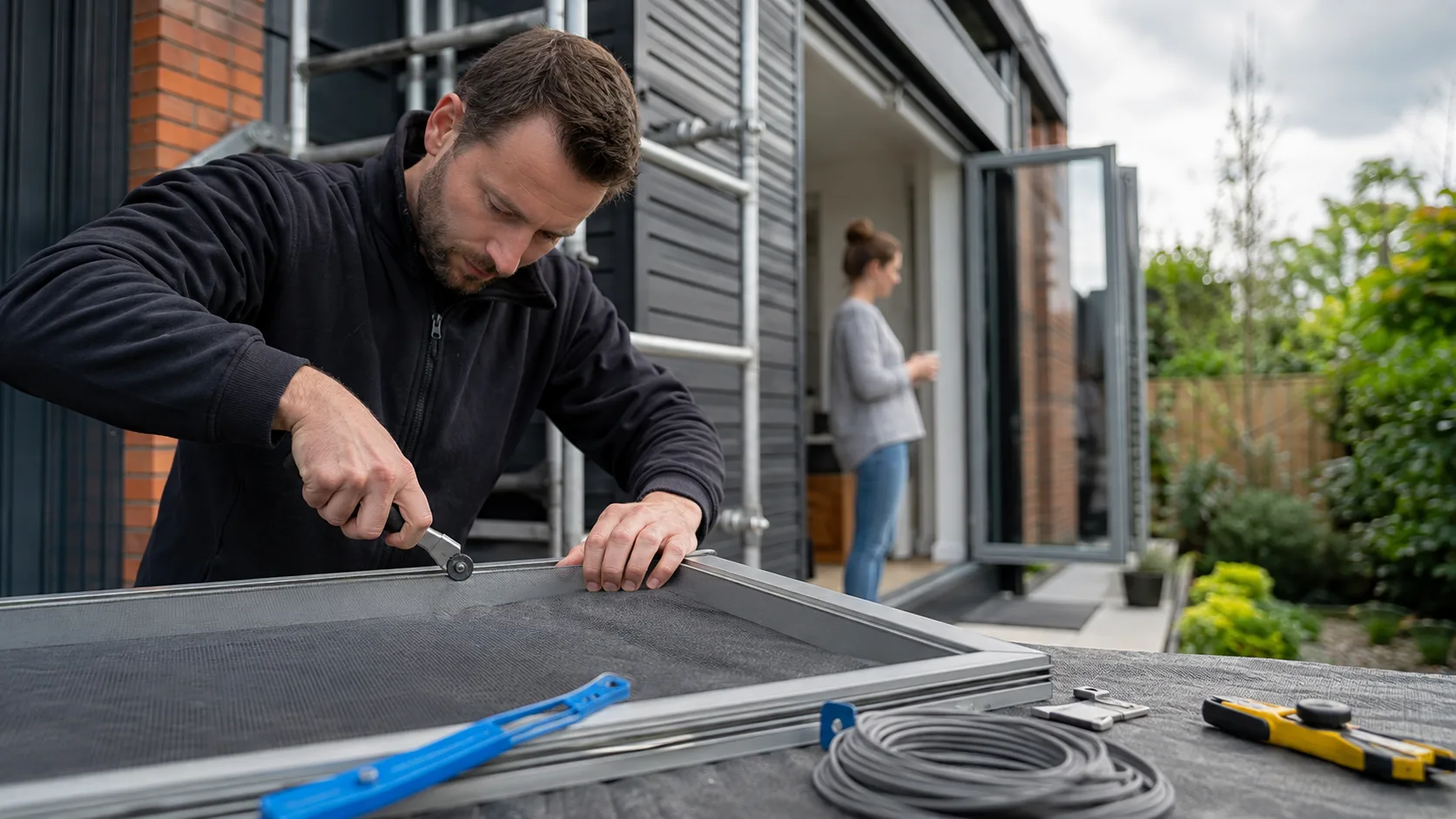
Booking software for fly screen fitters in the UK.
Made-to-measure work that gets quoted from a phone call tends to get measured twice. Let the customer count the windows as they book, price the roller and pleated options there, and keep every size on the house.
 Start with Google
- Per-panel pricing with the count chosen at booking
- Pet mesh and security mesh as priced upgrades
- Extra panels added as lines on the day
- Mesh type and panel count kept on the house
Online booking
The customer counts the windows, not you
They are standing in the room and you are not. Window count is a quantity, the total follows as they set it, and the roller upgrade sits beside it.
Learn moreSmart scheduling
Measure visits and fits, kept apart
A measure takes twenty minutes and a fit takes an afternoon. Give each its own length and the diary stops treating them as the same appointment.
Learn moreThe person in the hallway counts better than you guess.
Panel count is a quantity on the service, so the customer sets it while they book and the total moves in front of them. You get a number that came from someone looking at the windows, and they get a price without a phone call.
Priced by the panel, worked out on our side
They choose six or sixteen and the total follows. The amount charged is calculated here, never taken from whatever the page happened to show.
The mesh is chosen in the same breath
Heavier mesh sits on the service as an option with its own price change, so it is decided at the kitchen table rather than in your driveway.
Into a morning you are genuinely free
They take a slot off the calendar instead of a promise to ring back, and the length booked is the length that job really takes.
Booked up, and the flies have not read the diary.
Three warm weeks fill the calendar and the enquiries carry on regardless. With nothing left to book, the page says as much and takes the job.
The enquiry arrives as a thread
Address, how many openings, which style and a photo of the window, in one place, so you can judge it without ringing back.
Answer once, from the job
Reply from the record rather than your messages. What you quoted in June is still there when they ring the following spring.
Fit them in when one frees
A cancelled morning is a gap you fill from the same screen, and the confirmation does the telling on your behalf.
Six screens with the wire hanging out and the sliding door one is off its rollers. Anything at all this month?
Four windows on the phone, seven on the day.
It happens often enough to plan for. Put the extra openings on at the rate already agreed and move whatever no longer fits before tea.
Extra openings go on as lines
The same rate, added while you are standing there, so the invoice reflects the work rather than the original phone call.
Move what will not fit
The last fitting slides to Thursday and the customer is told without you having to write the message.
The van knows what is coming
Each job carries the count, the style and the sizes, so nobody rings the office to ask what they are walking into.
- Sep 2Rescreen · 6 screensCharcoal mesh
- Sep 2Paid on the dayCard
- Nov 18Pet mesh · back doorUpgrade, 1 panel
- Feb 4Quote · sliding door rollersSent, viewed
The house remembers what mesh went in.
An hour of work, then four years of nothing. When they ring back, the panel count, the mesh and what you charged last time are on the address, so the second job is quoted from a record instead of a memory.
- Gemma WhitfieldBooked just now£215Accepted
- Danny OkoroOpened 2h ago£480Viewed
- The Oak CaféSent yesterday£120Sent
Which of the agent's quotes actually got read.
Raj Chauhan asked for four addresses and approved two. Seeing what has been opened and what has gone quiet is the difference between a follow-up call worth making and four that are not.
Your cleaner Mark is on the way.
Somebody has to be in.
You cannot pull panels out of a house nobody is standing in. Tell them the window before you set off, not from the kerb.
- Mason King · ChorltonEmergency call-out · Wed · 3:30pm£180
- Ava Baker · AncoatsCallout +1 · Wed · 1:00pm£560
- Grace Walker · ManchesterRepair visit · Wed · 11:30am£120
- Amelia Ryan · ChorltonSecond visit · Tue · 2:00pm£190
A measure now, a fit in three weeks.
When the frames are past saving, that is two visits and it should be two bookings on the one house, both dated, neither living in your head.
Past your coverage. Decline politely, or make an exception.
One panel, two hours away.
Set the areas you work and the ones you do not. A single screen out past Ancoats should not quietly book itself into a Tuesday morning.
A terrace with flies in every room by July.
Six openings, three ways to price them: fixed frames on the casements, rollers where the windows get used, or the patio door done as well.
Priced by the panels you counted
Rescreens, new frames and door screens are separate lines, so a queried figure points straight at the panels it came from.
All three sit on one page
Re-mesh, re-frame or the lot. They read the difference between them instead of ringing two other outfits to find out.
Sent before you leave the street
The quote goes from the phone in the driveway, which is usually before anyone else has rung them back.
Mesh and extras priced as options · Pro
Roller instead of fixed, a pleated door screen, a finer mesh, a colour to match the frames, a magnetic set for the sash. Ticking one moves the quoted total. Priced options come with Pro.
- Rescreen per panel× 14£910
- Pet mesh upgrade× 3£135
- New frames · made to measure× 2£260
Paid before you load the van.
A fitting is finished in an afternoon and the invoice ought to be finished with it. Cash and transfers recorded by hand cost nothing; cards come with Pro.
Cash and transfer are free
Mark it paid when the transfer lands. That costs nothing on any plan, and it is not about to start.
Cards come with Pro
Send a link from the doorstep and it is settled on their phone while you are packing the ladder away.
The agent gets one invoice
Several addresses on one document, each with its own openings listed, so the office can pay it without asking you anything.
- Gemma WhitfieldP-1011 · 25 Jun · Bank transfer£380
- Danny OkoroP-1012 · 25 Jun · Cash£240
- Aisha PatelP-1013 · 28 Jun · Card£380
- Liam DochertyP-1001 · 27 Jun · Card£190
Built for your trade
Built for the screens you actually get called to
Made-to-measure frames for uPVC casements
The everyday work. Measured on one visit, fitted on another, and both sitting on the same record for the house.
Roller screens on patio doors
The door that is open all summer. Priced per opening as its own service, because it is not the same job as a kitchen window.
Pleated door screens for the back door
A different mechanism, a different price and a different fitting time. Kept as its own line so the quote is readable.
Sash windows on a Victorian terrace
Screens that have to sit inside the box without stopping the sash. Quoted per window once you have been and seen it.
Conservatories that cook and cannot be opened
Every vent and the door, in one go. Counted by the owner and blocked out as the half day it actually takes.
Rescreens where the mesh has gone brittle
Frames worth keeping and mesh that is not. Priced by the panel, done at the van and back in before you leave.
Kitchen screens for the summer flies
One or two openings, booked online for a morning, at a price the customer already knows. No call-out to arrange it.
Cluster flies in the autumn
A seasonal run on the same houses every year. Their sizes and the mesh you fitted last year are on the record, so the quote takes a minute.
Letting agent rounds across a portfolio
One agent, several addresses, one invoice, and a tenant at each who needs telling when you are coming.
Bi-fold and French doors
Wide openings that need a plan rather than a standard kit. Measured, ordered and fitted as two dated visits.
Starts free. Grows
only when you do.
Add your whole team and get booking for nothing.
As you grow with us you can go Pro.
One app for the whole job
Everything you need to run your flyscreen repair business.
Common questions.
Yes. The count is a quantity on the service, so they set it while booking and the total follows. What is charged is worked out on our side rather than read from the page.
They go on the job as lines at the rate already agreed. The rate was published before you arrived, which tends to make the extra four a larger figure rather than a conversation on the doorstep.
You can. Each style sits on the service as an option with its own price change, so a patio door can be a roller and the kitchen casement a fixed frame, both priced before anyone commits.
It does, as two bookings rather than one. The measure visit books itself at a set length, and the fit goes in the diary once the frames arrive, both hanging off the same record for the house.
Yes. One customer, as many addresses as they manage, each holding its own window sizes and job history, and the whole lot can go on a single estimate.
Cash and bank transfer recorded by hand are free on any plan and will stay so. Card payments come with Pro, so a link can go out from the van and the receipt sees itself out.
Flyscreen Repair & Replacement guides
All articlesOnline booking vs phone booking: which one actually gets the job booked?
Compare online and phone bookings for service businesses, with a practical way to handle standard jobs, tricky enquiries and customers who prefer a call.
ReadFully booked? How to keep the lead without promising the impossible
Handle enquiries when your diary is full with clear requests, alternative times and a practical manual waiting list that avoids double bookings.
ReadBooking deposits: enough to make it real, not a hostage negotiation
Choose booking deposits that fit your work, explain the balance and cancellation terms, and understand how deposits differ from refundable security bonds.
Read