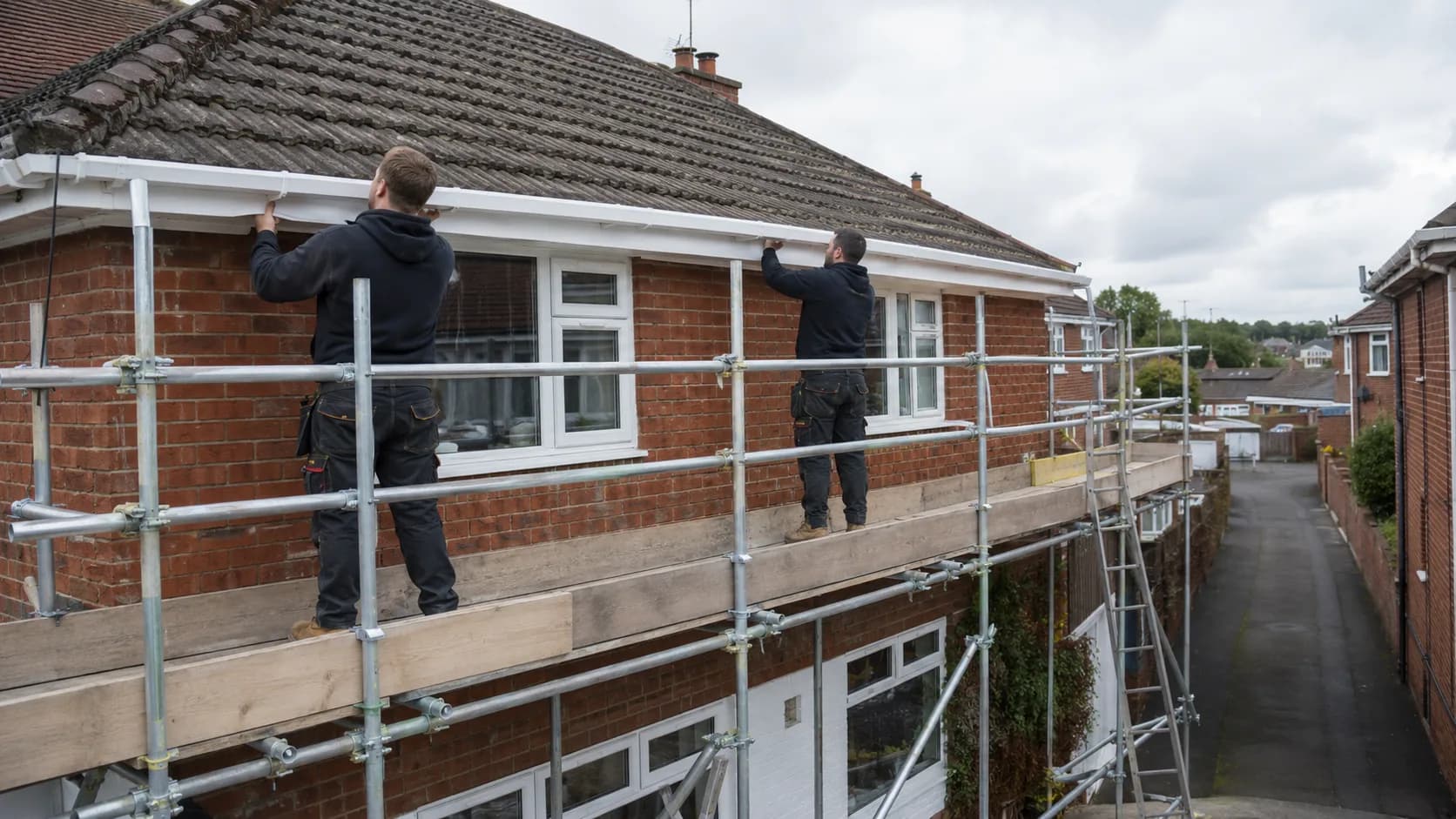
Run a guttering and roofline business in the UK.
Gutter clearing that books into a real gap, a roofline quote with three ways to go on it, and the invoice sent before the ladder is back on the roof bars.
 Start with Google
- Replacement quotes signed online
- Clears slotted in by least added driving
- Every roof on record for easy rebooks
- Deposits and card payments
- Emails confirm and remind for you
Online booking
Gutter clearing that books itself in the autumn
The first week of leaves down and every call is the same one. Put terraced, semi and detached prices on a booking page and let people take real gaps.
Learn moreSmart scheduling
A washed-out week you can put back together
Nobody is on a wet roof in February. Drag Tuesday onto Thursday, the customer is told, and the downpipe repairs you keep for this weather fill the gap.
Learn moreThe clean that never needed a phone call.
Storeys, roof type and whether the ladder can get down the side are questions with prices attached, not a five minute conversation. Ask them on the page, price it there, and hand over a slot you are genuinely free for.
- Danny Okoro2mCan you come Thursday instead?
- Bookables1hA booking request needs your answer
- Aisha Patel3hRunning 10 late on the Sale job
The roofline arrives as a photo, not a form.
Nobody books a full replacement online. They send a picture of water sheeting over the front door and ask what it would cost, and that picture wants to sit with the quote rather than in a phone in the van.
Booked solid until the leaves are down.
By the middle of November there is nothing left in the diary and the calls keep coming. The page does not simply go blank on them, it asks.
They ask rather than ring the next name
A request arrives with the address and the photograph, so when a job falls through you know who to call back first.
The wet week is where requests land
Work needing a dry roof moves out and the downpipe repairs move in, without a message being sent by hand.
Nothing offered that you cannot do
The page shows only genuine gaps, so a double booking made while you were up a ladder is not a thing that happens.
Water is pouring over the front door every time it rains. Photo attached. Can you look this week?
The day, on any plan.
Roofline work is weather work, and the week you set out on Sunday evening is rarely the week you get. Moving it takes one drag.
Drag it and everyone is told
Move a job to the next dry morning and the customer hears about it, without you working down a list of numbers.
The wet day has its own work
Downpipe repairs and quotes done from the ground sit ready to fill a day the roof is out of the question.
Free does all of it
Dragging work around the week costs nothing. Nothing on this panel sits behind a plan.
Clear it, repair it, or replace the roofline.
A cast-iron gutter is three jobs depending on the budget: clear and reseal, gutter and downpipe replacement, or the full fascia, soffit and gutter.
Good, better, best on one document, with Pro
Leaf guard by the metre, an extra downpipe, dry verge along the gable: added as options, the total moves as they tick, so the step from a repair to the lot is a figure rather than an argument. Options are Pro.
Priced off what is on the elevation
Gutter by the metre, downpipes by the number, skip on its own line. The customer sees the shape of the job rather than one figure.
Signed before you leave the drive
They accept on the phone while you are stood there, and the accepted quote becomes the job with nothing retyped.
The number stays where you put it
Set the quote number once and it is fixed, so estimate, job and invoice carry the same reference when the agent asks.
- Colorbond gutter & fascia · 32mSupply£2,240
- Remove old gutter & downpipesLabour£620
- Install & seal new run1 day£1,340
- 14 AprFull fascia, soffit and gutter replacementBooked · £4,200
- 2 AprFull fascia, soffit and gutter replacement quoteAccepted · £4,200
- 9 MarPayment received£180
- 9 MarAutumn gutter clearing roundsCompleted · rust noted, north side
Next season starts from a record, not a memory.
What profile is up there, what colour it was matched to, which side had the rust and what you cleared last season all stay with the address. When the leaves drop, rebooking the street is reading rather than remembering.
- Gemma WhitfieldBooked just now£215Accepted
- Danny OkoroOpened 2h ago£480Viewed
- The Oak CaféSent yesterday£120Sent
The replacement quote nobody has opened.
A roofline price sits for a fortnight and you cannot tell a busy customer from a cold one. One of these has been read three times.
- Mason King · ChorltonEmergency call-out · Wed · 3:30pm£180
- Ava Baker · AncoatsCallout +1 · Wed · 1:00pm£560
- Grace Walker · ManchesterRepair visit · Wed · 11:30am£120
- Amelia Ryan · ChorltonSecond visit · Tue · 2:00pm£190
An hour on a ladder and a three day roofline are the same list.
Cleans, downpipe repairs, site visits that are not billed as work and full replacements all sit in one list with their status on them, so the small jobs stop being the ones that get forgotten between the big ones.
Built for your trade
Built for every kind of roofline work
Autumn gutter clearing rounds
A clearing job books into a real gap at your terraced or detached price, with the address, the storey count and the rear access note attached.
Full fascia, soffit and gutter replacement
Quote the fascia, the soffit, the gutter run and the skip as separate lines, and the accepted quote becomes the job with the profile and colour on it.
Cast-iron gutter repair and repaint
On a listed terrace the replacement is not an option, so the quote carries the bracket repairs, the joint reseal and the paint as its own lines.
Leaking joints and overflowing downpipes
The small work that fills a wet week. Booked at a set price, kept against the property, and invoiced on the day rather than at the end of the month.
Bargeboards and dry verge
Rotten bargeboard rides along with a roofline quote as an option, so it is priced once rather than becoming a phone call a month later.
Soffit vents and loft ventilation
Over-fascia and soffit vents added by the metre on a replacement, with the photographs of the damp loft sat in the same thread as the estimate.
Storm damage call-outs
A gutter hanging off the front elevation goes in as an urgent job at your call-out rate, and their photographs arrive attached to the request.
Letting agent and block rounds
A list of properties cleared on a repeat visit, every address and key-safe note kept against the agent, so next autumn is not a fresh set of questions.
Gutter vacuum work from the ground
Three-storey clearing without scaffold, priced by the elevation, with the before and after camera stills sent back on the same job record.
Pre-sale roofline tidy-ups
Agents book the clear, the reseal and the touch-up before the survey, and the invoice goes to the agency rather than to the seller.
The postcodes you will actually drive to.
Guttering is drive time with a ladder on top, and an hour of clearing forty minutes out is a morning gone. Draw where you go.
Outside the line, no slot
An address you do not cover is offered nothing, so you are not ringing back to say no after a time has been picked.
Different rules for different work
Keep the far edge of the map for full roofline jobs and leave the clearing rounds close to home.
No charge for the extra miles
A longer drive does not quietly add anything to the quote. What is shown on the page is what is paid.
- Ancoats8 counties · 2 crew
- Prestwich7 counties · 2 crew
- Manchester North7 counties · 2 crew
Paid before you load the van.
Most of a clearing round is cash or a transfer while you are coiling the hose. Record it as you go and the receipt sees itself out.
Cash and transfer are free
Mark the job paid on the spot on any plan. No reader, no waiting, no invoice going quietly unopened for a fortnight.
Cards come with Pro
A pay link goes out with the invoice and the money lands in your own account. It is never held on the way through.
Larger jobs can pay in stages
A full roofline can take part when the materials arrive and the rest on completion. Staged payments are Pro.
- Gemma WhitfieldP-1011 · 25 Jun · Bank transfer£380
- Danny OkoroP-1012 · 25 Jun · Cash£240
- Aisha PatelP-1013 · 28 Jun · Card£380
- Liam DochertyP-1001 · 27 Jun · Card£190
One app for the whole job
Everything you need to run your guttering business.
Starts free. Grows
only when you do.
Add your whole team and get booking for nothing.
As you grow with us you can go Pro.
Common questions.
The Work at Height Regulations 2005 apply wherever a fall could cause injury, with no minimum height, and a ladder may only be used where a risk assessment shows heavier access is not justified. Northern Ireland works to its own equivalent regulations of the same year. Bookables does not assess any of that. It keeps the job, the access notes and the photos in one place so what you agreed is on the record.
There is no installer register for rainwater goods, fascias or soffits in the way there is for windows or gas work, so what you show a customer is your own insurance and your own workmanship guarantee. Both can sit on the quote they sign, alongside the photographs of the last job you did on their street.
They can. Publish clearing as a bookable job at your own price, set how long it really takes, and the page offers only slots you genuinely have. Terraced or detached, two storey or three, and rear access can be options on the job, so the price shown is the price you arrive on.
As one estimate with lines for the fascia, the soffit, the gutter run, the downpipes and the skip, each with quantity and rate. They sign on the phone while you are stood in the driveway, and the accepted quote becomes the job without being retyped.
Cash and bank transfer are free to record on any plan, which is most of a clearing round. Cards, and splitting a full roofline into a payment when the materials land and the rest on completion, come with Pro.
Draw the towns and postcodes you work as territories and the booking page offers nothing outside them. Keep the far edge for full roofline jobs only, so an hour of clearing never turns into a morning on the ring road.





Guttering & Fascias guides
All articlesOnline booking vs phone booking: which one actually gets the job booked?
Compare online and phone bookings for service businesses, with a practical way to handle standard jobs, tricky enquiries and customers who prefer a call.
ReadFully booked? How to keep the lead without promising the impossible
Handle enquiries when your diary is full with clear requests, alternative times and a practical manual waiting list that avoids double bookings.
ReadBooking deposits: enough to make it real, not a hostage negotiation
Choose booking deposits that fit your work, explain the balance and cancellation terms, and understand how deposits differ from refundable security bonds.
Read