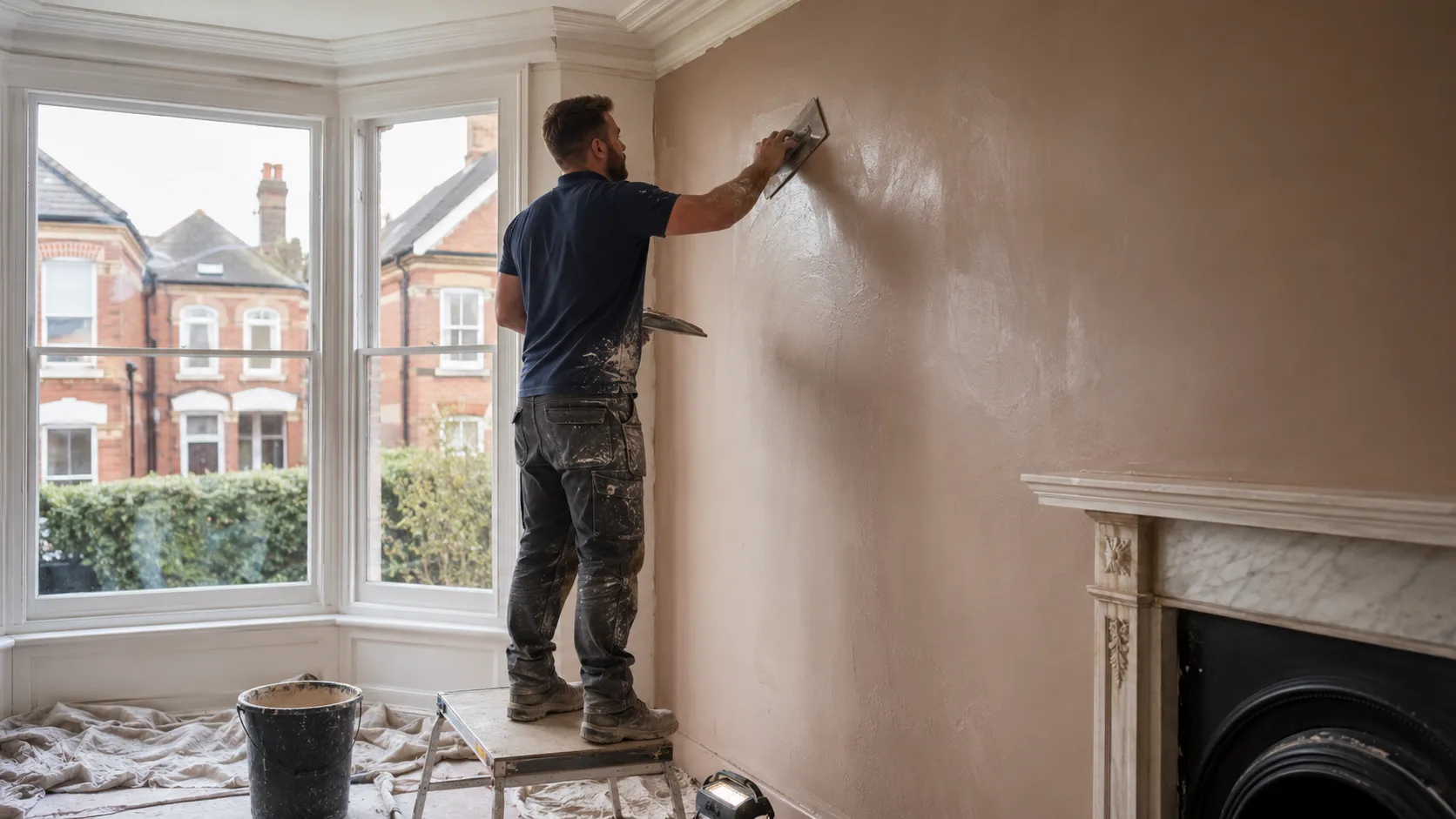
Booking and quoting software for plasterers in the UK.
From the first photo of a blown ceiling to the skim, the second coat and the invoice, one job record holds the lot.
 Start with Google
- Patch and repair jobs booked online
- Rooms quoted with online acceptance
- Return coats planned by drag
- Confirmations and reminders on autopilot
Online booking
Quote visits that arrange themselves
Very little gets priced without seeing it. Put the quote visit on your page with a proper duration and let people take a slot while you are on a ceiling.
Learn moreSmart scheduling
Floating, setting and rendering, kept apart
Backing coat, then skim, and the drying time in between is not a suggestion. Give each stage its own slot and duration on one calendar and the order holds.
Learn moreBuilt for your trade
From a patch round a light switch to a whole house of walls and ceilings
Ceiling repair after a leak upstairs
The bread-and-butter callout. Books short, priced by room, photos already on the thread, and the insurer gets a proper quote.
Overskim on artexed walls and ceilings
Priced by area or by room. Whether it takes a bonding coat first is an option with its own price, not a surprise on the day.
Dot and dab on a new extension
Board, tape and skim as separate stages with their own durations, so the second fix behind you is not left guessing.
Sand and cement render, external
Weather dependent and priced by area. Takes a real block of days on the calendar and moves as a block when the forecast turns.
Silicone or thin-coat render on a refurb
A different rate and a different duration to sand and cement, so it deserves its own service rather than a note in the quote.
Lime plaster on lath in a period property
Never quoted from a photograph. Books as a quote visit and comes back as an estimate with its own lines and its own timescale.
Making good after the electrician
Small, fast, and the job that ruins a day when the diary lies about it. Give it a real duration and let it book itself.
Replastering after a damp course
Its own service with its own waiting time built in, so nobody books the skim before the wall is anywhere near ready.
Coving and cornice replacement
The profile is the entire conversation, so it is an option group with prices attached rather than a number pulled out of the air.
Bathroom board out before tiling
Booked to land between the plumber and the tiler, and when the date shifts they both see it shift.
What the job carries before anyone loads up.
Room count, finish level, the profile to match, where the water is and how to get in. On the job when you take it, not remembered on the drive over.
- Danny Okoro2mCan you come Thursday instead?
- Bookables1hA booking request needs your answer
- Aisha Patel3hRunning 10 late on the Sale job
The photos, the dust question and the yes, all one thread.
Half of plastering is quoted off pictures of a stain on a ceiling. Those pictures belong on the job, not three screens deep in a phone.
- 21 AugUnit 6, walls and ceilingsBooked · £2,150
- 9 AugUnit 5, ceilingsPaid · £1,340
- 1 AugTrim profile, units 5-8Accepted · £980
- 18 JulUnit 4, make goodCompleted · £420
The builder who is eleven rooms deep.
One customer, a long run of jobs and a payment history worth keeping, instead of eleven separate searches through last year's messages.
Skimming a room, priced three ways.
Somebody asking what plastering costs wants three numbers: patch and make good, an overskim over what is there, or hack off and re-board.
By area, by room or by the hour
Price the way you already do. Square metres for walls and ceilings, rooms for a skim, hours for patching and making good.
The extras sit as choices
Bonding coat, moisture board, coving. Each is an option with its own price, agreed in writing before anyone mixes anything.
Accepted online, and kept
They accept from the link and the job holds what was agreed, which tends to settle matters when the decorator has opinions.
Extras priced as options · Pro
Pro adds what rides on top: coving, moisture board in the bathroom, bonding on bare brick, taking the waste away. Each carries its own price difference, so the figure moves as they choose.
- Plaster & materialsSupply£260
- Prep & set-outLabour£340
- Skim & two coats6 hrs£680
When the forecast rearranges the week.
Render will not go on in the wet and skim will not take a second coat early. Losing the day is survivable; ringing eleven people is the bit that hurts.
Drag it and it is dealt with
Move the job and both the customer and the crew are told. Free, on any plan.
The run travels together
Push the boarding and the skim behind it follows, rather than leaving a hole you find on Thursday afternoon.
Nobody has to be telephoned
The notification handles the awkward part rather well. You carry on with the next room.
Booked up until well into next month.
Which is the usual state of a decent plasterer. The page may as well say so, and still take the details of somebody willing to wait.
Slots come off the real calendar
The page can only offer what is genuinely left, so nothing books into a week already given to a contractor.
Full is not the end of it
With nothing free they send photos and an address instead, and it arrives in the inbox rather than as a missed call.
The quote need not wait for a date
An estimate can go out and be accepted with no date attached. The date follows when the run in front clears.
Ceiling in the back bedroom has come down after a leak. Photos attached, is there anything before the end of the month?
Paid before you load the van.
The money is usually a stage payment from a builder or a lump on completion. Either goes quicker when the invoice already sits on the job.
Cash and transfer, free
Record what came in by hand and the job closes. No plan required and nothing taken off the top.
Cards come with Pro
A link on the invoice rather than a phone call a fortnight later. The receipt rather sees itself out.
Staged where the job is staged
A long boarding and skimming job can bill in stages once the booking exists. Nothing is taken at the point of booking.
- Gemma WhitfieldP-1011 · 25 Jun · Bank transfer£380
- Danny OkoroP-1012 · 25 Jun · Cash£240
- Aisha PatelP-1013 · 28 Jun · Card£380
- Liam DochertyP-1001 · 27 Jun · Card£190
The postcodes that are worth it.
A van full of board and fifty minutes of dual carriageway is not the same job as one round the corner, whatever the quote says.
Draw it rather than explain it
Mark the postcodes you cover. Outside them people are told plainly instead of booking and then being cancelled.
Different work, different ground
The rendering side and the interior skimming side rarely cover the same patch. Each can hold its own area.
And what you would rather not take
Lath and lime, scaffolded render, whatever it is. Better said on the page than discovered on site.
- Ancoats8 counties · 2 crew
- Prestwich7 counties · 2 crew
- Manchester North7 counties · 2 crew
Starts free. Grows
only when you do.
Add your whole team and get booking for nothing.
As you grow with us you can go Pro.
One app for the whole job
Everything you need to run your plastering business.
Common questions.
Plastering is not licensed, but site work generally is not open to you without a CSCS card. The blue Skilled Worker card is the usual one, gained with a Level 2 NVQ Diploma in Plastering on the solid or fibrous pathway, or the SVQ if you trained in Scotland, plus the CITB Health, Safety and Environment test. Domestic work does not require it; most main contractors do. Put the card and your public liability on the estimate template and it goes out on every quote.
For a straightforward overskim, often. Ask for pictures on the thread, price the estimate by square metres or by room, send it. Anything with damp, blown plaster or lath behind it wants a look, and the quote visit books from the same page.
As its own service, because it is its own trade. Different duration, different rate, different customers. Setting it up separately keeps somebody with a Victorian ceiling from booking the same slot as a two-coat skim on new board.
Move it on the calendar and everyone attached to it is told. That is on every plan, including the free one, which is the point: weather moves rendering constantly and the cost is the ringing round, not the day.
Cash and bank transfer are recorded by hand and always free. Cards sit on Pro, which is what most people want when a builder owes them a stage payment. The plan cards further down carry the numbers.
Yes, and they behave differently. A builder is one customer with a long run of jobs and a payment history worth keeping. A householder is one job and a great many questions. Both sit on the same records, so nothing needs looking up twice.

Plastering guides
All articlesOnline booking vs phone booking: which one actually gets the job booked?
Compare online and phone bookings for service businesses, with a practical way to handle standard jobs, tricky enquiries and customers who prefer a call.
ReadFully booked? How to keep the lead without promising the impossible
Handle enquiries when your diary is full with clear requests, alternative times and a practical manual waiting list that avoids double bookings.
ReadBooking deposits: enough to make it real, not a hostage negotiation
Choose booking deposits that fit your work, explain the balance and cancellation terms, and understand how deposits differ from refundable security bonds.
Read