Booking software for sandblasting businesses in the UK.
From the enquiry that arrives with photographs of a rusted railing, through the soda-or-grit quote, to the day the pot is loaded and the invoice is settled.
 Start with Google
- A details and photos request instead of a straight booking
- Soda strip and garnet blast offered as priced options
- Containment and site protection as their own quote lines
- Media covered by a deposit before you order it
Online booking
Enquiries that arrive with the surface
Two photographs and a rough size is not a quote. Your page asks what the substrate is and what is on it before any of it becomes a job.
Learn moreSmart scheduling
Unit days and site days on one board
Work brought into the unit and work you take the lorry out to sit on the same week, so the pot is not promised in two places at once.
Learn moreThe pot is out for a fortnight.
Blasting books out in blocks rather than hours. When there is nothing left this month the page still takes the enquiry, photographs included.
It asks the awkward questions
Substrate, a rough size, how many coats and whether anyone has blasted it before. All of it arrives before you write a number.
The photographs land on the job
The hole under the enamel is on the record from the first message, which saves a discussion held with the pot already unloaded.
One place to reply from
The enquiry and the quote you sent back sit together, so nothing goes missing three screens into a thread on the other phone.
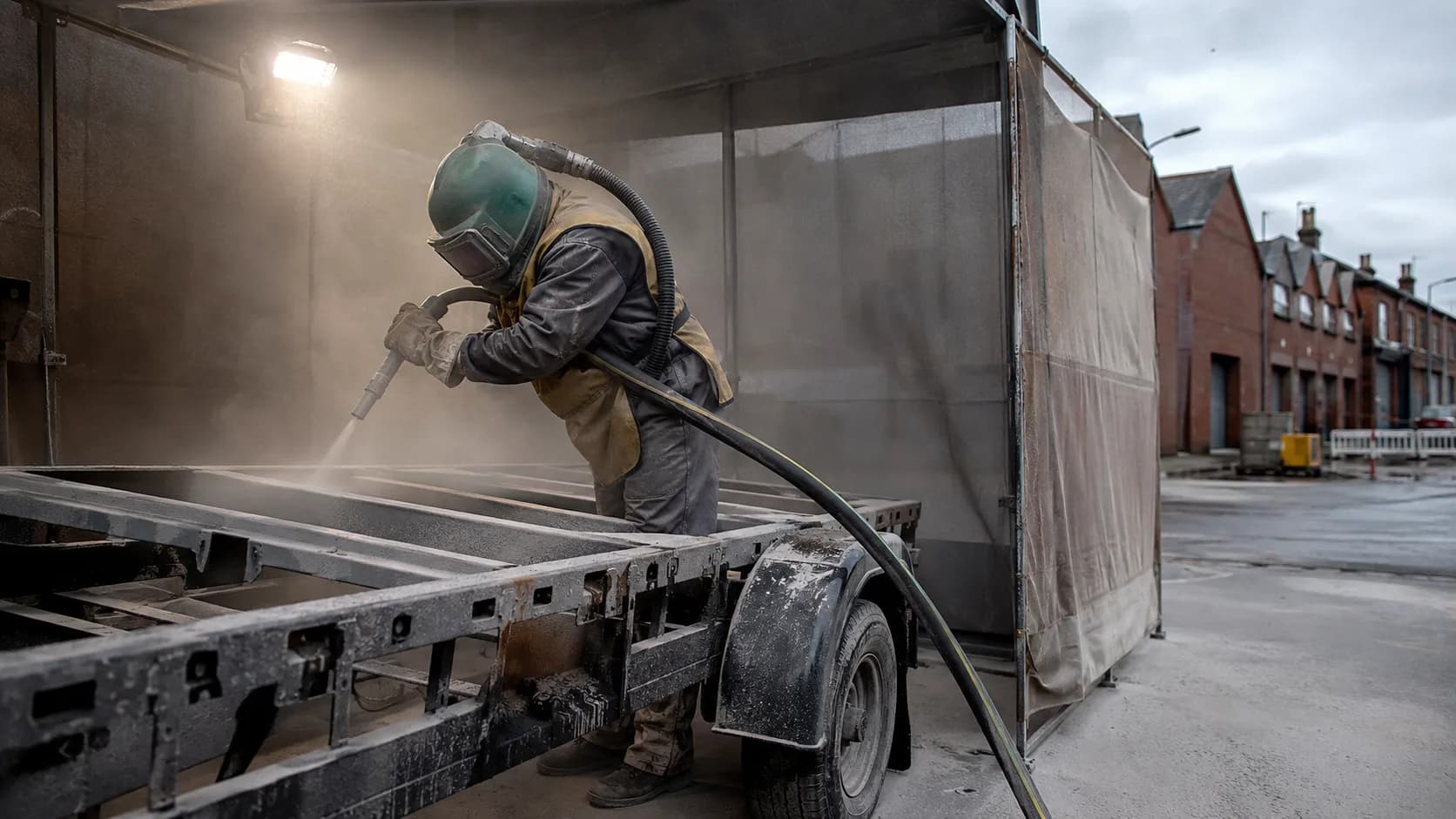
Trailer chassis back to bare steel. Photos of the pitting attached, plus what I think is on it. Can you price soda and grit both ways?
A run of Victorian railings, stripped and primed.
Two ways to do the same railings: a soda strip that leaves the ironwork alone, or a grit blast that cuts a key for the primer.
Priced off the surface, not a hunch
Metres, media, primer and containment are separate lines, so a query about the price can be answered by pointing at the part it came from.
Containment is a line, not a courtesy
Sheeting, shrouding and removing spent media is quoted where the customer can see it, which is the only way it is ever paid for.
Sent before you leave the kerb
The quote goes from the phone while you are still parked outside, which tends to be before the next firm has rung them back.
Media and extras priced as options · Pro
Containment, spent media removed, a coat of primer before it leaves the unit, collection and return. Each is a priced option, and ticking one moves the quoted total rather than starting a further phone call.
- Soda stripOption A£680
- Garnet blastOption B£920
- Containment & site protectionFixed£260
The morning the wind gets up.
Outdoor blasting stops when it blows and the week shuffles behind it. Drag the job to Thursday and everyone booked behind it hears about it.
One record, first photo to final coat.
What the substrate is, what came off it, which media you used and what it cost, all on the job rather than in a folder on the office phone.
Built for your trade
Built for the surfaces you actually strip
Wrought-iron railings and gates
Old coatings off ironwork, usually taken back to the unit so the media can be contained rather than left across a pavement.
Victorian brick and stone facades
Paint off a terrace front without taking the mortar with it. Low pressure, slow going, and quoted by the day rather than the metre.
Cast-iron rainwater goods
Hoppers and downpipes stripped and primed off the building, where the handling costs about as much as the blasting does.
Land Rover and classic chassis
Soda on the panels and grit on the chassis rails. The owner mentions two coats and there are five underneath them.
Narrowboat and steel hulls
Blacking off back to steel in a dry dock, where the slot is booked weeks ahead and the day length decides the price.
Agricultural trailers and implements
A yard full of gear over the winter, quoted as one job with a run of lines rather than eight separate conversations.
Structural steel for a contractor
Beams and columns blasted before the coating crew arrives, where access and sheeting decide the number well before the tonnage does.
Fire escapes and balconies
Work over a pavement, so the shrouding and the licence take up as much of the quote as the blasting itself.
Timber beams and floorboards
Soda at low pressure to lift limewash and old paint off oak without raising the grain. Priced by the day, not the board.
Graffiti removal on brick
Tags taken off a wall without ghosting it, quoted off the area and the substrate rather than off the photograph sent in.
- 18 AugGarnet blast, trailer chassisBooked · £1,180
- 11 AugContainment & media disposalInvoiced · £260
- 2 AugSoda strip, gatesAccepted · £680
- 9 JulStructural steel, prep onlyCompleted · £2,400
The shop that sends you work every winter.
Every job you have blasted for them, what was on the steel last time and the rate you gave, on one card instead of in last year's book.
- Gemma WhitfieldBooked just now£215Accepted
- Danny OkoroOpened 2h ago£480Viewed
- The Oak CaféSent yesterday£120Sent
The soda quote they never came back on.
Two media, two prices, and then silence. See which quote was opened and which was signed, so you know whether to order the pallet or make the call.
Paid for the blast, without the chase.
The media is bought before the job and the money ought not to arrive a month after it. Record cash and transfers free, or take cards on Pro.
Cash and transfer are free
Mark the job paid when the transfer lands. That costs nothing on any plan and it is not going to start costing something.
Cards come with Pro
Send a card link when the railings go back up. The money goes to your account rather than sitting in ours on the way.
Ask for part of it early
Once the job is booked you can request part before the pallet of grit is ordered and the rest on completion. Staged requests come with Pro.
- Gemma WhitfieldP-1011 · 25 Jun · Bank transfer£380
- Danny OkoroP-1012 · 25 Jun · Cash£240
- Aisha PatelP-1013 · 28 Jun · Card£380
- Liam DochertyP-1001 · 27 Jun · Card£190
How far the lorry sensibly goes.
Half this trade comes into your unit and half of it does not. Set what the lorry covers and a job the far side of the county cannot book in.
Draw the patch around the unit
Addresses outside it hear so straight away rather than a week later, which suits them and suits you rather more.
Drop-off work travels nowhere
Unit jobs book to your address rather than theirs, so they are never counted against a day the lorry is already out.
Same rate across the patch
Inside your area the price is the price. Bookables does not quietly add anything on for a longer run out.
- Ancoats8 counties · 2 crew
- Prestwich7 counties · 2 crew
- Manchester North7 counties · 2 crew
Starts free. Grows
only when you do.
Add your whole team and get booking for nothing.
As you grow with us you can go Pro.
One app for the whole job
Everything you need to run your sandblasting business.
Common questions.
Yes. Route blasting to a details-and-photographs request rather than an instant booking and set the questions yourself: the substrate, a rough size, what is on it and whether it has been blasted before. The enquiry then arrives with enough to price it.
They can. Both go on as options with their own prices and the total moves when the customer chooses. The option they signed for is on the record, rather than in a conversation the two of you recall rather differently.
Yes, each with a quantity and a rate. Sheeting a driveway, shrouding a balcony over a pavement and removing spent media is real labour and a real disposal cost, and breaking it out is the only reliable way of not absorbing it.
Once the job is booked you can send a payment request for part of it and another for the balance on completion. Staged requests and card payments come with Pro. Cash and bank transfer recorded by hand cost nothing on any plan.
It does. Drop-off jobs are booked to your own address, so they take no travel and do not count against the day the lorry is out. Service areas then govern only the work that genuinely goes somewhere.
Drag the job to another day and everyone booked behind it is told. Moving work around the day sits on every plan, including the free one, which seems the least a diary can do in this climate.

Sandblasting & Soda Blasting guides
All articlesOnline booking vs phone booking: which one actually gets the job booked?
Compare online and phone bookings for service businesses, with a practical way to handle standard jobs, tricky enquiries and customers who prefer a call.
ReadFully booked? How to keep the lead without promising the impossible
Handle enquiries when your diary is full with clear requests, alternative times and a practical manual waiting list that avoids double bookings.
ReadBooking deposits: enough to make it real, not a hostage negotiation
Choose booking deposits that fit your work, explain the balance and cancellation terms, and understand how deposits differ from refundable security bonds.
Read