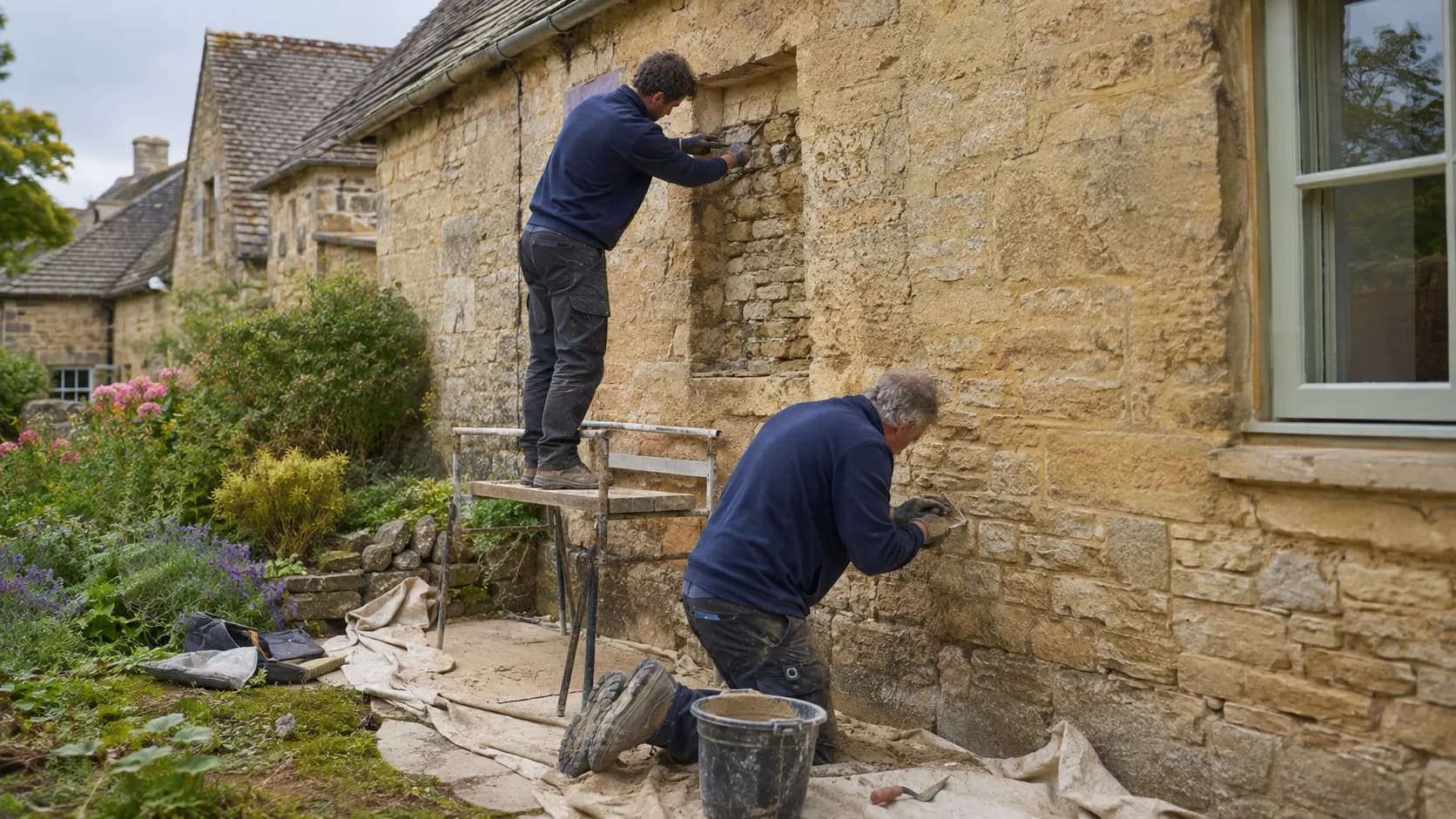
Software for stonemasons working across the UK.
A spalled Bath stone cill, a gable in need of repointing, a run of ashlar to work in the shop: the survey, the quote and the fixing day, all in one place.
 Start with Google
- Quotes with options, signed online
- Deposits before the stone is ordered
- Long builds held, repairs slotted around
- Every wall and client on record
Online booking
Let them book the survey not leave a message
The page shows the days you can get out and takes the address with the booking, so the first real conversation happens at the building.
Learn moreSmart scheduling
Banker work and fixing days on one board
What is on the banker and what is on the scaffold sit on the same schedule. Move the fixing when the stone is late and the gang moves with it.
Learn moreThe sandstone fence out the front is bowing badly at the corner. Can it be rebuilt with the old blocks?
Full until spring is no reason to lose work.
Masonry books further ahead than most trades. With nothing left on the page, the owner can still describe the job.
The visit books, not the wall.
Nobody should be able to buy a stone wall from a page. What your page hands out is the twenty minutes with a tape, which is the only honest thing to sell before you have seen the ground and the access.
- 18 SepRepoint · west elevationBooked · £1,480
- 2 SepStone matched on siteSandstone · lime mortar
- 11 AugRetaining wall quoteAccepted · £6,580
- 30 JunPayment received£2,150
The house remembers its stone.
What you matched, what the mortar was and which elevation you did last time stay on the address, so the call about the next crack does not start with you trying to remember a mix from four years ago.
One elevation, three ways to put it right.
Rake out and repoint in lime, repoint with indent repairs to the worst stones, or cut new and replace the failed units outright.
The survey feeds the quote
Metres, units and hours go on as lines, so a change of mortar or a stone fewer moves one number rather than the document.
One address per line
A quote covering the front elevation and the boundary wall can carry both addresses, so the day each is done is never in doubt.
The number is set once
Quote numbers are set once behind a confirm and do not quietly change, which matters when two versions are read side by side.
Options come with Pro
Pro turns the choices into option groups: mortar specification, number of indents, a lime wash on completion. Each carries its own price movement, so the total redraws as the owner reads.
- Sandstone blocks · 8m runSupply£3,200
- Cutting & dressing to sizeWorkshop£980
- Build, point & capLabour£2,400
The stone is late and the fixing has to move.
It happens most months. Shifting a fixing day should take one drag rather than four calls and a rubbed-out board in the shop.
Drag it and it has moved
Pick the booking up and drop it on Thursday. The gang, the address and the notes travel with it on any plan.
The owner hears it once
The new date goes out from the record, so nobody arrives at a locked gate on the strength of the old one.
The banker day moves too
Working the stone and fixing it are separate bookings on one job, so moving one does not leave the other stranded.
- Mason King · ChorltonEmergency call-out · Wed · 3:30pm£180
- Ava Baker · AncoatsCallout +1 · Wed · 1:00pm£560
- Grace Walker · ManchesterRepair visit · Wed · 11:30am£120
- Amelia Ryan · ChorltonSecond visit · Tue · 2:00pm£190
One job, three bookings.
Measure, cut and fix are three days in two places, and treating them as one entry is how a saw day quietly disappears. Each is its own booking under the same job, with the same customer, the same stone and the same notes.
- Gemma WhitfieldBooked just now£215Accepted
- Danny OkoroOpened 2h ago£480Viewed
- The Oak CaféSent yesterday£120Sent
The quote that waits on a family.
A headstone or a whole elevation is not decided in an afternoon. Sent, opened and accepted each show on the quote, so the follow-up call goes to the person who read it twice rather than to everybody.
Built for stone
Built for the work a mason actually sells
Lime repointing to a stone elevation
Priced by the metre of joint or the hour on the scaffold. Whichever driver you use is on the quote, so the scope is not argued afterwards.
Indent repairs and stone replacement
Indents count as units, cutting counts as banker hours. Two lines that let the owner see exactly where the cost sits.
Ashlar walling and quoins
Square metres of face, with quoins and returns on their own line because they are the part that eats the week, not the plain walling.
Window cills, mullions and copings
Small units, long lead times. Book the fixing against the delivery week so the owner gets the date once instead of chasing it.
Chimney rebuilds and repointing
A scaffold, a weather window and a survey. All three sit on the one record instead of scattered across texts and a notebook.
Dry stone walling and field boundaries
Quoted by the metre of wall and the height. Change the height and the metres follow rather than the whole quote being rebuilt.
York stone paving and steps
Square metres of paving, linear metres of edge, and a line for lifting what is there. Nobody is surprised by the making good.
Fireplace surrounds and hearths
One survey, one template, one fixing. Good, better and best stone choices sit as options on a single quote, not three documents.
Headstones and memorial work
Quiet work with a fixed date. Inscription wording, the burial authority paperwork and the fixing day all live on one record.
Stone cleaning and making good
Priced by the square metre of elevation, with access as its own line, because the scaffold is usually the larger half of the job.
The counties you will actually take stone to.
A pallet of stone changes what a long drive means. A coverage area draws the line once so the conversation stops repeating itself.
Draw it, do not explain it
Areas in, areas out. Beyond the line the page stops the booking rather than quietly putting it on your Tuesday.
Different work, different reach
Memorial work may travel further than the walling gang. Areas are set per service, not once for the whole business.
No charge for the distance
There is no drive-time loading here and we are not going to invent one. The line is where you go, not what you add.
- Ancoats8 counties · 2 crew
- Prestwich7 counties · 2 crew
- Manchester North7 counties · 2 crew
The slot that adds the least driving.
Two surveys on the same side of the moor on one morning is worth more than a tidy calendar. Pro scores the open slots on the driving they add.
Ranked, not rearranged
Nothing already booked is moved. The open slots are simply ordered by how much extra driving each would cost you.
Surveys benefit most
Twenty minutes at the wall and an hour each way. Grouping those is where a week quietly gets its afternoon back.
You still choose
The ranking sits beside the slots as a suggestion. Take the second if the owner is only there on a Friday.
- APAisha PatelToday · 15:45Best+8 min
- LDLiam DochertyToday · 14:30+22 min
- SMSophie MarshTomorrow · 09:15+35 min
Paid before you load the van.
Most masonry money still moves as a transfer, and that has never cost anything here. Cards are the part that comes with Pro.
Cash and transfer are free
Mark it paid on any plan. We are not taking a share of a bank transfer you arranged between the two of you.
Cards come with Pro
Send a link and the balance settles while the gang is sweeping the flags, rather than a month after the scaffold went.
Stages, not checkout deposits
Split a job across the stone order and the fixing. Stages go out once the booking exists, never as a charge to hold a survey.
- Gemma WhitfieldP-1011 · 25 Jun · Bank transfer£380
- Danny OkoroP-1012 · 25 Jun · Cash£240
- Aisha PatelP-1013 · 28 Jun · Card£380
- Liam DochertyP-1001 · 27 Jun · Card£190
One app for the whole job
Everything you need to run your stonemasonry business.
Starts free. Grows
only when you do.
Add your whole team and get booking for nothing.
As you grow with us you can go Pro.
Common questions.
No, and nothing that claimed to would be worth trusting. Works to a listed building that affect its character need listed building consent from the local planning authority, and the legislation behind that consent is not the same in every nation of the UK. Either way it is between the owner, the conservation officer and you. What the software does is keep the consent reference, the survey photographs and the specified mortar on the job record so the gang is not working off memory.
They book the survey. You look at the joints, the stone and the access, and the quote follows. Repointing quoted from a photograph is how a fortnight turns into five weeks, so the page takes the visit rather than the job.
No. Cash and bank transfer recorded by hand are free on every plan, which is still how most masonry gets paid. Cards come with Pro if you would rather the balance was settled before the scaffold came down. The plan cards on this page carry the numbers.
Yes. Split the job so the stone order, the banker work and the fixing are separate stages, and send them once the booking exists. Staged payments come with Pro. Nothing is ever taken at online checkout, so booking a survey costs the customer nothing.
Draw a coverage area over the places you genuinely travel to. An address beyond it stops before it becomes a booking, which spares you the call that ends with you explaining the haulage on a pallet of stone.
Yes. Owner, Manager and Staff are separate roles. Staff see the day, the address and the cutting list. Rates, margins and what the stone cost stay with the Owner. A blue CSCS card via a Level 2 NVQ or SVQ Diploma in Stonemasonry is a separate matter and we make no claim to track it.



Stonemasonry guides
All articlesOnline booking vs phone booking: which one actually gets the job booked?
Compare online and phone bookings for service businesses, with a practical way to handle standard jobs, tricky enquiries and customers who prefer a call.
ReadFully booked? How to keep the lead without promising the impossible
Handle enquiries when your diary is full with clear requests, alternative times and a practical manual waiting list that avoids double bookings.
ReadBooking deposits: enough to make it real, not a hostage negotiation
Choose booking deposits that fit your work, explain the balance and cancellation terms, and understand how deposits differ from refundable security bonds.
Read